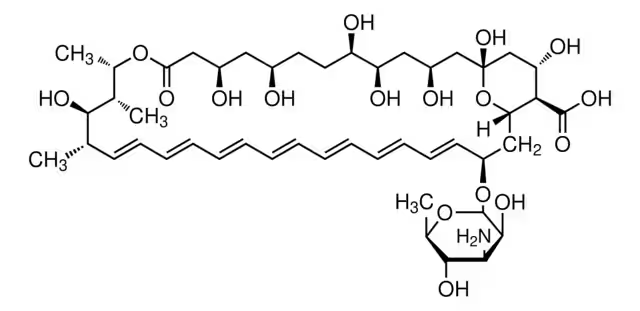
CAS Number1397-89-3
SynonymsAmpho-moronal; LNS-AmB; Amphocin; Amphotec; MFCD00877763; Halizon; abicyclo[33.3.1]nonatriaconta-19,21,23,25,27,29,31-heptaene-36-carboxylic acid; Fungilin; EINECS 215-742-2; Amphozone; Amphotericin B; AmBisome; FUNGIZONE; ns718; Abelcet; Abelecet
Molecular FormulaC47H73NO17
Molecular Weight924.08
Purity98%
Density1.3±0.1 g/cm3
Boiling Point1140.4±65.0 °C at 760 mmHg
Melting Point>170°C
Appearanceliquid
Symbol
Signal WordWarning
| Chemical & Physical Properties | |
|---|---|
| CAS Number | 1397-89-3 |
| Catalog No. | 2A-9009179 |
| Chinese Name | 两性霉素B |
| Synonyms | Ampho-moronal; LNS-AmB; Amphocin; Amphotec; MFCD00877763; Halizon; abicyclo[33.3.1]nonatriaconta-19,21,23,25,27,29,31-heptaene-36-carboxylic acid; Fungilin; EINECS 215-742-2; Amphozone; Amphotericin B; AmBisome; FUNGIZONE; ns718; Abelcet; Abelecet |
| Molecular Formula | C47H73NO17 |
| Molecular Weight | 924.08 |
| Purity | 98 |
| Density | 1.3±0.1 g/cm3 |
| Boiling Point | 1140.4±65.0 °C at 760 mmHg |
| Melting Point | >170°C |
| Appearance | liquid |
| Water Solubility | sterile water: 20 mg/mL as a stock solution. Stock |
| Storage Condition | This product should be sealed and stored at 4°C to |
| Packaging | III |
| Application | Amphotericin B is a polyene antifungal (fungal) agent against a variety of fungal pathogens. It binds irreversibly to ergosterol, leading to disruption of membrane integrity and ultimately cell death. |
| PubChem ID | 24890711 |
| MDL Number | MFCD00877763 |
| SMILES | [H][C@]12C[C@@H](O[C@@H]3O[C@H](C)[C@@H](O)[C@H](N)[C@@H]3O)\C=C\C=C\C=C\C=C\C=C\C=C\C=C\[C@H](C)[C@@H](O)[C@@H](C)[C@H](C)OC(=O)C[C@H](O)C[C@H](O)CC[C@@H](O)[C@H](O)C[C@H](O)C[C@](O)(C[C@H](O)[C@H]1C(=O)O[Na])O2 |
| InChI | 1S/C47H73NO17/c1-27-17-15-13-11-9-7-5-6-8-10-12-14-16-18-34(64-46-44(58)41(48)43(57)30(4)63-46)24-38-40(45(59)60)37(54)26-47(61,65-38)25-33(51)22-36(53)35(52)20-19-31(49)21-32(50)23-39(55)62-29(3)28(2)42(27)56/h5-18,27-38,40-44,46,49-54,56-58,61H,19-26,48H2,1-4H3,(H,59,60)/b6-5+,9-7+,10-8+,13-11+,14-12+,17-15+,18-16+/t27-,28-,29-,30+,31+,32+,33-,34-,35+,36+,37-,38-,40+,41-,42+,43+,44-,46-,47+/m0/s1 |
| InChI Key | APKFDSVGJQXUKY-INPOYWNPSA-N |
| NACRES Code | NA.76 |
| eCl@ss | 34010400 |
| UNSPSC | 12352207 |
| Hazard Symbols | 6.1(b) |
| MSDS | msds/9179_1_1397_89_3.pdf |
| Bioactivity | Amphotericin B is a polyene antifungal agent against a wide variety of fungal pathogens. It binds irreversibly to ergosterol, resulting in disruption of membrane integrity and ultimately cell death. Related Catalog Signaling Pathways >> Anti-infection >> Fungal Research Areas >> Infection Target Fungal[1] In Vitro Amphotericin B administration is limited by infusion-related toxicity, including fever and chills, an effect postulated to result from proinflammatory cytokine production by innate immune cells. Amphotericin B induces signal transduction and inflammatory cytokine release from cells expressing TLR2 and CD14[1]. Amphotericin B interacts with cholesterol, the major sterol of mammal membranes, thus limiting the usefulness of Amphotericin B due to its relatively high toxicity. Amphotericin B is dispersed as a pre-micellar or as a highly aggregated state in the subphase[2]. Amphotericin B only kills unicellular Leishmania promastigotes (LPs) when aqueous pores permeable to small cations and anions are formed. Amphotericin B (0.1 mM) induces a polarization potential, indicating K+ leakage in KCl-loaded liposomes suspended in an iso-osmotic sucrose solution. Amphotericin B (0.05 mM) exhibits a nearly total collapse of the negative membrane potential, indicating Na+ entry into the cells[3]. In Vivo Amphotericin B results in prolonging the incubation time and decreasing PrPSc accumulation in the hamster scrapie model. Amphotericin B markedly reduces PrPSc levels in mice with transmissible subacute spongiform encephalopathies (TSSE)[4]. Amphotericin B exerts a direct effect on Plasmodium falciparum and influences eryptosis of infected erythrocytes, parasitemia and hostsurvival in murine malaria. Amphotericin B tends to delay the increase of parasitemia and significantly delays host death plasmodium berghei-infected mice[5]. Kinase Assay THP-1 and HEK293 cells are transiently transfected using DEAE-dextran and Polyfect reagent, respectively. Plasmids transfected contain genes coding for the NF-κB-dependent pELAM-luc luciferase reporter, TLR2, TLR4, CD14, and MD2. Cells (5×10⁵ THP-1 or 1×10⁵ HEK293) are added to 12-well plates, washed after 18 h, and stimulated for 5 h. Cells are then lysed with reporter lysis buffer as directed, and lysates are analyzed for luminescence using Promega luciferase substrate and a Monolight 3010 luminometer. Cell Assay The kinetics of cell death induced by AmB against Leishmania promastigotes is followed by using fluorometry with the DNA-binding compound ethidium bromide (EB). Fluorescence measurements are performed on a SPEX Fluorolog II spectrophotometer at 365-580 nm excitation-emission wavelengths. Promastigotes at a final concentration of 25×106 cells/mL are incubated for 5 min with gentle stirring in the fluorescence cuvette with 2 mL of different buffered solutions but always containing 10 mM glucose and EB (50 mM). After signal stabilization is achieved, AmB is added and dissolved in dimethylsulfoxide. Maximal EB incorporation is always obtained by adding digitonin (50 mg/mL). All solutions used are buffered with 75 mM TRIS (pH 4 7.6) and contain 150 mM NaCl (BNa+), 150 mM KCl (BK+), 150 mM choline chloride, and 100 mM sucrose, 100 mM NaCl. The osmolarity of all solutions is always adjusted to 390±5 mOsm using an advanced instrument SW2 osmometer. References [1]. Sau K, et al. The antifungal drug amphotericin B promotes inflammatory cytokine release by a Toll-like receptor- and CD14-dependent mechanism. J Biol Chem. 2003 Sep 26;278(39):37561-8. Epub 2003 Jul 14. [2]. Barwicz J, et al. The effect of aggregation state of amphotericin-B on its interactions with cholesterol- or ergosterol-containing phosphatidylcholine monolayers. Chem Phys Lipids. 1997 Feb 28;85(2):145-55. [3]. Ramos H, et al. Amphotericin B kills unicellular leishmanias by forming aqueous pores permeable to small cations and anions. J Membr Biol. 1996 Jul;152(1):65-75. [4]. Demaimay R, et al. Pharmacological studies of a new derivative of amphotericin B, MS-8209, in mouse and hamster scrapie. J Gen Virol. 1994 Sep;75 (Pt 9):2499-503. [5]. Adams ML, et al. Amphotericin B encapsulated in micelles based on poly(ethylene oxide)-block-poly(L-amino acid) derivatives exerts reduced in vitro hemolysis but maintains potent in vivo antifungal activity. Biomacromolecules. 2003 May-Jun;4(3):750-7. Chemical & Physical Properties Density 1.3±0.1 g/cm3 Boiling Point 1140.4±65.0 °C at 760 mmHg Melting Point >170°C Molecular Formula C47H73NO17 Molecular Weight 924.079 Flash Point 643.5±34.3 °C Exact Mass 923.487854 PSA 319.61000 LogP 1.16 Vapour Pressure 0.0±0.6 mmHg at 25°C Index of Refraction 1.614 InChIKey APKFDSVGJQXUKY-PMWARXAXSA-N SMILES CC1C=CC=CC=CC=CC=CC=CC=CC(OC2OC(C)C(O)C(N)C2O)CC2OC(O)(CC(O)CC(O)C(O)CCC(O)CC(O)CC(=O)OC(C)C(C)C1O)CC(O)C2C(=O)O Stability Stable, but may be light sensitive. Incompatible with strong oxidizing agents. Water Solubility sterile water: 20 mg/mL as a stock solution. Stock solutions should be stored at −20?#x00b0;C. Stable at 37?#x00b0;C for 3 days. | <0.1 g/100 mL at 21 ºC |
| Use of | Amphotericin B is a polyene antifungal agent against a wide variety of fungal pathogens. It binds irreversibly to ergosterol, resulting in disruption of membrane integrity and ultimately cell death. Properties Articles405 Name amphotericin B Synonym More Synonyms Amphotericin B Biological Activity Description Amphotericin B is a polyene antifungal agent against a wide variety of fungal pathogens. It binds irreversibly to ergosterol, resulting in disruption of membrane integrity and ultimately cell death. Related Catalog Signaling Pathways >> Anti-infection >> Fungal Research Areas >> Infection In Vivo Amphotericin B results in prolonging the incubation time and decreasing PrPSc accumulation in the hamster scrapie model. Amphotericin B markedly reduces PrPSc levels in mice with transmissible subacute spongiform encephalopathies (TSSE)[4]. Amphotericin B exerts a direct effect on Plasmodium falciparum and influences eryptosis of infected erythrocytes, parasitemia and hostsurvival in murine malaria. Amphotericin B tends to delay the increase of parasitemia and significantly delays host death plasmodium berghei-infected mice[5]. References [1]. Sau K, et al. The antifungal drug amphotericin B promotes inflammatory cytokine release by a Toll-like receptor- and CD14-dependent mechanism. J Biol Chem. 2003 Sep 26;278(39):37561-8. Epub 2003 Jul 14. [2]. Barwicz J, et al. The effect of aggregation state of amphotericin-B on its interactions with cholesterol- or ergosterol-containing phosphatidylcholine monolayers. Chem Phys Lipids. 1997 Feb 28;85(2):145-55. [3]. Ramos H, et al. Amphotericin B kills unicellular leishmanias by forming aqueous pores permeable to small cations and anions. J Membr Biol. 1996 Jul;152(1):65-75. [4]. Demaimay R, et al. Pharmacological studies of a new derivative of amphotericin B, MS-8209, in mouse and hamster scrapie. J Gen Virol. 1994 Sep;75 (Pt 9):2499-503. [5]. Adams ML, et al. Amphotericin B encapsulated in micelles based on poly(ethylene oxide)-block-poly(L-amino acid) derivatives exerts reduced in vitro hemolysis but maintains potent in vivo antifungal activity. Biomacromolecules. 2003 May-Jun;4(3):750-7. Chemical & Physical Properties Molecular Formula C47H73NO17 Exact Mass 923.487854 PSA 319.61000 Index of Refraction 1.614 InChIKey APKFDSVGJQXUKY-PMWARXAXSA-N Stability Stable, but may be light sensitive. Incompatible with strong oxidizing agents. |
| Transport Info | Shipping Name: UN |
| MSDS Transport Info | Module 14. Shipping information 14.1 UN dangerous goods number European Land Transport Dangerous Regulations: -International Maritime Dangerous Regulations: -International Air Transport Dangerous Regulations: - 14.2 United Nations shipping name European Land Transport Dangerous Regulations: Non-dangerous goods IMDG Code: Non-dangerous goods International air transport dangerous goods regulations: non-dangerous goods 14.3 Transport hazard categories European Land Transport Dangerous Regulations: -International Maritime Dangerous Regulations: -International Air Transport Dangerous Regulations: - 14.4 Package group European Land Transport Dangerous Regulations: -International Maritime Dangerous Regulations: -International Air Transport Dangerous Regulations: - 14.5 Environmental hazards European Land Transport Danger Regulations: No International Maritime Danger Regulations International Air Transport Danger Regulations: No Marine pollutants (yes/no): No 14.6 Special reminder to users No data available |
| Related Products in Specialty Chemicals | ||
|---|---|---|
| Amodiaquine hydrochloride | 6398-98-7 | 2A-9009171 |
| Amoproxan | 22661-76-3 | 2A-9009172 |
| Amorolfine | 78613-35-1 | 2A-9009173 |
| amorolfine hydrochloride | 106614-68-0 | 2A-9009174 |
| Amosulalol | 85320-68-9 | 2A-9009175 |
| Ampicillin | 69-53-4 | 2A-9009180 |
| Ampicillin sodium | 69-52-3 | 2A-9009181 |
| Ampiroxicam | 99464-64-9 | 2A-9009182 |
| Amprenavir | 161814-49-9 | 2A-9009183 |
| Amprolium hydrochloride | 137-88-2 | 2A-9009184 |
| Browse all Specialty Chemicals products » | ||
Phone:
630-322-8886
630-322-8887
Email:
Office Locations:
Chicago, IL, USA
San Francisco, CA, USA


 EN
EN


 SDS
SDS