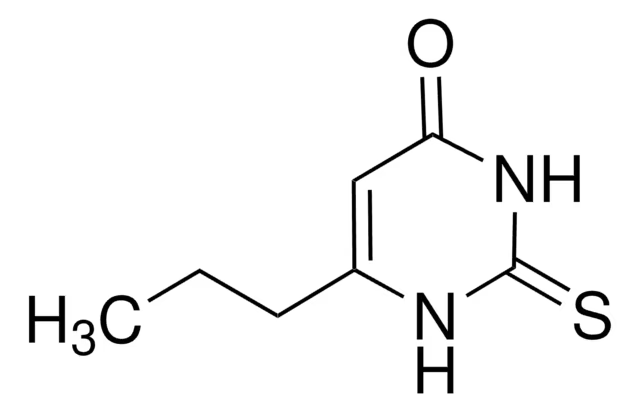
CAS Number51-52-5
Synonyms6-Propyl-2-thiouracil; T 72; PROTHYRAN; Propylthiouracil [BAN:INN:JAN]; 4-propyl-2-thiouracil; EINECS 200-103-2; 6-n-propyl-2-thiouracil; 6-propyl-2-sulfanylpyrimidin-4-ol; Prothycil; 6-Propyl-2-thioxo-2,3-dihydropyrimidin-4(1H)-on; 2,3-Dihydro-6-propyl-2-thioxo-4(1H)-pyrimidinone,4-Hydroxy-2-mercapto-6-propylpyrimidine; Thiuragyl; 6-propyl-2-thioxo-2,3-dihydropyrimidin-4(1H)-one; MFCD00006041; 6-Propyl-2-thioxo-2,3-dihydro-4(1H)-pyrimidinone; PROPACIL; 6-n-propylthiouracil; 6-propylthiouracil; propylthiouracil; Protiural; PROPYCIL; 2-mercapto-6-propylpyrimidin-4-ol; 4-Hydroxy-2-mercapto-6-propylpyrimidine; PROIL
Molecular FormulaC7H10N2OS
Molecular Weight170.23
Purity≥99 (HPLC)%
Density1.2±0.1 g/cm3
Boiling Point355.2±34.0 °C at 760 mmHg
Melting Point218-220 °C (lit.)
Appearancepowder
EINECS200-103-2
Symbol
Signal WordWarning
| Chemical & Physical Properties | |
|---|---|
| CAS Number | 51-52-5 |
| Catalog No. | 2A-9008701 |
| Chinese Name | 丙硫氧嘧啶 |
| Synonyms | 6-Propyl-2-thiouracil; T 72; PROTHYRAN; Propylthiouracil [BAN:INN:JAN]; 4-propyl-2-thiouracil; EINECS 200-103-2; 6-n-propyl-2-thiouracil; 6-propyl-2-sulfanylpyrimidin-4-ol; Prothycil; 6-Propyl-2-thioxo-2,3-dihydropyrimidin-4(1H)-on; 2,3-Dihydro-6-propyl-2-thioxo-4(1H)-pyrimidinone,4-Hydroxy-2-mercapto-6-propylpyrimidine; Thiuragyl; 6-propyl-2-thioxo-2,3-dihydropyrimidin-4(1H)-one; MFCD00006041; 6-Propyl-2-thioxo-2,3-dihydro-4(1H)-pyrimidinone; PROPACIL; 6-n-propylthiouracil; 6-propylthiouracil; propylthiouracil; Protiural; PROPYCIL; 2-mercapto-6-propylpyrimidin-4-ol; 4-Hydroxy-2-mercapto-6-propylpyrimidine; PROIL |
| Molecular Formula | C7H10N2OS |
| Molecular Weight | 170.23 |
| Purity | ≥99 (HPLC) |
| Density | 1.2±0.1 g/cm3 |
| Boiling Point | 355.2±34.0 °C at 760 mmHg |
| Melting Point | 218-220 °C (lit.) |
| Appearance | powder |
| Water Solubility | 1.1 g/L |
| Storage Condition | This product should be sealed and stored in a cool |
| Application | Propylthiouracil (6-Propyl-2-thiouracil) is an inhibitor of thyroid peroxidase and 5'-deiodinase. |
| EINECS | 200-103-2 |
| HTC | 2933599090 |
| PubChem ID | 24898446 |
| MDL Number | MFCD00006041 |
| SMILES | CCCC1=CC(=O)NC(=S)N1 |
| InChI | 1S/C7H10N2OS/c1-2-3-5-4-6(10)9-7(11)8-5/h4H,2-3H2,1H3,(H2,8,9,10,11) |
| InChI Key | KNAHARQHSZJURB-UHFFFAOYSA-N |
| Beilstein/REAXYS | 130039 |
| NACRES Code | NA.51 |
| UNSPSC | 41106305 |
| Hazard Symbols | Transport |
| Risk Codes | R22;R40 |
| Safety Description | S36/37;S45 |
| MSDS | msds/8701_1_51_52_5.pdf |
| Bioactivity | Propylthiouracil(6-Propyl-2-thiouracil) is a thyroperoxidase and 5'-deiodinase inhibitor. Target: Thyroperoxidase (TPO)Propylthiouracil (PTU) is a thiouracil-derived drug used to treat hyperthyroidism (including Graves' disease) by decreasing the amount of thyroid hormone produced by the thyroid gland [1]. The antithyroid drug 6-propylthiouracil (PTU) was shown to have an unexpectedly prolonged inhibitory effect on iodination in the thyroid glands of rats. Eighteen hours after injection of a relatively small dose, iodination in the thyroid remained inhibited by more than 90% [2]. PTU inhibits the enzyme thyroperoxidase, which normally acts in thyroid hormone synthesis by oxidizing the anion iodide (I-) to iodine (I0), facilitating iodine's addition to tyrosine residues on the hormone precursor thyroglobulin. This is one of the essential steps in the formation of thyroxine (T4). PTU does not inhibit the action of the sodium-dependent iodide transporter located on follicular cells' basolateral membranes. Inhibition of this step requires competitive inhibitors, such as perchlorate and thiocyanate. From Wikipedia. Related Catalog Signaling Pathways >> Others >> Others Research Areas >> Endocrinology References [1]. Nakamura, H., et al., Comparison of methimazole and propylthiouracil in patients with hyperthyroidism caused by Graves' disease. J Clin Endocrinol Metab, 2007. 92(6): p. 2157-62. [2]. Taurog, A. and M.L. Dorris, A reexamination of the proposed inactivation of thyroid peroxidase in the rat thyroid by propylthiouracil. Endocrinology, 1989. 124(6): p. 3038-42. Chemical & Physical Properties Density 1.2±0.1 g/cm3 Boiling Point 355.2±34.0 °C at 760 mmHg Melting Point 218-220 °C(lit.) Molecular Formula C7H10N2OS Molecular Weight 170.232 Flash Point 168.6±25.7 °C Exact Mass 170.051376 PSA 80.74000 LogP -0.32 Vapour Pressure 0.0±0.8 mmHg at 25°C Index of Refraction 1.601 InChIKey KNAHARQHSZJURB-UHFFFAOYSA-N SMILES CCCc1cc(=O)[nH]c(=S)[nH]1 Storage condition Refrigerator Stability Stable. Combustible. Incompatible with strong oxidizing agents, strong acids, strong bases. Light sensitive. Water Solubility 1.1 g/L |
| Use of | Propylthiouracil(6-Propyl-2-thiouracil) is a thyroperoxidase and 5'-deiodinase inhibitor. Target: Thyroperoxidase (TPO)Propylthiouracil (PTU) is a thiouracil-derived drug used to treat hyperthyroidism (including Graves' disease) by decreasing the amount of thyroid hormone produced by the thyroid gland [1]. The antithyroid drug 6-propylthiouracil (PTU) was shown to have an unexpectedly prolonged inhibitory effect on iodination in the thyroid glands of rats. Eighteen hours after injection of a relatively small dose, iodination in the thyroid remained inhibited by more than 90% [2]. PTU inhibits the enzyme thyroperoxidase, which normally acts in thyroid hormone synthesis by oxidizing the anion iodide (I-) to iodine (I0), facilitating iodine's addition to tyrosine residues on the hormone precursor thyroglobulin. This is one of the essential steps in the formation of thyroxine (T4). PTU does not inhibit the action of the sodium-dependent iodide transporter located on follicular cells' basolateral membranes. Inhibition of this step requires competitive inhibitors, such as perchlorate and thiocyanate. From Wikipedia. Properties Articles57 Name 6-propyl-2-thiouracil Synonym More Synonyms Propylthiouracil Biological Activity Description Propylthiouracil(6-Propyl-2-thiouracil) is a thyroperoxidase and 5'-deiodinase inhibitor. Target: Thyroperoxidase (TPO)Propylthiouracil (PTU) is a thiouracil-derived drug used to treat hyperthyroidism (including Graves' disease) by decreasing the amount of thyroid hormone produced by the thyroid gland [1]. The antithyroid drug 6-propylthiouracil (PTU) was shown to have an unexpectedly prolonged inhibitory effect on iodination in the thyroid glands of rats. Eighteen hours after injection of a relatively small dose, iodination in the thyroid remained inhibited by more than 90% [2]. PTU inhibits the enzyme thyroperoxidase, which normally acts in thyroid hormone synthesis by oxidizing the anion iodide (I-) to iodine (I0), facilitating iodine's addition to tyrosine residues on the hormone precursor thyroglobulin. This is one of the essential steps in the formation of thyroxine (T4). PTU does not inhibit the action of the sodium-dependent iodide transporter located on follicular cells' basolateral membranes. Inhibition of this step requires competitive inhibitors, such as perchlorate and thiocyanate. From Wikipedia. Related Catalog Signaling Pathways >> Others >> Others Research Areas >> Endocrinology References [1]. Nakamura, H., et al., Comparison of methimazole and propylthiouracil in patients with hyperthyroidism caused by Graves' disease. J Clin Endocrinol Metab, 2007. 92(6): p. 2157-62. [2]. Taurog, A. and M.L. Dorris, A reexamination of the proposed inactivation of thyroid peroxidase in the rat thyroid by propylthiouracil. Endocrinology, 1989. 124(6): p. 3038-42. Chemical & Physical Properties Molecular Formula C7H10N2OS Exact Mass 170.051376 PSA 80.74000 LogP -0.32 Index of Refraction 1.601 InChIKey KNAHARQHSZJURB-UHFFFAOYSA-N Storage condition Refrigerator Stability Stable. Combustible. Incompatible with strong oxidizing agents, strong acids, strong bases. Light sensitive. |
| Tax Rebate | 13.0% |
| Supervision | None. MFN tariff: 6.5%. Ordinary tariff: 20.0% |
| Transport Info | Product name: Purity: 98.0% |
| MSDS Transport Info | Module 14. Shipping information 14.1 UN dangerous goods number European Land Transport Dangerous Regulations: -International Maritime Dangerous Regulations: -International Air Transport Dangerous Regulations: - 14.2 Names specified by the United Nations (UN) European Land Transport Dangerous Regulations: Non-dangerous goods IMDG Code: Non-dangerous goods International air transport dangerous goods regulations: non-dangerous goods 14.3 Transport hazard categories European Land Transport Dangerous Regulations: -International Maritime Dangerous Regulations: -International Air Transport Dangerous Regulations: - 14.4 Package group European Land Transport Dangerous Regulations: -International Maritime Dangerous Regulations: -International Air Transport Dangerous Regulations: - 14.5 Environmental hazards European Land Transport Dangerous Regulations: No International Maritime Transport Dangerous Regulations Maritime Pollutants: No International Air Transport Risk Regulations: No 14.6 Special reminder to users No data available |
| Related Products in Specialty Chemicals | ||
|---|---|---|
| Pregnenolone acetate | 1778-02-5 | 2A-9008694 |
| Promethazine hydrochloride | 58-33-3 | 2A-9008696 |
| Propyl vinyl ether | 764-47-6 | 2A-9008698 |
| Propylmalonic acid | 14636-95-4 | 2A-9008699 |
| Propylpyridinium bromide | 873-71-2 | 2A-9008700 |
| Purpald | 1750-12-5 | 2A-9008702 |
| Pyrene | 129-00-0 | 2A-9008704 |
| Pyridinium dichromate | 20039-37-6 | 2A-9008714 |
| R-(-)-5-[2(2-Amino-2-methyl)ethyl]-2-methoxybenzenesulfonamide | 112101-81-2 | 2A-9008723 |
| Ramosetron hydrochloride | 132907-72-3 | 2A-9008726 |
| Browse all Specialty Chemicals products » | ||
Phone:
630-322-8886
630-322-8887
Email:
Office Locations:
Chicago, IL, USA
San Francisco, CA, USA


 EN
EN


 SDS
SDS