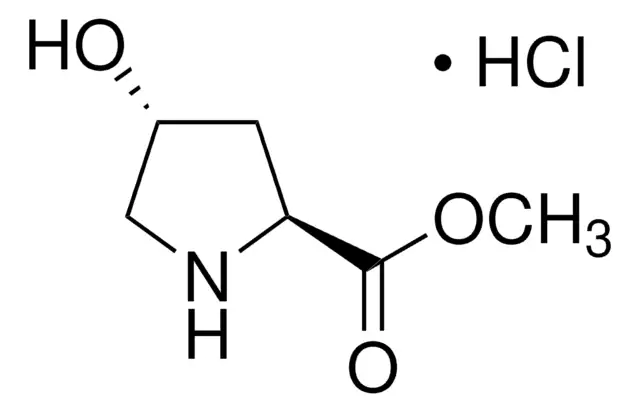
CAS Number40216-83-9
SynonymsProline, 4-hydroxy-, methyl ester, hydrochloride (1:1); Trans-4-hydroxy-L-proline methyl ester hydrochloride; Methyl (4R)-4-hydroxy-L-prolinate hydrochloride (1:1); L-Proline, 4-hydroxy-, methyl ester, (4R)-, hydrochloride (1:1); Trans-4-Hydroxy-L-Proline Methyl Ester,Hydrochloride Salt; (2S,4R)-4-Hydroxypyrrolidine-2-carboxylic Acid Methyl Ester Hydrochloride; Methyl 4-hydroxyprolinate hydrochloride (1:1); L-4-Hydroxyproline methyl ester hydrochloride; Methyl (2S,4R)-4-hydroxypyrrolidine-2-carboxylate; Methyl (2S,4R)-4-Hydroxypyrrolidine-2-carboxylate Hydrochloride; H-Hyp-OMe·HCl; methyl 4-hydroxypyrrolidine-2-carboxylate hydrochloride; MFCD00080855; H-Hyp-OMe.HCl; trans-4-Hydroxy-L-proline methylester hydrochloride
Molecular FormulaC6H12ClNO3
Molecular Weight181.62
Purity≥98.0 (GC)%
Boiling Point247.2ºC at 760 mmHg
Appearancesolid
Symbol
Signal WordWarning
| Chemical & Physical Properties | |
|---|---|
| CAS Number | 40216-83-9 |
| Catalog No. | 2A-9008092 |
| Chinese Name | L-羟脯氨酸甲酯盐酸盐 |
| Synonyms | Proline, 4-hydroxy-, methyl ester, hydrochloride (1:1); Trans-4-hydroxy-L-proline methyl ester hydrochloride; Methyl (4R)-4-hydroxy-L-prolinate hydrochloride (1:1); L-Proline, 4-hydroxy-, methyl ester, (4R)-, hydrochloride (1:1); Trans-4-Hydroxy-L-Proline Methyl Ester,Hydrochloride Salt; (2S,4R)-4-Hydroxypyrrolidine-2-carboxylic Acid Methyl Ester Hydrochloride; Methyl 4-hydroxyprolinate hydrochloride (1:1); L-4-Hydroxyproline methyl ester hydrochloride; Methyl (2S,4R)-4-hydroxypyrrolidine-2-carboxylate; Methyl (2S,4R)-4-Hydroxypyrrolidine-2-carboxylate Hydrochloride; H-Hyp-OMe·HCl; methyl 4-hydroxypyrrolidine-2-carboxylate hydrochloride; MFCD00080855; H-Hyp-OMe.HCl; trans-4-Hydroxy-L-proline methylester hydrochloride |
| Molecular Formula | C6H12ClNO3 |
| Molecular Weight | 181.62 |
| Purity | ≥98.0 (GC) |
| Boiling Point | 247.2ºC at 760 mmHg |
| Appearance | solid |
| Water Solubility | Water solubility: soluble |
| Storage Condition | Sealed, cool, dry storage |
| Application | H-Hyp-OMe hydrochloride is a non-cleavable ADC linker used in the synthesis of antibody drug conjugates (ADC). H-Hyp-OMe hydrochloride is also a PROTAC linker based on alkyl chains and can be used to |
| HTC | 2933990090 |
| PubChem ID | 57648453 |
| MDL Number | MFCD00080855 |
| SMILES | Cl.COC(=O)[C@@H]1C[C@@H](O)CN1 |
| InChI | 1S/C6H11NO3.ClH/c1-10-6(9)5-2-4(8)3-7-5;/h4-5,7-8H,2-3H2,1H3;1H/t4-,5+;/m1./s1 |
| InChI Key | KLGSHNXEUZOKHH-JBUOLDKXSA-N |
| Beilstein/REAXYS | 4716932 |
| NACRES Code | NA.22 |
| eCl@ss | 32160406 |
| UNSPSC | 12352209 |
| Hazard Symbols | Transport |
| MSDS | msds/8092_1_40216_83_9.pdf |
| Bioactivity | H-Hyp-OMe hydrochloride is a non-cleavable ADC linker used in the synthesis of antibody-drug conjugates (ADCs). H-Hyp-OMe hydrochloride is also a alkyl chain-based PROTAC linker that can be used in the synthesis of PROTACs[1]< Related Catalog Research Areas >> Cancer Signaling Pathways >> Antibody-drug Conjugate >> ADC Linker Signaling Pathways >> PROTAC >> PROTAC Linker Target Non-cleavable In Vitro ADCs are comprised of an antibody to which is attached an ADC cytotoxin through an ADC linker[1]. PROTACs contain two different ligands connected by a linker; one is a ligand for an E3 ubiquitin ligase and the other is for the target protein. PROTACs exploit the intracellular ubiquitin-proteasome system to selectively degrade target proteins[2]. References [1]. Beck A, et al. Strategies and challenges for the next generation of antibody-drug conjugates. Nat Rev Drug Discov. 2017;16(5):315-337. [2]. Nalawansha DA, et al. PROTACs: An Emerging Therapeutic Modality in Precision Medicine. Cell Chem Biol. 2020;27(8):998-985. Chemical & Physical Properties Boiling Point 247.2ºC at 760 mmHg Molecular Formula C6H12ClNO3 Molecular Weight 181.617 Flash Point 103.3ºC Exact Mass 181.050568 PSA 58.56000 LogP 0.01300 InChIKey KLGSHNXEUZOKHH-JBUOLDKXSA-N SMILES COC(=O)C1CC(O)CN1.Cl Storage condition 2-8°C |
| Use of | H-Hyp-OMe hydrochloride is a non-cleavable ADC linker used in the synthesis of antibody-drug conjugates (ADCs). H-Hyp-OMe hydrochloride is also a alkyl chain-based PROTAC linker that can be used in the synthesis of PROTACs[1]< Properties Name (2S,4R)-Methyl 4-hydroxypyrrolidine-2-carboxylate hydrochloride Synonym More Synonyms H-Hyp-OMe hydrochloride Biological Activity Description H-Hyp-OMe hydrochloride is a non-cleavable ADC linker used in the synthesis of antibody-drug conjugates (ADCs). H-Hyp-OMe hydrochloride is also a alkyl chain-based PROTAC linker that can be used in the synthesis of PROTACs[1]< Related Catalog Research Areas >> Cancer Signaling Pathways >> Antibody-drug Conjugate >> ADC Linker Signaling Pathways >> PROTAC >> PROTAC Linker Non-cleavable In Vitro ADCs are comprised of an antibody to which is attached an ADC cytotoxin through an ADC linker[1]. PROTACs contain two different ligands connected by a linker; one is a ligand for an E3 ubiquitin ligase and the other is for the target protein. PROTACs exploit the intracellular ubiquitin-proteasome system to selectively degrade target proteins[2]. References [1]. Beck A, et al. Strategies and challenges for the next generation of antibody-drug conjugates. Nat Rev Drug Discov. 2017;16(5):315-337. [2]. Nalawansha DA, et al. PROTACs: An Emerging Therapeutic Modality in Precision Medicine. Cell Chem Biol. 2020;27(8):998-985. Chemical & Physical Properties Exact Mass 181.050568 PSA 58.56000 LogP 0.01300 InChIKey KLGSHNXEUZOKHH-JBUOLDKXSA-N |
| Tax Rebate | 13.0% |
| Supervision | None. MFN tariff: 6.5%. Ordinary tariff: 20.0% |
| Transport Info | Shipping Name: UN |
| MSDS Transport Info | Module 14. Shipping information European Land Transport Dangerous Regulations: -International Maritime Dangerous Regulations: -International Air Transport Dangerous Regulations: - 14.2 United Nations shipping name European Land Transport Dangerous Regulations: Non-dangerous goods IMDG Code: Non-dangerous goods International air transport dangerous goods regulations: non-dangerous goods 14.3 Transport hazard categories European Land Transport Dangerous Regulations: -International Maritime Dangerous Regulations: -International Air Transport Dangerous Regulations: - 14.4 Package group European Land Transport Dangerous Regulations: -International Maritime Dangerous Regulations: -International Air Transport Dangerous Regulations: - 14.5 Environmental hazards European Land Transport Danger Regulations: No International Maritime Danger Regulations International Air Transport Danger Regulations: No Marine pollutants (yes/no): No 14.6 Special reminder to users No data available |
| Related Products in Specialty Chemicals | ||
|---|---|---|
| L-(-)-Dianisoyl-tartaric acid | 50583-51-2 | 2A-9008084 |
| L-(+)-Ribose | 24259-59-4 | 2A-9008086 |
| L-2-Aminobutyric acid | 1492-24-6 | 2A-9008087 |
| L-2-Octanol | 5978-70-1 | 2A-9008089 |
| L-3,4-Dimethoxyphenylalanine | 55-59-4 | 2A-9008091 |
| L-5-Hydroxytryptophan | 4350-09-8 | 2A-9008093 |
| Lactone-(5-hydroxymethyl)orotic acid | 4156-75-6 | 2A-9008094 |
| L-Alaninamide hydrochloride | 33208-99-0 | 2A-9008095 |
| L-Alloisoleucine | 1509-34-8 | 2A-9008098 |
| L-alpha-Allyl-Gly | 16338-48-0 | 2A-9008099 |
| Browse all Specialty Chemicals products » | ||
Phone:
630-322-8886
630-322-8887
Email:
Office Locations:
Chicago, IL, USA
San Francisco, CA, USA


 EN
EN


 SDS
SDS