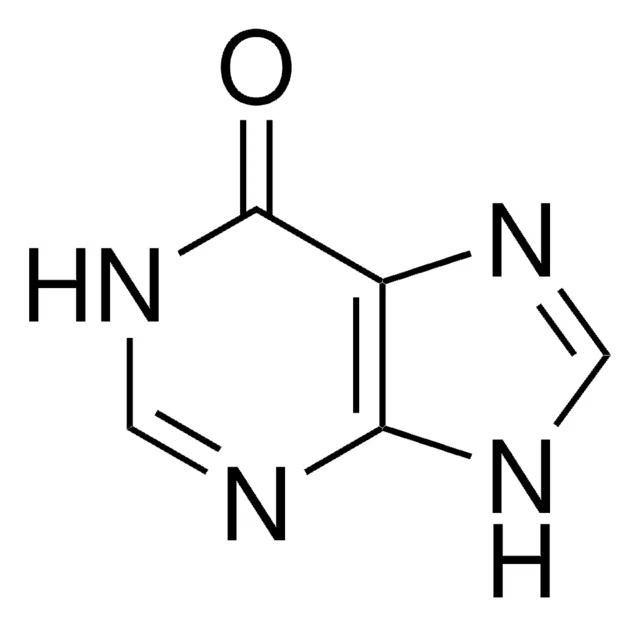
CAS Number68-94-0
Synonyms3,9-Dihydro-6H-purin-6-on; 1,7-Dihydro-6H-purin-6-on; 6-Oxopurine; 1,7-Dihydro-6H-purin-6-one; 7H-Purin-6-ol; PURIN-6-OL; Hypexanthine; SARKIN; SARCINE; Hypoxathine; 3,9-Dihydro-6H-purin-6-one; MFCD00005725; Hypoxanthine; Purine-6-ol; 6-oxypurine; Sarkine; Hypoxanthin; 6-Hydroxypurine; EINECS 200-697-3; 1H,7H-Hypoxanthine; 1,7-dihydro-purin-6-one; 1,7-Dihydro-6H-purine-6-one
Molecular FormulaC5H4N4O
Molecular Weight136.11
Purity≥99.0%
Density1.7±0.1 g/cm3
Boiling Point551.0±30.0 °C at 760 mmHg
Melting Point>300 °C (lit.)
Appearancepowder
EINECS200-697-3
Symbol
Signal WordWarning
| Chemical & Physical Properties | |
|---|---|
| CAS Number | 68-94-0 |
| Catalog No. | 2A-9008018 |
| Chinese Name | 次黄嘌呤 |
| Synonyms | 3,9-Dihydro-6H-purin-6-on; 1,7-Dihydro-6H-purin-6-on; 6-Oxopurine; 1,7-Dihydro-6H-purin-6-one; 7H-Purin-6-ol; PURIN-6-OL; Hypexanthine; SARKIN; SARCINE; Hypoxathine; 3,9-Dihydro-6H-purin-6-one; MFCD00005725; Hypoxanthine; Purine-6-ol; 6-oxypurine; Sarkine; Hypoxanthin; 6-Hydroxypurine; EINECS 200-697-3; 1H,7H-Hypoxanthine; 1,7-dihydro-purin-6-one; 1,7-Dihydro-6H-purine-6-one |
| Molecular Formula | C5H4N4O |
| Molecular Weight | 136.11 |
| Purity | ≥99.0 |
| Density | 1.7±0.1 g/cm3 |
| Boiling Point | 551.0±30.0 °C at 760 mmHg |
| Melting Point | >300 °C (lit.) |
| Appearance | powder |
| Water Solubility | practically insoluble |
| Storage Condition | This product should be stored in a sealed, cool, d |
| Application | Hypoxanthine is a purine derivative and a potential free radical generator that can serve as an indicator of hypoxia. |
| EINECS | 200-697-3 |
| HTC | 2933990090 |
| PubChem ID | 24895850 |
| MDL Number | MFCD00005725 |
| SMILES | O=C1NC=Nc2nc[nH]c12 |
| InChI | 1S/C5H4N4O/c10-5-3-4(7-1-6-3)8-2-9-5/h1-2H,(H2,6,7,8,9,10) |
| InChI Key | FDGQSTZJBFJUBT-UHFFFAOYSA-N |
| Beilstein/REAXYS | 5811 |
| NACRES Code | NA.51 |
| UNSPSC | 41106305 |
| Hazard Symbols | Transport |
| MSDS | msds/8018_1_68_94_0.pdf |
| Bioactivity | Hypoxanthine, a purine derivative, is a potential free radical generator and could be used as an indicator of hypoxia. Related Catalog Research Areas >> Others Natural Products >> Saccharides and Glycosides Target Human Endogenous Metabolite In Vitro Hypoxanthine is a potential free radical generator. Hypoxanthine seems to play a role in posthypoxic reoxygenation cell injury through oxygen radical production and is therefore involved in the pathogenesis of a number of diseases. Hypoxanthine also modulates a number of other processes because it reacts with benzodiazepine receptors and inhibits phosphodiesterase in the brain. Hypoxanthine inhibits the effect of several cytotoxic drugs and may therefore influence treatment with such drugs[1]. In Vivo In pigs, a linear increase of plasma hypoxanthine with duration of hypoxemia is found, and there is no difference between arterial and venous plasma. There are good correlations between hypoxanthine and lactate, base deficit and pH. There is also a direct relationship between survival time and increase in plasma hypoxanthine. Survival time correlates negatively with the rate of hypoxanthine increase (r=-0.62).All animals die when hypoxanthine exceeds 125 pM/liter. The increase of hypoxanthine therefore reflected the prognosis of acute hypoxia in contrast to base deficit[1]. References [1]. Saugstad OD, et al. Hypoxanthine as an indicator of hypoxia: its role in health and disease through free radical production. Pediatr Res. 1988 Feb;23(2):143-50. Chemical & Physical Properties Density 1.7±0.1 g/cm3 Boiling Point 551.0±30.0 °C at 760 mmHg Melting Point >300 °C(lit.) Molecular Formula C5H4N4O Molecular Weight 136.111 Flash Point 287.0±24.6 °C Exact Mass 136.038513 PSA 74.43000 LogP -0.91 Vapour Pressure 0.0±1.5 mmHg at 25°C Index of Refraction 1.816 Storage condition 2-8°C Water Solubility practically insoluble |
| Use of | Hypoxanthine, a purine derivative, is a potential free radical generator and could be used as an indicator of hypoxia. Properties Articles248 Name Hypoxanthine Synonym More Synonyms Hypoxanthine Biological Activity Description Hypoxanthine, a purine derivative, is a potential free radical generator and could be used as an indicator of hypoxia. Related Catalog Research Areas >> Others Natural Products >> Saccharides and Glycosides Human Endogenous Metabolite In Vitro Hypoxanthine is a potential free radical generator. Hypoxanthine seems to play a role in posthypoxic reoxygenation cell injury through oxygen radical production and is therefore involved in the pathogenesis of a number of diseases. Hypoxanthine also modulates a number of other processes because it reacts with benzodiazepine receptors and inhibits phosphodiesterase in the brain. Hypoxanthine inhibits the effect of several cytotoxic drugs and may therefore influence treatment with such drugs[1]. In Vivo In pigs, a linear increase of plasma hypoxanthine with duration of hypoxemia is found, and there is no difference between arterial and venous plasma. There are good correlations between hypoxanthine and lactate, base deficit and pH. There is also a direct relationship between survival time and increase in plasma hypoxanthine. Survival time correlates negatively with the rate of hypoxanthine increase (r=-0.62).All animals die when hypoxanthine exceeds 125 pM/liter. The increase of hypoxanthine therefore reflected the prognosis of acute hypoxia in contrast to base deficit[1]. References [1]. Saugstad OD, et al. Hypoxanthine as an indicator of hypoxia: its role in health and disease through free radical production. Pediatr Res. 1988 Feb;23(2):143-50. Chemical & Physical Properties Molecular Formula C5H4N4O Exact Mass 136.038513 PSA 74.43000 LogP -0.91 Index of Refraction 1.816 Water Solubility practically insoluble |
| Tax Rebate | 13.0% |
| Supervision | None. MFN tariff: 6.5%. Ordinary tariff: 20.0% |
| Transport Info | Product name: Purity: 0.0% |
| MSDS Transport Info | Module 14. Shipping information 14.1 UN dangerous goods number European Land Transport Dangerous Regulations: -International Maritime Dangerous Regulations: -International Air Transport Dangerous Regulations: - 14.2 Names specified by the United Nations (UN) European Land Transport Dangerous Regulations: Non-dangerous goods IMDG Code: Non-dangerous goods International air transport dangerous goods regulations: non-dangerous goods 14.3 Transport hazard categories European Land Transport Dangerous Regulations: -International Maritime Dangerous Regulations: -International Air Transport Dangerous Regulations: - 14.4 Package group European Land Transport Dangerous Regulations: -International Maritime Dangerous Regulations: -International Air Transport Dangerous Regulations: - 14.5 Environmental hazards European Land Transport Dangerous Regulations: No International Maritime Transport Dangerous Regulations Maritime Pollutants: No International Air Transport Risk Regulations: No 14.6 Special reminder to users No data available |
| Related Products in Specialty Chemicals | ||
|---|---|---|
| Hydrogen fluoridecollidine | 45725-47-1 | 2A-9008012 |
| Hydroxycarbamide | 127-07-1 | 2A-9008013 |
| Hydroxylamine sulfate | 10039-54-0 | 2A-9008014 |
| Hydroxylamine-O-sulfonic acid | 2950-43-8 | 2A-9008015 |
| Hydroxypropyl Methyl Cellulose | 9004-65-3 | 2A-9008016 |
| Picaridin | 119515-38-7 | 2A-9008019 |
| Imidocarb dipropionate | 55750-06-6 | 2A-9008022 |
| Iminodibenzyl-5-carbonyl chloride | 33948-19-5 | 2A-9008023 |
| Inosinate 5'-diphosphate | 86-04-4 | 2A-9008055 |
| Intermediates of pazufloxacin | 176760-98-8 | 2A-9008057 |
| Browse all Specialty Chemicals products » | ||
Phone:
630-322-8886
630-322-8887
Email:
Office Locations:
Chicago, IL, USA
San Francisco, CA, USA


 EN
EN


 SDS
SDS