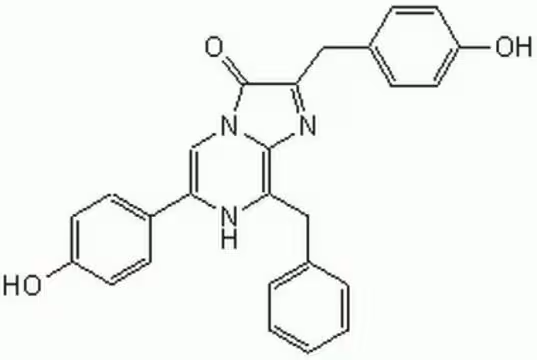
CAS Number55779-48-1
SynonymsCoelenterazine, native; 2-(4-Hydroxybenzyl)-6-(4-hydroxyphenyl)-8-benzyl-3,7-dihydroimidazo(1,2-a)pyrazin-3-one; Coelenterazine; MFCD00467176; 8-Benzyl-2-(4-hydroxybenzyl)-6-(4-hydroxyphenyl)imidazo[1,2-a]pyrazin-3(7H)-one
Molecular FormulaC26H21N3O3
Molecular Weight423.46
Purity≥90 (TLC)%
Density1.3±0.1 g/cm3
Boiling Point641.4±65.0 °C at 760 mmHg
Appearancesolid
Symbol
Signal WordWarning
| Chemical & Physical Properties | |
|---|---|
| CAS Number | 55779-48-1 |
| Catalog No. | 2A-9044493 |
| Chinese Name | 腔肠素 |
| Synonyms | Coelenterazine, native; 2-(4-Hydroxybenzyl)-6-(4-hydroxyphenyl)-8-benzyl-3,7-dihydroimidazo(1,2-a)pyrazin-3-one; Coelenterazine; MFCD00467176; 8-Benzyl-2-(4-hydroxybenzyl)-6-(4-hydroxyphenyl)imidazo[1,2-a]pyrazin-3(7H)-one |
| Molecular Formula | C26H21N3O3 |
| Molecular Weight | 423.46 |
| Purity | ≥90 (TLC) |
| Density | 1.3±0.1 g/cm3 |
| Boiling Point | 641.4±65.0 °C at 760 mmHg |
| Appearance | solid |
| Water Solubility | methanol and ethanol: soluble |
| Storage Condition | Sealed, store at -20 ºC |
| Application | Coelenterazine is widely distributed in marine organisms and produces bioluminescence through calcium-insensitive oxidation mediated by Renilla luciferase (Rluc) and calcium-dependent oxidation mediat |
| PubChem ID | 3191487 |
| MDL Number | MFCD00467176 |
| SMILES | [n]21c(nc([c]2=O)Cc5ccc(cc5)O)c([nH]c(c1)c4ccc(cc4)O)Cc3ccccc3 |
| InChI | 1S/C26H21N3O3/c30-20-10-6-18(7-11-20)15-23-26(32)29-16-24(19-8-12-21(31)13-9-19)27-22(25(29)28-23)14-17-4-2-1-3-5-17/h1-13,16,27,30-31H,14-15H2 |
| InChI Key | YHIPILPTUVMWQT-UHFFFAOYSA-N |
| NACRES Code | NA.77 |
| UNSPSC | 12352200 |
| Hazard Symbols | transportation |
| MSDS | msds/44493_1_55779_48_1.pdf |
| Bioactivity | Coelenterazine is widely distributed among marine organisms which can produce bioluminescence by calcium-dependent oxidation mediated by the photoprotein aequorin. Related Catalog Signaling Pathways >> Others >> Others Research Areas >> Cancer Dye Reagents Natural Products >> Others In Vitro On addition of Coelenterazine to the buffer, intact KB 3-1 Rluc cells show high bioluminescence, whereas intact KB 8-5-11 Rluc cells show low bioluminescence. A specific Pgp-mediated reduction in steady-state content of Coelenterazine exists in KB 8-5-11 Rluc cells compare to KB 3-1 Rluc cells. Bioluminescence signals from KB 3-1 Rluc cells, both in the absence and presence of GF120918 (300 nM), are readily detected with as little as 1 nM extracellular Coelenterazine and increase in a concentration-dependent manner to 1 μM extracellular Coelenterazine. In Pgp-expressing cells, there is evidence for a GF120918-reversible concentration-dependent saturation of bioluminescence with an EC50 of 257 nM Coelenterazine. The plateau in bioluminescence signal observed in KB 8-5-11 Rluc cells implies hat the capacity of Pgp to limit delivery of Coelenterazine to cytosolic Rluc is not exceeded within the concentration range test[1]. In Vivo At baseline, KB 3-1 Rluc tumors show a 4-fold higher bioluminescence signal in vivo than KB 8-5-11 Rluc tumors. Normalized bioluminescence signals arise from KB 3-1 Rluc tumors, signals emits from KB 8-5-11 Rluc tumors in vivo are consistently reduced by ≈75%[1] . Cell Assay Cells are plated at a density of 5×10⁴ cells per well into 24-well plates and grown to 80-100% confluency. Just before imaging, media are changed to a colorless solution containing (in mM): 2.7 KCl, 139 NaCl, 8.1 Na2HPO4, 0.7 H2O, 1.5 KH2PO4, 1.8 CaCl2, 1 MgCl2 and 5.5 d-glucose. Cells are preincubated for 15 min in the absence or presence of Pgp modulator, after which Coelenterazine (final concentration of 470 nM) is added directly to the cells[1]. Animal Admin Mice are anesthetized with metofane or isoflurane before tail vein injection of Coelenterazine (4 μg/g) formulated from an ethanol stock diluted in sodium phosphate buffer (50 mM). Bioluminescence imaging is performed on the in vivo imaging system at 2, 6, 8, and 11 min after injection. Anesthesia is maintained during imaging by nose cone delivery of 2.5% isoflurane. After imaging, animals are killed by cervical dislocation; tumors are then harvested and weighed[1]. References [1]. Andrea Pichler, et al. Imaging reversal of multidrug resistance in living mice with bioluminescence: MDR1 P-glycoprotein transports coelenterazine. Proc Natl Acad Sci U S A. 2004 Feb 10; 101(6): 1702-1707. Chemical & Physical Properties Density 1.3±0.1 g/cm3 Boiling Point 641.4±65.0 °C at 760 mmHg Molecular Formula C26H21N3O3 Molecular Weight 423.463 Flash Point 341.7±34.3 °C Exact Mass 423.158295 PSA 90.62000 LogP 3.87 Appearance of Characters solid | yellow Vapour Pressure 0.0±2.0 mmHg at 25°C Index of Refraction 1.689 InChIKey LNCOEGVEEQDKGX-UHFFFAOYSA-N SMILES C1=CC=C(C=C1)CC2=NC(=CN3C2=NC(=C3O)CC4=CC=C(C=C4)O)C5=CC=C(C=C5)O Storage condition −20°C Water Solubility methanol and ethanol: soluble |
| Use of | Coelenterazine is widely distributed among marine organisms which can produce bioluminescence by calcium-dependent oxidation mediated by the photoprotein aequorin. Properties Articles44 Name Oplophorus luciferin Synonym More Synonyms Coelenterazine Biological Activity Description Coelenterazine is widely distributed among marine organisms which can produce bioluminescence by calcium-dependent oxidation mediated by the photoprotein aequorin. Related Catalog Signaling Pathways >> Others >> Others Research Areas >> Cancer Dye Reagents Natural Products >> Others In Vitro On addition of Coelenterazine to the buffer, intact KB 3-1 Rluc cells show high bioluminescence, whereas intact KB 8-5-11 Rluc cells show low bioluminescence. A specific Pgp-mediated reduction in steady-state content of Coelenterazine exists in KB 8-5-11 Rluc cells compare to KB 3-1 Rluc cells. Bioluminescence signals from KB 3-1 Rluc cells, both in the absence and presence of GF120918 (300 nM), are readily detected with as little as 1 nM extracellular Coelenterazine and increase in a concentration-dependent manner to 1 μM extracellular Coelenterazine. In Pgp-expressing cells, there is evidence for a GF120918-reversible concentration-dependent saturation of bioluminescence with an EC50 of 257 nM Coelenterazine. The plateau in bioluminescence signal observed in KB 8-5-11 Rluc cells implies hat the capacity of Pgp to limit delivery of Coelenterazine to cytosolic Rluc is not exceeded within the concentration range test[1]. In Vivo At baseline, KB 3-1 Rluc tumors show a 4-fold higher bioluminescence signal in vivo than KB 8-5-11 Rluc tumors. Normalized bioluminescence signals arise from KB 3-1 Rluc tumors, signals emits from KB 8-5-11 Rluc tumors in vivo are consistently reduced by ≈75%[1] . References [1]. Andrea Pichler, et al. Imaging reversal of multidrug resistance in living mice with bioluminescence: MDR1 P-glycoprotein transports coelenterazine. Proc Natl Acad Sci U S A. 2004 Feb 10; 101(6): 1702-1707. Chemical & Physical Properties Molecular Formula C26H21N3O3 Exact Mass 423.158295 PSA 90.62000 Appearance of Characters solid | yellow Index of Refraction 1.689 InChIKey LNCOEGVEEQDKGX-UHFFFAOYSA-N Water Solubility methanol and ethanol: soluble |
| Transport Info | Product name: Purity: 94.0% |
| MSDS Transport Info | Module 14. Shipping information 14.1 UN dangerous goods number European Land Transport Dangerous Regulations: -International Maritime Dangerous Regulations: -International Air Transport Dangerous Regulations: - 14.2 Names specified by the United Nations (UN) European Land Transport Dangerous Regulations: Non-dangerous goods IMDG Code: Non-dangerous goods International air transport dangerous goods regulations: non-dangerous goods 14.3 Transport hazard categories European Land Transport Dangerous Regulations: -International Maritime Dangerous Regulations: -International Air Transport Dangerous Regulations: - 14.4 Package group European Land Transport Dangerous Regulations: -International Maritime Dangerous Regulations: -International Air Transport Dangerous Regulations: - 14.5 Environmental hazards European Land Transport Dangerous Regulations: No International Maritime Transport Dangerous Regulations Maritime Pollutants: No International Air Transport Risk Regulations: No 14.6 Special reminder to users No data available |
| Related Products in Specialty Chemicals | ||
|---|---|---|
| N-Succinimidyl maleimidoacetate | 55750-61-3 | 2A-9044481 |
| N-Succinimidyl 6-maleimidohexanoate | 55750-63-5 | 2A-9044483 |
| 2-Methylphenethylamine | 55755-16-3 | 2A-9044484 |
| 3-Methylphenethylamine | 55755-17-4 | 2A-9044485 |
| S-(2,5-Dimethyl-3-furyl) thioacetate | 55764-22-2 | 2A-9044489 |
| 2-(Cyanomethylthio)acetic acid | 55817-29-3 | 2A-9044503 |
| 4-Ethoxybenzamide | 55836-71-0 | 2A-9044505 |
| Lysine clonixinate | 55837-30-4 | 2A-9044509 |
| Ammonium (-)-3-bromo-8-camphorsulfonate | 55870-50-3 | 2A-9044514 |
| Ethyl (chlorosulfonyl)acetate | 55896-93-0 | 2A-9044516 |
| Browse all Specialty Chemicals products » | ||
Phone:
630-322-8886
630-322-8887
Email:
Office Locations:
Chicago, IL, USA
San Francisco, CA, USA


 EN
EN


 SDS
SDS