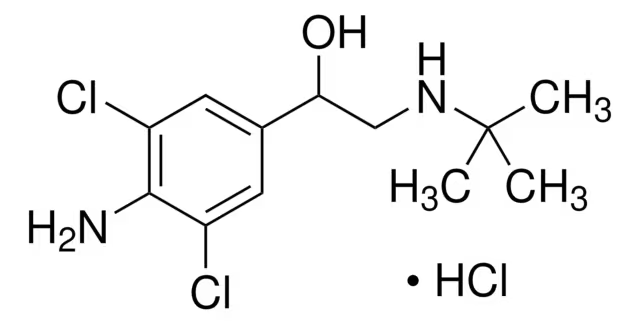
CAS Number21898-19-1
SynonymsClenbuterol hydrochloride; (1R)-1-(4-Amino-3,5-dichlorophenyl)-2-[(2-methyl-2-propanyl)amino]ethanol hydrochloride (1:1); 1-(4-amino-3,5-dichlorophenyl)-2-(tert-butylamino)ethanol, hydrochloride; EINECS 244-643-7; 4-Amino-α-(t-butylaminomethyl)-3,5-dichlorobenzyl alcohol hydrochloride; MFCD00083280; Clenbuterol (hydrochloride)
Molecular FormulaC12H19Cl3N2O
Molecular Weight313.65
Purity≥95%
Density1.25g/cm3
Boiling Point404.9ºC at 760 mmHg
Melting Point174-175.5°C
Appearancepowder
EINECS244-643-7
Symbol
Signal WordWarning
| Chemical & Physical Properties | |
|---|---|
| CAS Number | 21898-19-1 |
| Catalog No. | 2A-9038803 |
| Chinese Name | 盐酸克仑特罗 |
| Synonyms | Clenbuterol hydrochloride; (1R)-1-(4-Amino-3,5-dichlorophenyl)-2-[(2-methyl-2-propanyl)amino]ethanol hydrochloride (1:1); 1-(4-amino-3,5-dichlorophenyl)-2-(tert-butylamino)ethanol, hydrochloride; EINECS 244-643-7; 4-Amino-α-(t-butylaminomethyl)-3,5-dichlorobenzyl alcohol hydrochloride; MFCD00083280; Clenbuterol (hydrochloride) |
| Molecular Formula | C12H19Cl3N2O |
| Molecular Weight | 313.65 |
| Purity | ≥95 |
| Density | 1.25g/cm3 |
| Boiling Point | 404.9ºC at 760 mmHg |
| Melting Point | 174-175.5°C |
| Appearance | powder |
| Storage Condition | The warehouse is low temperature, ventilated and d |
| Packaging | III |
| Application | Clenbuterol hydrochloride (NAB-365 hydrochloride) is a β2 adrenergic receptor agonist. It is a powerful bronchodilator with fat burning properties. |
| EINECS | 244-643-7 |
| HTC | 2922199020 |
| PubChem ID | 24892782 |
| MDL Number | MFCD00083280 |
| SMILES | Cl.CC(C)(C)NCC(O)c1cc(Cl)c(N)c(Cl)c1 |
| InChI | 1S/C12H18Cl2N2O.ClH/c1-12(2,3)16-6-10(17)7-4-8(13)11(15)9(14)5-7;/h4-5,10,16-17H,6,15H2,1-3H3;1H |
| InChI Key | OPXKTCUYRHXSBK-UHFFFAOYSA-N |
| NACRES Code | NA.77 |
| UNSPSC | 12352200 |
| Hazard Symbols | 6.1(b) |
| MSDS | msds/38803_1_21898_19_1.pdf |
| Bioactivity | Clenbuterol hydrochloride (NAB-365 hydrochloride) is a β2 adrenergic receptor agonist. It is a powerful bronchodilator withfat burning properties. Related Catalog Signaling Pathways >> GPCR/G Protein >> Adrenergic Receptor Research Areas >> Metabolic Disease Research Areas >> Inflammation/Immunology Natural Products >> Others In Vitro Clenbuterol increases lipolysis in rat primary adipocytes compared with control. Free glycerol release into the culture medium is 158% and 190% of control values in cultures containing 0.1, or 1 μM Clenbuterol, respectively[1]. In Vivo Clenbuterol has been shown to decrease body fat in animals and can induce apoptosis in adipose tissue in mice[1]. In red and white muscles, Clenbuterol induces reductions in mitochondrial content, proteins involved in fatty acid transport oxidation, glucose transport, lactate transport, monocarboxylate transporter, and pyruvate oxidation. These extensive metabolic changes induced by Clenbuterol are associated with reductions in PGC-1α and increases in RIP140[2]. Repeated administration of the centrally acting beta adrenoceptor agonist, Clenbuterol, to rats reduces the ability of isoproterenol to increase the concentration of cyclic AMP (cAMP) in slices of cerebellum. This reduced responsiveness to isoproterenol is accompanied by a marked reduction in the density of beta adrenoceptors[3]. In normal soleus muscle, Clenbuterol treatment stimulates protein synthesis, inhibits Ca2+-dependent proteolysis, and increases the levels of calpastatin protein. On the other hand, the administration of Clenbuterol to DEN rats ameliorates the loss of muscle mass, enhances the rate of protein synthesis, attenuates hyperactivation of proteasomal and lysosomal proteolysis, and suppresses the transcription of the lysosomal protease cathepsin L and of atrogin-1/MAFbx and MuRF1[4]. Cell Assay MTS assay is performed to determine the number of viable cells in culture. Cells are treated with 0 (vehicle only), 0.1, or 1 μM Clenbuterol for 6, 12, 24, or 48 h. The absorbance is measured at 490 nm in a plate reader determine the formazan concentration, which is proportional to the number of living cells in culture[1]. Animal Admin Rats: Rats are randomly divided into two treatment groups. The control group is provided with standard chow and water ad libitum for 3 weeks, while the Clenbuterol group is provided with standard chow and treated for 3 weeks with Clenbuterol administered via the drinking water (30 mg Clenbuterol/L). Body weight and the amount of water consumed are recorded twice each week. After 3 wk, the animals are anesthetized and hindlimb muscles are excised[2]. References [1]. Kim HK, et al. Effect of clenbuterol on apoptosis, adipogenesis, and lipolysis in adipocytes.J PhysiolBiochem. 2010 Sep;66(3):197-203. [2]. Hoshino D, et al. Clenbuterol, a β2-adrenergic agonist, reciprocally alters PGC-1 alpha and RIP140 and reduces fatty acid and pyruvate oxidation in rat skeletal muscle.Am J PhysiolRegulIntegr Comp Physiol. 2012 Feb 1;302(3):R373-84. [3]. O'Donnell JM, et al. Effects of clenbuterol and antidepressant drugs on beta adrenergic receptor/N-protein coupling in the cerebral cortex of the rat.J PharmacolExpTher. 1985 Jul;234(1):30-6. [4]. Gon?alves DA, et al. Clenbuterol suppresses proteasomal and lysosomal proteolysis and atrophy-related genes in denervated rat soleus muscles independently of Akt.Am J PhysiolEndocrinolMetab. 2012 Jan 1;302(1):E123-33. Chemical & Physical Properties Density 1.25g/cm3 Boiling Point 404.9ºC at 760 mmHg Melting Point 174-175.5°C Molecular Formula C12H19Cl3N2O Molecular Weight 313.651 Flash Point 198.7ºC Exact Mass 312.056305 PSA 58.28000 LogP 4.77120 |
| Use of | Clenbuterol hydrochloride (NAB-365 hydrochloride) is a β2 adrenergic receptor agonist. It is a powerful bronchodilator withfat burning properties. Properties Name clenbuterol hydrochloride Synonym More Synonyms Clenbuterol hydrochloride Biological Activity Description Clenbuterol hydrochloride (NAB-365 hydrochloride) is a β2 adrenergic receptor agonist. It is a powerful bronchodilator withfat burning properties. Related Catalog Signaling Pathways >> GPCR/G Protein >> Adrenergic Receptor Research Areas >> Metabolic Disease Research Areas >> Inflammation/Immunology Natural Products >> Others In Vitro Clenbuterol increases lipolysis in rat primary adipocytes compared with control. Free glycerol release into the culture medium is 158% and 190% of control values in cultures containing 0.1, or 1 μM Clenbuterol, respectively[1]. Cell Assay MTS assay is performed to determine the number of viable cells in culture. Cells are treated with 0 (vehicle only), 0.1, or 1 μM Clenbuterol for 6, 12, 24, or 48 h. The absorbance is measured at 490 nm in a plate reader determine the formazan concentration, which is proportional to the number of living cells in culture[1]. References [1]. Kim HK, et al. Effect of clenbuterol on apoptosis, adipogenesis, and lipolysis in adipocytes.J PhysiolBiochem. 2010 Sep;66(3):197-203. [2]. Hoshino D, et al. Clenbuterol, a β2-adrenergic agonist, reciprocally alters PGC-1 alpha and RIP140 and reduces fatty acid and pyruvate oxidation in rat skeletal muscle.Am J PhysiolRegulIntegr Comp Physiol. 2012 Feb 1;302(3):R373-84. [3]. O'Donnell JM, et al. Effects of clenbuterol and antidepressant drugs on beta adrenergic receptor/N-protein coupling in the cerebral cortex of the rat.J PharmacolExpTher. 1985 Jul;234(1):30-6. [4]. Gon?alves DA, et al. Clenbuterol suppresses proteasomal and lysosomal proteolysis and atrophy-related genes in denervated rat soleus muscles independently of Akt.Am J PhysiolEndocrinolMetab. 2012 Jan 1;302(1):E123-33. Chemical & Physical Properties Exact Mass 312.056305 PSA 58.28000 LogP 4.77120 |
| Tax Rebate | 9.0% |
| Supervision | L (Drug Import and Export License). Minimum tariff: 6.5%. Ordinary tariff: 30.0% |
| Transport Info | Shipping Name: UN |
| MSDS Transport Info | Module 14. Shipping information 14.1 UN dangerous goods number European Dangerous Regulations for land transport: 2811 International Dangerous Regulations for sea transport: 2811 International Dangerous Regulations for air transport: 2811 14.2 United Nations shipping name European Land Transport Dangerous Regulations: TOXIC SOLID, ORGANIC, N.O.S. (4-Amino-α-[(tert-butylamino)methyl]-3,5-dichlorobenzyl alcohol monohydrochloride) IMDG: TOXIC SOLID, ORGANIC, N.O.S. (4-Amino-α-[(tert-butylamino)methyl]-3,5-dichlorobenzyl alcohol monohydrochloride) International air transport hazard regulations: Toxic solid, organic, n.o.s. (4-Amino-α-[(tert-butylamino)methyl]-3,5-dichlorobenzyl alcohol monohydrochloride) 14.3 Transport hazard categories European Land Transport Danger Regulations: 6.1 International Maritime Transport Danger Regulations: 6.1 International Air Transport Danger Regulations: 6.1 14.4 Package group European Land Transport Danger Regulations: III International Maritime Transport Danger Regulations: III International Air Transport Danger Regulations: III 14.5 Environmental hazards European Land Transport Danger Regulations: No International Maritime Danger Regulations International Air Transport Danger Regulations: No Marine pollutants (yes/no): No 14.6 Special reminder to users No data available |
| Related Products in Specialty Chemicals | ||
|---|---|---|
| Cocal | 21834-92-4 | 2A-9038787 |
| 3-Ethyl-2-hydroxy-2-cyclopenten-1-one | 21835-01-8 | 2A-9038788 |
| 2,3'-Dichloroacetophenone | 21886-56-6 | 2A-9038798 |
| 3-Methyl-2-benzoxazolinone | 21892-80-8 | 2A-9038800 |
| 1-Hydroxy-4-(4-nitrophenoxy)-2-naphthoic acid | 21894-06-4 | 2A-9038802 |
| 5-Fluoro-2-methylbenzoyl chloride | 21900-39-0 | 2A-9038805 |
| 2-Chloro-5-fluorobenzoyl chloride | 21900-51-6 | 2A-9038807 |
| Mercury monoxide | 21908-53-2 | 2A-9038818 |
| Methyl 3-(phenylamino)propanoate | 21911-84-2 | 2A-9038819 |
| 7,8-Dihydro-5(6H)-isoquinolinone | 21917-86-2 | 2A-9038820 |
| Browse all Specialty Chemicals products » | ||
Phone:
630-322-8886
630-322-8887
Email:
Office Locations:
Chicago, IL, USA
San Francisco, CA, USA


 EN
EN


 SDS
SDS