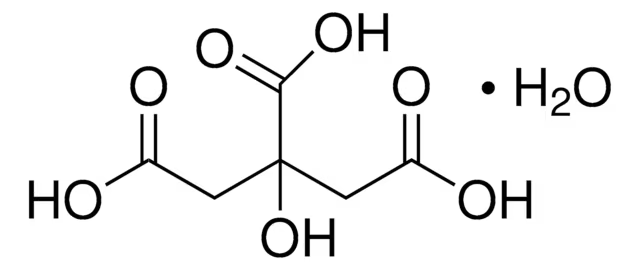
CAS Number5949-29-1
SynonymsEXTRAN AP 22; monohydrate citric acid; ACETONE D; ACETONE 300; Citric acid hydrate; citric acid monohydrate powder; 1,2,3-Propanetricarboxylic acid, 2-hydroxy-, hydrate (1:1); citric acid hydride; MFCD00008765; EINECS 200-662-2; citric; 2-Hydroxy-1,2,3-propanetricarboxylic acid hydrate (1:1); ACETONE 5000; 2-Hydroxypropane-1,2,3-tricarboxylic acid hydrate (1:1); ACETONUM; 2-Hydroxy-1,2,3-propanetricarboxylic acid hydrate; METHYL KETONE; FEMA 3326; Citric acid monohydrate; PROPANONE; Acide 2-hydroxy-1,2,3-propanetricarboxylique hydrate
Molecular FormulaHOC(COOH)(CH2COOH)2 · H2O
Molecular Weight210.14
Purity99.5-100.5 anhydrous basis (acidimetric)%
Density1.54
Boiling Point56 °C760 mm Hg(lit.)
Melting Point135-152 °C
Appearancesolid
Symbol
Signal WordWarning


Please Login or Create an Account to: See VlP prices and availability
US Stock: ship in 0-1 business day
Global Stock: ship in 5-7 days
| Chemical & Physical Properties | |
|---|---|
| CAS Number | 5949-29-1 |
| Catalog No. | 2A-0201578 |
| Chinese Name | 一水柠檬酸 |
| Synonyms | EXTRAN AP 22; monohydrate citric acid; ACETONE D; ACETONE 300; Citric acid hydrate; citric acid monohydrate powder; 1,2,3-Propanetricarboxylic acid, 2-hydroxy-, hydrate (1:1); citric acid hydride; MFCD00008765; EINECS 200-662-2; citric; 2-Hydroxy-1,2,3-propanetricarboxylic acid hydrate (1:1); ACETONE 5000; 2-Hydroxypropane-1,2,3-tricarboxylic acid hydrate (1:1); ACETONUM; 2-Hydroxy-1,2,3-propanetricarboxylic acid hydrate; METHYL KETONE; FEMA 3326; Citric acid monohydrate; PROPANONE; Acide 2-hydroxy-1,2,3-propanetricarboxylique hydrate |
| Molecular Formula | HOC(COOH)(CH2COOH)2 · H2O |
| Molecular Weight | 210.14 |
| Purity | 99.5-100.5 anhydrous basis (acidimetric) |
| Density | 1.54 |
| Boiling Point | 56 °C760 mm Hg(lit.) |
| Melting Point | 135-152 °C |
| Appearance | solid |
| Water Solubility | 1630 g/L (20 ºC) |
| Storage Condition | 1. Pack in woven bags or double-layer kraft paper |
| Packaging | I; II; III |
| Application | Citric acid monohydrate is a natural preservative and food acidity enhancer. Citrate monohydrate induces apoptosis and cell cycle arrest in G2/M and S phases. Citric acid monohydrate causes oxidative |
| HTC | 2918140000 |
| MDL Number | MFCD00149972 |
| SMILES | OC(CC(O)(C(O)=O)CC(O)=O)=O.O |
| InChI | 1S/C6H8O7.H2O/c7-3(8)1-6(13,5(11)12)2-4(9)10;/h13H,1-2H2,(H,7,8)(H,9,10)(H,11,12);1H2 |
| InChI Key | YASYEJJMZJALEJ-UHFFFAOYSA-N |
| Beilstein/REAXYS | 4018641 |
| NACRES Code | NA.21 |
| UNSPSC | 12352106 |
| Hazard Symbols | transportation |
| MSDS | msds/32342_1_5949_29_1.pdf |
| Bioactivity | Citric acid monohydrate is a natural preservative and food tartness enhancer. Citric acid monohydrate induces apoptosis and cell cycle arrest at G2/M phase and S phase. Citric acid monohydrate cause oxidative damage of the liver by means of the decrease of antioxidative enzyme activities. Citric acid monohydrate causes renal toxicity in mice[1][2][3]. Related Catalog Research Areas >> Inflammation/Immunology Research Areas >> Metabolic Disease Target Human Endogenous Metabolite In Vitro Citric acid monohydrate (0-12.5 mM; 24 h) shows antiproliferative activity in a dose dependent manner[3]. Citric acid monohydrate (12.5 mM; 72 h) induces apoptosis and cell cycle arrest at G2/M phase and S phase in a dosedependent manner[3]. Citric acid monohydrate (12.5 mM; 48 h) increases the expression of FAS, BAX, BID, AIF, EndoG, cytochrome c, PARP, GADD153, GRP78 and caspase-3, -8, -9, and decreases of BCL-2 and BCL-Xl[3]. Cell Viability Assay[3] Cell Line: HaCaT cells Concentration: 0, 2.5, 5, 7.5, 10, 12.5 mM Incubation Time: 24 h Result: Inhibited the cell viability in a dose dependent manner. Cell Cycle Analysis[3] Cell Line: HaCaT cells Concentration: 12.5 mM Incubation Time: 0, 12, 24, 48, 72 h Result: Induced apoptosis and cell cycle arrest at G2/M phase and S phase in a dosedependent manner. Western Blot Analysis[3] Cell Line: HaCaT cells Concentration: 12.5 mM Incubation Time: 12, 24, 48 h Result: Increased the expression of FAS, BAX, BID, AIF, EndoG, cytochrome c, PARP, GADD153, GRP78 and caspase-3, -8, -9, and decreased of BCL-2 and BCL-Xl. In Vivo Citric acid monohydrate (120, 240, and 480 mg/kg; i.p.) significantly decreases GSH-Px activity and induces an increase in the MDA (malonyldialdehyde) levels in mouse liver[1]. Citric acid monohydrate (120, 240, and 480 mg/kg; i.p.) induces apoptosis by increases caspase-3 activity in a dose-dependent manner in mouse hepatocytes[1]. Citric acid monohydrate (120, 240, and 480 mg/kg; i.p.; weekly for 3 weeks) causes renal toxicity in mice[2]. Animal Model: 20 g male Kunming mice[2] Dosage: 120, 240, 480 mg/kg Administration: I.p.; weekly for 3 weeks Result: T-SOD and GSH-Px activities in the treated groups decreased with increasing doses of citric acid, NOS activity tended to increase, and H2O2 and MDA contents gradually decreased. References [1]. Chen X, et al. Study on injury effect of food additive citric acid on liver tissue in mice. Cytotechnology. 2014 Mar;66(2):275-82. [2]. Chen X, Lv Q, Liu Y, Deng W. Effects of the food additive, citric acid, on kidney cells of mice. Biotech Histochem. 2015 Jan;90(1):38-44. [3]. Ying TH, et al. Citric acid induces cell-cycle arrest and apoptosis of human immortalized keratinocyte cell line (HaCaT) via caspase- and mitochondrial-dependent signaling pathways. Anticancer Res. 2013 Oct;33(10):4411-20. Chemical & Physical Properties Density 1.54 Boiling Point 56 °C760 mm Hg(lit.) Melting Point 135-152 ºC Molecular Formula C6H10O8 Molecular Weight 210.139 Flash Point 173.9 ºC Exact Mass 210.037567 PSA 141.36000 Vapour density 2 (vs air) Vapour Pressure 184 mm Hg ( 20 °C) Index of Refraction n20/D 1.359(lit.) InChIKey YASYEJJMZJALEJ-UHFFFAOYSA-N SMILES O.O=C(O)CC(O)(CC(=O)O)C(=O)O Storage condition Store at RT. Stability Stable. Incompatible with oxidizing agents, bases, reducing agents, nitrates. Water Solubility 1630 g/L (20 ºC) |
| Use of | Properties Articles63 Name Citric acid monohydrate Synonym More Synonyms Citric acid monohydrate Biological Activity Related Catalog Research Areas >> Inflammation/Immunology Research Areas >> Metabolic Disease Human Endogenous Metabolite References [1]. Chen X, et al. Study on injury effect of food additive citric acid on liver tissue in mice. Cytotechnology. 2014 Mar;66(2):275-82. [2]. Chen X, Lv Q, Liu Y, Deng W. Effects of the food additive, citric acid, on kidney cells of mice. Biotech Histochem. 2015 Jan;90(1):38-44. [3]. Ying TH, et al. Citric acid induces cell-cycle arrest and apoptosis of human immortalized keratinocyte cell line (HaCaT) via caspase- and mitochondrial-dependent signaling pathways. Anticancer Res. 2013 Oct;33(10):4411-20. Chemical & Physical Properties Molecular Formula C6H10O8 Exact Mass 210.037567 PSA 141.36000 Vapour density 2 (vs air) InChIKey YASYEJJMZJALEJ-UHFFFAOYSA-N SMILES O.O=C(O)CC(O)(CC(=O)O)C(=O)O Storage condition Store at RT. Stability Stable. Incompatible with oxidizing agents, bases, reducing agents, nitrates. |
| Tax Rebate | 9.0% |
| Supervision | None. MFN tariff: 6.5%. Ordinary tariff: 30.0% |
| Transport Info | Product name: Purity: 0.0% |
| MSDS Transport Info | Module 14. Shipping information 14.1 UN dangerous goods number European Land Transport Dangerous Regulations: -International Maritime Dangerous Regulations: -International Air Transport Dangerous Regulations: - 14.2 Names specified by the United Nations (UN) European Land Transport Dangerous Regulations: Non-dangerous goods IMDG Code: Non-dangerous goods International air transport dangerous goods regulations: non-dangerous goods 14.3 Transport hazard categories European Land Transport Dangerous Regulations: -International Maritime Dangerous Regulations: -International Air Transport Dangerous Regulations: - 14.4 Package group European Land Transport Dangerous Regulations: -International Maritime Dangerous Regulations: -International Air Transport Dangerous Regulations: - 14.5 Environmental hazards European Land Transport Dangerous Regulations: No International Maritime Transport Dangerous Regulations Maritime Pollutants: No International Air Transport Risk Regulations: No 14.6 Special reminder to users No data available |
| Related Products in Specialty Chemicals | ||
|---|---|---|
| Darutigenol | 5940-00-1 | 2A-9032334 |
| sec-Butyl disulfide | 5943-30-6 | 2A-9032336 |
| Diisopropyl trisulphide | 5943-34-0 | 2A-9032337 |
| Bisphenol-A bis(diphenyl phosphate) | 5945-33-5 | 2A-9032338 |
| Monotropein | 5945-50-6 | 2A-9032339 |
| 2-Methylbenzoyl cyanide | 5955-73-7 | 2A-9032346 |
| Bredemolic acid | 5957-40-4 | 2A-9032347 |
| Carnosol | 5957-80-2 | 2A-9032348 |
| L-2-Aminobutyric acid hydrochloride | 5959-29-5 | 2A-9032349 |
| 4-Amino-1-naphthol hydrochloride | 5959-56-8 | 2A-9032351 |
| Browse all Specialty Chemicals products » | ||
Phone:
630-322-8886
630-322-8887
Email:
Office Locations:
Chicago, IL, USA
San Francisco, CA, USA


 EN
EN

 SDS
SDS