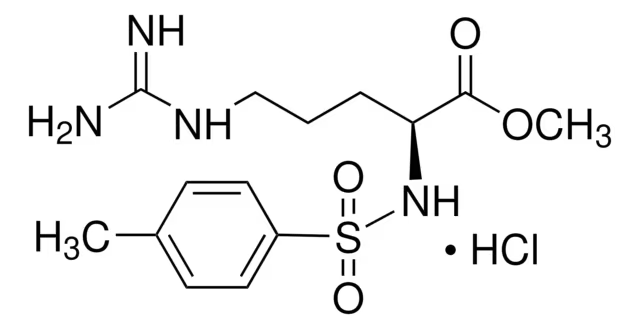
CAS Number1784-03-8
SynonymsNalpha-4-Tosyl-L-arginine methyl ester hydrochloride; Na-p-Tosyl-L-arginine methyl ester hydrochloride; (S)-Methyl 5-guanidino-2-(4-methylphenylsulfonamido)pentanoate hydrochloride; Nα-p-Toluenesulfonyl-L-arginine Methyl Ester Hydrochloride; N-4-Tosyl-L-arginine methyl ester hydrochloride; Tos-Arg-OMe.HCl; Tos-Arg-Ome·Hcl; EINECS 217-235-1; TAME hydrochloride; Imino{[(4S)-5-methoxy-4-{[(4-methylphenyl)sulfonyl]amino}-5-oxopentyl]amino}methanaminium chloride; MFCD00012578; L-Ornithine, N-(diaminomethylene)-N-[(4-methylphenyl)sulfonyl]-, methyl ester, hydrochloride (1:1); Nα-p-Tosyl-L-arginine methyl ester hydrochloride; Methyl N2-((p-tolyl)sulphonyl)-L-argininate monohydrochloride; Nalpha-Tosyl-L-arginine Methyl Ester Hydrochloride; TOS-ARG-OME HCL; Methyl N-(diaminomethylene)-N-[(4-methylp
Molecular FormulaH2NC(=NH)NH(CH2)3CH(NHSO2C6H4CH3)CO2CH3 · HCl
Molecular Weight378.87
Purity≥98 (TLC)%
Boiling Point544.1ºC at 760mmHg
Melting Point145-147 (lit.)
Appearancepowder
EINECS217-235-1
Symbol
Signal WordWarning
| Chemical & Physical Properties | |
|---|---|
| CAS Number | 1784-03-8 |
| Catalog No. | 2A-9027474 |
| Chinese Name | Nα-对甲苯磺酰基-L-精氨酸甲酯盐酸盐 |
| Synonyms | Nalpha-4-Tosyl-L-arginine methyl ester hydrochloride; Na-p-Tosyl-L-arginine methyl ester hydrochloride; (S)-Methyl 5-guanidino-2-(4-methylphenylsulfonamido)pentanoate hydrochloride; Nα-p-Toluenesulfonyl-L-arginine Methyl Ester Hydrochloride; N-4-Tosyl-L-arginine methyl ester hydrochloride; Tos-Arg-OMe.HCl; Tos-Arg-Ome·Hcl; EINECS 217-235-1; TAME hydrochloride; Imino{[(4S)-5-methoxy-4-{[(4-methylphenyl)sulfonyl]amino}-5-oxopentyl]amino}methanaminium chloride; MFCD00012578; L-Ornithine, N-(diaminomethylene)-N-[(4-methylphenyl)sulfonyl]-, methyl ester, hydrochloride (1:1); Nα-p-Tosyl-L-arginine methyl ester hydrochloride; Methyl N2-((p-tolyl)sulphonyl)-L-argininate monohydrochloride; Nalpha-Tosyl-L-arginine Methyl Ester Hydrochloride; TOS-ARG-OME HCL; Methyl N-(diaminomethylene)-N-[(4-methylp |
| Molecular Formula | H2NC(=NH)NH(CH2)3CH(NHSO2C6H4CH3)CO2CH3 · HCl |
| Molecular Weight | 378.87 |
| Purity | ≥98 (TLC) |
| Boiling Point | 544.1ºC at 760mmHg |
| Melting Point | 145-147 (lit.) |
| Appearance | powder |
| Storage Condition | Sealed and stored in a cool, dry place; |
| Application | TAME hydrochloride is an activated protein C (APC) inhibitor that inhibits APC activity by acting on Cdc20 and Cdh1. |
| EINECS | 217-235-1 |
| HTC | 2935009090 |
| PubChem ID | 24900058 |
| MDL Number | MFCD00012578 |
| SMILES | Cl.COC(=O)[C@H](CCCNC(N)=N)NS(=O)(=O)c1ccc(C)cc1 |
| InChI | 1S/C14H22N4O4S.ClH/c1-10-5-7-11(8-6-10)23(20,21)18-12(13(19)22-2)4-3-9-17-14(15)16;/h5-8,12,18H,3-4,9H2,1-2H3,(H4,15,16,17);1H/t12-;/m0./s1 |
| InChI Key | JIQFFACVQXXHMY-YDALLXLXSA-N |
| Beilstein/REAXYS | 3922357 |
| NACRES Code | NA.26 |
| eCl@ss | 32160406 |
| UNSPSC | 12352103 |
| Hazard Symbols | transportation |
| MSDS | msds/27474_1_1784_03_8.pdf |
| Bioactivity | TAME hydrochloride is an inhibitor of anaphase-promoting complex (APC), which prevents its activation by Cdc20 and Cdh1. Related Catalog Signaling Pathways >> Cell Cycle/DNA Damage >> APC Research Areas >> Cancer Target APC [1]. In Vitro TAME shows inhibitory effect on APC activation when added to mitotic Xenopus extract. TAME (1-200 μM) inhibits Cdc20 association with mitotic APC and also inhibits Cdh1 association with interphase APC. TAME significantly inhibits crosslinking of the IR peptide to Cdc27 and Cdc16 but only slightly reduces crosslinking to Cdc23 and Apc7 at 20 µM; TAME strongly inhibits crosslinking to all APC subunits at 200 µM. TAME also inhibits binding of wild type Cdc20 to the APC, but not binding of a ΔIR mutant[1]. TAME (200 μM) induces Cdc20 dissociation from the APC in mitotic Xenopus extract calls for APC-dependent ubiquitination. TAME induces Cdc20 dissociation from the APC by promoting Cdc20 ubiquitination, but the dissociation can be suppresses by Cyclin B1. TAME terminates cyclin B1 ubiquitination prematurely[2]. TAME interacts with ATP by β and γ phosphate and the adenine ring of ATP. TAME in combination with the Mg(II) ion accelerates the ATP hydrolysis process[3]. References [1]. Zeng X, et al. Pharmacologic inhibition of the anaphase-promoting complex induces a spindle checkpoint-dependent mitotic arrest in the absence of spindle damage. Cancer Cell. 2010 Oct 19;18(4):382-95. [2]. Zeng X, et al. An APC/C inhibitor stabilizes cyclin B1 by prematurely terminating ubiquitination. Nat Chem Biol. 2012 Feb 26;8(4):383-92. [3]. Ma Y, et al. Differential effects of Mg(ii) and N(alpha)-4-tosyl-l-arginine methyl ester hydrochloride on the recognition and catalysis in ATP hydrolysis. Dalton Trans. 2008 Feb 28;(8):1081-6. Chemical & Physical Properties Boiling Point 544.1ºC at 760mmHg Melting Point 145-147(lit.) Molecular Formula C14H23ClN4O4S Molecular Weight 378.875 Flash Point 282.9ºC Exact Mass 378.112854 PSA 142.75000 LogP 3.54280 Vapour Pressure 6.73E-12mmHg at 25°C Index of Refraction -14 ° (C=4, H2O) InChIKey JIQFFACVQXXHMY-YDALLXLXSA-N SMILES COC(=O)C(CCCN=C(N)N)NS(=O)(=O)c1ccc(C)cc1.Cl Storage condition -20°C |
| Use of | TAME hydrochloride is an inhibitor of anaphase-promoting complex (APC), which prevents its activation by Cdc20 and Cdh1. Properties Name methyl (2S)-5-(diaminomethylideneamino)-2-[(4-methylphenyl)sulfonylamino]pentanoate,hydrochloride Synonym More Synonyms TOS-ARG-OME.HCL Biological Activity Description TAME hydrochloride is an inhibitor of anaphase-promoting complex (APC), which prevents its activation by Cdc20 and Cdh1. Related Catalog Signaling Pathways >> Cell Cycle/DNA Damage >> APC Research Areas >> Cancer In Vitro TAME shows inhibitory effect on APC activation when added to mitotic Xenopus extract. TAME (1-200 μM) inhibits Cdc20 association with mitotic APC and also inhibits Cdh1 association with interphase APC. TAME significantly inhibits crosslinking of the IR peptide to Cdc27 and Cdc16 but only slightly reduces crosslinking to Cdc23 and Apc7 at 20 µM; TAME strongly inhibits crosslinking to all APC subunits at 200 µM. TAME also inhibits binding of wild type Cdc20 to the APC, but not binding of a ΔIR mutant[1]. TAME (200 μM) induces Cdc20 dissociation from the APC in mitotic Xenopus extract calls for APC-dependent ubiquitination. TAME induces Cdc20 dissociation from the APC by promoting Cdc20 ubiquitination, but the dissociation can be suppresses by Cyclin B1. TAME terminates cyclin B1 ubiquitination prematurely[2]. TAME interacts with ATP by β and γ phosphate and the adenine ring of ATP. TAME in combination with the Mg(II) ion accelerates the ATP hydrolysis process[3]. References [1]. Zeng X, et al. Pharmacologic inhibition of the anaphase-promoting complex induces a spindle checkpoint-dependent mitotic arrest in the absence of spindle damage. Cancer Cell. 2010 Oct 19;18(4):382-95. [2]. Zeng X, et al. An APC/C inhibitor stabilizes cyclin B1 by prematurely terminating ubiquitination. Nat Chem Biol. 2012 Feb 26;8(4):383-92. [3]. Ma Y, et al. Differential effects of Mg(ii) and N(alpha)-4-tosyl-l-arginine methyl ester hydrochloride on the recognition and catalysis in ATP hydrolysis. Dalton Trans. 2008 Feb 28;(8):1081-6. Chemical & Physical Properties Exact Mass 378.112854 PSA 142.75000 LogP 3.54280 InChIKey JIQFFACVQXXHMY-YDALLXLXSA-N |
| Tax Rebate | 9.0% |
| Supervision | None MFN tariff: 6.5% Ordinary tariff: 35.0% |
| Transport Info | Product name: Purity: 98.0% |
| MSDS Transport Info | Module 14. Shipping information 14.1 UN dangerous goods number European Land Transport Dangerous Regulations: -International Maritime Dangerous Regulations: -International Air Transport Dangerous Regulations: - 14.2 Names specified by the United Nations (UN) European Land Transport Dangerous Regulations: Non-dangerous goods IMDG Code: Non-dangerous goods International air transport dangerous goods regulations: non-dangerous goods 14.3 Transport hazard categories European Land Transport Dangerous Regulations: -International Maritime Dangerous Regulations: -International Air Transport Dangerous Regulations: - 14.4 Package group European Land Transport Dangerous Regulations: -International Maritime Dangerous Regulations: -International Air Transport Dangerous Regulations: - 14.5 Environmental hazards European Land Transport Dangerous Regulations: No International Maritime Transport Dangerous Regulations Maritime Pollutants: No International Air Transport Risk Regulations: No 14.6 Special reminder to users No data available |
| Related Products in Nutritional Ingredients | ||
|---|---|---|
| N-Carbamyl-L-glutamic acid | 1188-38-1 | 2A-9026402 |
| R-(+)-alpha-Lipoic acid | 1200-22-2 | 2A-9026474 |
| Tocopherol | 1406-18-4 | 2A-9026767 |
| D-Erythro-sphingosylphosphorylcholine | 1670-26-4 | 2A-9027239 |
| L-Leucine benzyl ester p-toluenesulfonate salt | 1738-77-8 | 2A-9027396 |
| Bromazepam | 1812-30-2 | 2A-9027512 |
| Glycyl-L-valine | 1963-21-9 | 2A-9027737 |
| Nimetazepam | 2011-67-8 | 2A-9027806 |
| Vitamin E | 2074-53-5 | 2A-9027944 |
| N'-Nitro-L-arginine | 2149-70-4 | 2A-9028057 |
| Browse all Nutritional Ingredients products » | ||
Phone:
630-322-8886
630-322-8887
Email:
Office Locations:
Chicago, IL, USA
San Francisco, CA, USA


 EN
EN


 SDS
SDS