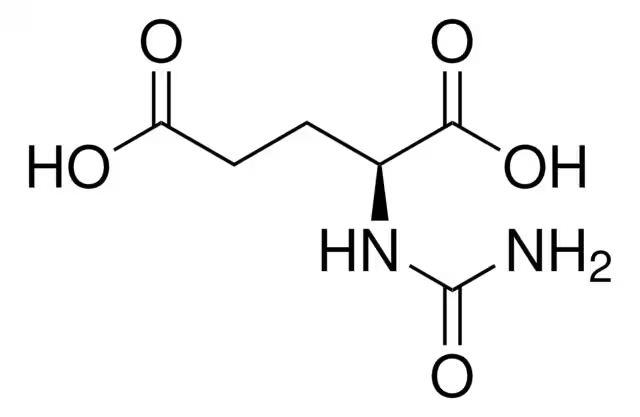
CAS Number1188-38-1
Synonyms(S)-2-Ureidopentanedioic acid; (2S)-2-(carbamoylamino)pentanedioic acid; N-Carbamyl-L-glutamic Acid; MFCD00047874
Molecular FormulaC6H10N2O5
Molecular Weight190.15
Purity≥98.0 (TLC)%
Density1.499g/cm3
Boiling Point438.1ºC at 760 mmHg
Melting Point174°
Appearancepowder
Symbol
Signal WordWarning
| Chemical & Physical Properties | |
|---|---|
| CAS Number | 1188-38-1 |
| Catalog No. | 2A-9026402 |
| Chinese Name | N-氨基甲酰-L-谷氨酸 |
| Synonyms | (S)-2-Ureidopentanedioic acid; (2S)-2-(carbamoylamino)pentanedioic acid; N-Carbamyl-L-glutamic Acid; MFCD00047874 |
| Molecular Formula | C6H10N2O5 |
| Molecular Weight | 190.15 |
| Purity | ≥98.0 (TLC) |
| Density | 1.499g/cm3 |
| Boiling Point | 438.1ºC at 760 mmHg |
| Melting Point | 174° |
| Appearance | powder |
| Storage Condition | 2-8°C |
| Application | Carglumic acid is a functional analog of N-acetylglutamate (NAG) and an activator of carbamoyl phosphate synthetase 1 (CPS1), and is indicated for the treatment of acute and chronic hyperammonemia ass |
| PubChem ID | 24892688 |
| MDL Number | MFCD00047874 |
| SMILES | NC(=O)N[C@@H](CCC(O)=O)C(O)=O |
| InChI | 1S/C6H10N2O5/c7-6(13)8-3(5(11)12)1-2-4(9)10/h3H,1-2H2,(H,9,10)(H,11,12)(H3,7,8,13)/t3-/m0/s1 |
| InChI Key | LCQLHJZYVOQKHU-VKHMYHEASA-N |
| NACRES Code | NA.26 |
| eCl@ss | 32160406 |
| UNSPSC | 12352209 |
| Hazard Symbols | transportation |
| MSDS | msds/26402_1_1188_38_1.pdf |
| Bioactivity | Carglumic acid, a functional analogue of N-acetylglutamate (NAG) and a carbamoyl phosphate synthetase 1 (CPS1) activator, is used to treat acute and chronic hyperammonemia associated with NAG synthase (NAGS) deficiency. Related Catalog Signaling Pathways >> Others >> Others Research Areas >> Cancer Target CPS1[1] In Vitro Carglumic acid suppresses cell viability in the pancreatic ductal adenocarcinoma cell lines, triple-negative breast cancer cell lines, hepatoma cell lines, and human non-small cell lung carcinoma cell lines in a dose-dependent manner. The 50% inhibitory concentration (IC50) of Carglumic acid against those cell lines is between 5 and 7.5 mM. The results show that Carglumic acid does not induce complete cell cycle arrest. Instead, there are more sub-G1 cells among Carglumic acid-treated AsPC1 and MDA-MB-231 cells than among untreated cells. In AsPC1 and HPDE-E6E7 cells, the IC50s of Carglumic acid are 5 mM and over 10 mM, respectively . In MDA-MB-231 and MCF-12A cells, the IC50s of Carglumic acid are 5 mM and 6 mM, respectively[1]. In Vivo The results show that Carglumic acid, but not the vehicle control, markedly inhibits tumor growth. In the orthotopic pancreatic cancer model, tumor growth inhibition by Carglumic acid on day 21 is 80% (P<0.01). In the orthotopic triple-negative breast cancer model, tumor growth inhibition by Carglumic acid on day 20 is 82% (P<0.01). These results indicate that Carglumic acid suppresses tumor growth in pancreatic cancer and triple-negative breast cancer. On day 20, mean tumor growth inhibition in orally and intravenously treated mice is 55% and 93%, respectively, relative to untreated mice (P<0.01)[1]. Kinase Assay Caspase activity is measured by using a fluorimetric caspase-3 assay kit. In brief, cells that are treated with Carglumic Acid or that are left untreated are lysed in a lysis buffer, and 50 μg of protein lysate is incubated with Ac-DEVD-AMC substrate in the assay buffer for 1 h. The resultant fluorescence signals are read by using a fluorometer (excitation 360 nm, emission 460 nm), and the results are tabulated as fold changes relative to the untreated control cells[1]. Cell Assay Cell viability is evaluated by MTT (3-(4,5-dimethylthiazol-2-yl)-2,5-diphenyltetrazolium bromide) assay. In brief, various cancer cell lines are seeded (1×10⁴ cells/well) in a 96-well plate and treated with different doses of Carglumic Acid. After 48 h, 50 μL of MTT solution per well (stock solution concentration 5 mg/mL) is added to each well, and the cells are incubated for 2 h more, followed by addition of 100 μL of dimethyl sulfoxide to each well. Absorbance at 570 nm is measured immediately using a multiwell scanner[1]. Animal Admin For orthotopic cancer models, AsPC1/luc human pancreatic cancer cells (1×10⁶) are injected into the pancreas of nude mice or MDA-MB-231 human triple-negative breast cancer cells (3×10⁶) are injected into the mammary fat pad of nude mice. Carglumic acid is administered to mice 5 days after tumor inoculation in the pancreatic cancer model and 7 days after tumor inoculation in the triple-negative breast cancer model. Tumor-bearing mice receive a Carglumic acid dose of 120 mg/kg orally every day for 10 days, 60 mg/kg orally three times per week for 2 weeks, or 60 mg/kg intravenously three times per week for 2 weeks. Tumor volume is determined by measuring luciferase signals using the in vivo imaging system in the pancreatic cancer model[1]. References [1]. Chen CT, et al. Carglumic acid promotes apoptosis and suppresses cancer cell proliferation in vitro and in vivo. Am J Cancer Res. 2015 Nov 15;5(12):3560-9. Chemical & Physical Properties Density 1.499g/cm3 Boiling Point 438.1ºC at 760 mmHg Melting Point 174° Molecular Formula C6H10N2O5 Molecular Weight 190.15400 Flash Point 218.8ºC Exact Mass 190.05900 PSA 129.72000 LogP 0.06390 Vapour Pressure 6.7E-09mmHg at 25°C Index of Refraction 1.544 InChIKey LCQLHJZYVOQKHU-VKHMYHEASA-N SMILES NC(=O)NC(CCC(=O)O)C(=O)O Storage condition 2-8°C |
| Use of | Carglumic acid, a functional analogue of N-acetylglutamate (NAG) and a carbamoyl phosphate synthetase 1 (CPS1) activator, is used to treat acute and chronic hyperammonemia associated with NAG synthase (NAGS) deficiency. Properties Articles32 Name carglumic acid Synonym More Synonyms Carglumic Acid Biological Activity Description Carglumic acid, a functional analogue of N-acetylglutamate (NAG) and a carbamoyl phosphate synthetase 1 (CPS1) activator, is used to treat acute and chronic hyperammonemia associated with NAG synthase (NAGS) deficiency. Related Catalog Signaling Pathways >> Others >> Others Research Areas >> Cancer In Vivo The results show that Carglumic acid, but not the vehicle control, markedly inhibits tumor growth. In the orthotopic pancreatic cancer model, tumor growth inhibition by Carglumic acid on day 21 is 80% (P<0.01). In the orthotopic triple-negative breast cancer model, tumor growth inhibition by Carglumic acid on day 20 is 82% (P<0.01). These results indicate that Carglumic acid suppresses tumor growth in pancreatic cancer and triple-negative breast cancer. On day 20, mean tumor growth inhibition in orally and intravenously treated mice is 55% and 93%, respectively, relative to untreated mice (P<0.01)[1]. Kinase Assay Caspase activity is measured by using a fluorimetric caspase-3 assay kit. In brief, cells that are treated with Carglumic Acid or that are left untreated are lysed in a lysis buffer, and 50 μg of protein lysate is incubated with Ac-DEVD-AMC substrate in the assay buffer for 1 h. The resultant fluorescence signals are read by using a fluorometer (excitation 360 nm, emission 460 nm), and the results are tabulated as fold changes relative to the untreated control cells[1]. References [1]. Chen CT, et al. Carglumic acid promotes apoptosis and suppresses cancer cell proliferation in vitro and in vivo. Am J Cancer Res. 2015 Nov 15;5(12):3560-9. Chemical & Physical Properties Molecular Formula C6H10N2O5 Exact Mass 190.05900 PSA 129.72000 LogP 0.06390 Index of Refraction 1.544 InChIKey LCQLHJZYVOQKHU-VKHMYHEASA-N SMILES NC(=O)NC(CCC(=O)O)C(=O)O |
| Transport Info | Product name: Purity: 95.0% |
| MSDS Transport Info | Module 14. Shipping information 14.1 UN dangerous goods number European Land Transport Dangerous Regulations: -International Maritime Dangerous Regulations: -International Air Transport Dangerous Regulations: - 14.2 Names specified by the United Nations (UN) European Land Transport Dangerous Regulations: Non-dangerous goods IMDG Code: Non-dangerous goods International air transport dangerous goods regulations: non-dangerous goods 14.3 Transport hazard categories European Land Transport Dangerous Regulations: -International Maritime Dangerous Regulations: -International Air Transport Dangerous Regulations: - 14.4 Package group European Land Transport Dangerous Regulations: -International Maritime Dangerous Regulations: -International Air Transport Dangerous Regulations: - 14.5 Environmental hazards European Land Transport Dangerous Regulations: No International Maritime Transport Dangerous Regulations Maritime Pollutants: No International Air Transport Risk Regulations: No 14.6 Special reminder to users No data available |
| Related Products in Nutritional Ingredients | ||
|---|---|---|
| Ubiquinol | 992-78-9 | 2A-9025829 |
| N-Acetyl-3,5-diiodo-L-tyrosine | 1027-28-7 | 2A-9025961 |
| DL-Ornithine hydrochloride | 1069-31-4 | 2A-9026004 |
| L-Glutamic acid gamma-ethyl ester | 1119-33-1 | 2A-9026175 |
| N-p-Tosyl-L-arginine | 1159-15-5 | 2A-9026354 |
| R-(+)-alpha-Lipoic acid | 1200-22-2 | 2A-9026474 |
| Tocopherol | 1406-18-4 | 2A-9026767 |
| D-Erythro-sphingosylphosphorylcholine | 1670-26-4 | 2A-9027239 |
| L-Leucine benzyl ester p-toluenesulfonate salt | 1738-77-8 | 2A-9027396 |
| N-4-Tosyl-L-arginine methyl ester hydrochloride | 1784-03-8 | 2A-9027474 |
| Browse all Nutritional Ingredients products » | ||
Phone:
630-322-8886
630-322-8887
Email:
Office Locations:
Chicago, IL, USA
San Francisco, CA, USA


 EN
EN


 SDS
SDS