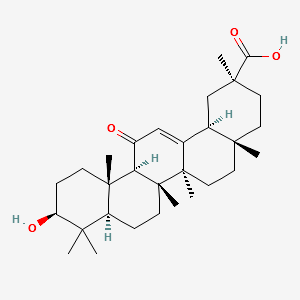
CAS Number1449-05-4
Synonyms18a-Glycyrrhetic acid; (3β,18α)-3-Hydroxy-11-oxoolean-12-en-29-oic acid; 18a-Glycyrrhetinic acid; MFCD00064897; Glycyrrhetinic acid; EINECS 215-907-9
Molecular FormulaC30H46O4
Molecular Weight470.684
Purity98.00%
Density1.1±0.1 g/cm3
Boiling Point588.3±50.0 °C at 760 mmHg
Melting Point331-333°C
| Chemical & Physical Properties | |
|---|---|
| CAS Number | 1449-05-4 |
| Catalog No. | 2A-9026817 |
| Chinese Name | 甘草次酸(α型) |
| Synonyms | 18a-Glycyrrhetic acid; (3β,18α)-3-Hydroxy-11-oxoolean-12-en-29-oic acid; 18a-Glycyrrhetinic acid; MFCD00064897; Glycyrrhetinic acid; EINECS 215-907-9 |
| Molecular Formula | C30H46O4 |
| Molecular Weight | 470.684 |
| Purity | 98.00 |
| Density | 1.1±0.1 g/cm3 |
| Boiling Point | 588.3±50.0 °C at 760 mmHg |
| Melting Point | 331-333°C |
| Storage Condition | Keep the container sealed and stored in a cool, dr |
| Application | 18α-Glycyrrhetinic acid, a dietary-derived compound, is an inhibitor of NF-kB and an activator of the proteasome and plays a role as a longevity-promoting and anti-aggregation factor in multicellular |
| HTC | 2938909030 |
| PubChem ID | 8195701 |
| SMILES | CC1(C(=O)O)CCC2(C)CCC3(C)C(=CC(=O)C4C5(C)CCC(O)C(C)(C)C5CCC43C)C2C1 |
| InChI | InChI=1S/C30H46O4/c1-25(2)21-8-11-30(7)23(28(21,5)10-9-22(25)32)20(31)16-18-19-17-27(4,24(33)34)13-12-26(19,3)14-15-29(18,30)6/h16,19,21-23,32H,8-15,17H2,1-7H3,(H,33,34)/p-1/t19-,21-,22-,23+,26+,27-,28-,29+,30+/m0/s1 |
| InChI Key | MPDGHEJMBKOTSU-MNEJCTLJSA-N |
| Bioactivity | 18α-Glycyrrhetinic acid, a diet-derived compound, is an inhibitor of NF-kB and an activator of proteasome, which serves as pro-longevity and anti-aggregation factor in a multicellular organism. 18α-Glycyrrhetinic acid induces apoptosis[1][2]. Related Catalog Signaling Pathways >> Apoptosis >> Apoptosis Research Areas >> Cancer Research Areas >> Inflammation/Immunology Signaling Pathways >> Metabolic Enzyme/Protease >> Proteasome Research Areas >> Neurological Disease Target NF-κB Proteasome In Vitro 18α-Glycyrrhetinic acid (18a-GA) markedly reduces LX-2 cell numbers by 14.8% and 31.2% after 48 h and 72 h of treatment, respectively (P< 0.05). 18α-Glycyrrhetinic acid also significantly increases the percentage of LX-2 cells in phase G0/G1 and decreases it in phase S after treated for 48 h and 72 h compare with the control group. 18α-Glycyrrhetinic acid increases apoptosis to 6.8% at 48 h, compare with control (2.5%), and at 72 h the percentages of apoptotic cells in control and the treatment groups are 3.1% and 15.6%, respectively, in LX-2 cells (P<0.01). Furthermore, 18α-Glycyrrhetinic acid induces expression of PPAR-γ and alters some cell cycle and apoptosis-related proteins. 18α-Glycyrrhetinic acid also inhibits NF-κB DNA-binding activity[1]. In Vivo 18α-Glycyrrhetinic acid (18α-GA) treatment significantly enhances life span of C. elegans strains with the most effective concentration being 20 μg/mL. Results reveal a significant delay of paralysis upon 18α-Glycyrrhetinic acid treatment. 18α-Glycyrrhetinic acid treatment also confers a significant reduction of Aβ deposits[2]. Cell Assay For the determination of cell cycle, 5×10⁵ cells per well are seeded onto 6-well plates and incubated overnight in complete growth medium (DMEM+10% FBS). After starvation for 24 h, the cells are subsequently stimulated with 10% FBS with or without the presence of 18α-Glycyrrhetinic acid (18a-GA). The final concentration of 18α-Glycyrrhetinic acid is 8.0 mM. The cells are incubated for 24 h, 48 h and 72 h, respectively, and then the flow cytometric analysis is performed. Flow cytometric analysis is performed in triplicate. After being treated with 18α-Glycyrrhetinic acid, the cells are stained and then cell apoptosis status is measured by flow cytometry[1]. Animal Admin C. elegans strains are used in this study. Synchronized L4 larvae CL2006 animals (100 to 120 animals per condition) are transferred to nematode growth medium (NGM) plates containing either 18α-Glycyrrhetinic acid (18α-GA) or DMSO at 20°C. Synchronized CL4176 animals (150 to 300 animals per condition) are transferred to NGM plates containing either 18α-Glycyrrhetinic acid or DMSO at 16°C for 48 h before temperature upshift to 25°C for transgene induction. Scoring of paralyzed animals is initiated at day 1 of adulthood for CL2006 strain and 24 h after temperature upshift for CL4176 strain. Each paralysis assay is repeated at least thrice. Nematodes are scored as paralyzed if they exhibit halos of cleared bacteria around their heads or fail to undergo half end body wave propagation upon prodding[2]. References [1]. Zong L et al. 18α-glycyrrhetinic acid extracted from Glycyrrhiza radix inhibits proliferation and promotes apoptosis of the hepatic stellate cell line. J Dig Dis. 2013 Jun;14(6):328-36. [2]. Papaevgeniou N, et al. 18α-Glycyrrhetinic Acid Proteasome Activator Decelerates Aging and Alzheimer's Disease Progression in Caenorhabditis elegans and Neuronal Cultures. Antioxid Redox Signal. 2016 Dec 1;25(16):855-869. Chemical & Physical Properties Density 1.1±0.1 g/cm3 Boiling Point 588.3±50.0 °C at 760 mmHg Melting Point 331-333°C Molecular Formula C30H46O4 Molecular Weight 470.684 Flash Point 323.7±26.6 °C Exact Mass 470.339600 PSA 74.60000 LogP 6.57 Vapour Pressure 0.0±3.7 mmHg at 25°C Index of Refraction 1.563 InChIKey MPDGHEJMBKOTSU-MNEJCTLJSA-N SMILES CC1(C(=O)O)CCC2(C)CCC3(C)C(=CC(=O)C4C5(C)CCC(O)C(C)(C)C5CCC43C)C2C1 Storage condition 2-8℃ |
| Use of | 18α-Glycyrrhetinic acid, a diet-derived compound, is an inhibitor of NF-kB and an activator of proteasome, which serves as pro-longevity and anti-aggregation factor in a multicellular organism. 18α-Glycyrrhetinic acid induces apoptosis[1][2]. Properties Name glycyrrhetinate Synonym More Synonyms Glycyrrhetinic acid Biological Activity Description 18α-Glycyrrhetinic acid, a diet-derived compound, is an inhibitor of NF-kB and an activator of proteasome, which serves as pro-longevity and anti-aggregation factor in a multicellular organism. 18α-Glycyrrhetinic acid induces apoptosis[1][2]. Related Catalog Signaling Pathways >> Apoptosis >> Apoptosis Research Areas >> Cancer Research Areas >> Inflammation/Immunology Signaling Pathways >> Metabolic Enzyme/Protease >> Proteasome Research Areas >> Neurological Disease Proteasome In Vivo 18α-Glycyrrhetinic acid (18α-GA) treatment significantly enhances life span of C. elegans strains with the most effective concentration being 20 μg/mL. Results reveal a significant delay of paralysis upon 18α-Glycyrrhetinic acid treatment. 18α-Glycyrrhetinic acid treatment also confers a significant reduction of Aβ deposits[2]. References [1]. Zong L et al. 18α-glycyrrhetinic acid extracted from Glycyrrhiza radix inhibits proliferation and promotes apoptosis of the hepatic stellate cell line. J Dig Dis. 2013 Jun;14(6):328-36. [2]. Papaevgeniou N, et al. 18α-Glycyrrhetinic Acid Proteasome Activator Decelerates Aging and Alzheimer's Disease Progression in Caenorhabditis elegans and Neuronal Cultures. Antioxid Redox Signal. 2016 Dec 1;25(16):855-869. Chemical & Physical Properties Molecular Formula C30H46O4 Exact Mass 470.339600 PSA 74.60000 Index of Refraction 1.563 InChIKey MPDGHEJMBKOTSU-MNEJCTLJSA-N Storage condition 2-8℃ |
| Tax Rebate | 9.0% |
| Supervision | A. Customs clearance form for inbound goods B. Customs clearance form for outbound goods |
| Inspection | R. Imported food hygiene supervision and inspection S. Export food hygiene supervision and inspection M. Imported commodity inspection N. Exported commodity inspection |
| Transport Info | Product name: Supervision conditions A. Customs clearance form for inbound goods B. Customs clearance form for outbound goods |
| Related Products in Botanical Reference Standards | ||
|---|---|---|
| 3-Epiursolic acid | 989-30-0 | 2A-9025822 |
| (-)-Epigallocatechin gallate | 989-51-5 | 2A-9025824 |
| 2-Nitrophenyl beta-D-thiogalactopyranoside | 1158-17-4 | 2A-9026353 |
| Cholesterol sulfate | 1256-86-6 | 2A-9026545 |
| (-)-Epicatechin gallate | 1257-08-5 | 2A-9026546 |
| Protopanaxatriol | 1453-93-6 | 2A-9026833 |
| Phenyl beta-D-glucopyranoside | 1464-44-4 | 2A-9026866 |
| 25-Hydroxycholesterol | 2140-46-7 | 2A-9028036 |
| Cucurbitacin I | 2222-07-3 | 2A-9028177 |
| Sinensetin | 2306-27-6 | 2A-9028293 |
| Browse all Botanical Reference Standards products » | ||
Phone:
630-322-8886
630-322-8887
Email:
Office Locations:
Chicago, IL, USA
San Francisco, CA, USA


 EN
EN


 SDS
SDS