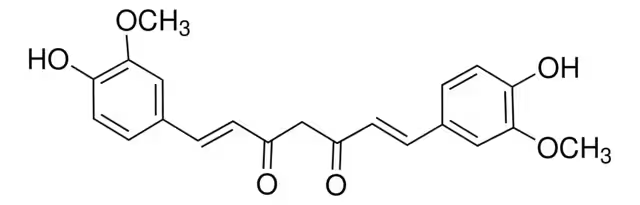
CAS Number458-37-7
SynonymsDiferulylmethane; Turmeric yellow; curcuma; EINECS 207-280-5; diferuloylmethane; Natural Yellow 3; gelbwurz; (1E,4Z,6E)-5-Hydroxy-1,7-bis(4-hydroxy-3-methoxyphenyl)-1,4,6-heptatrien-3-one; (1E,4Z,6E)-5-Hydroxy-1,7-bis(4-hydroxy-3-methoxyphenyl)hepta-1,4,6-trien-3-one; curouma; halad; souchet; kurkumin; haidr; Curcumin; (1E,6E)-1,7-bis(4-hydroxy-3-methoxyphenyl)hepta-1,6-diene-3,5-dione; (E,E)-1,7-bis(4-Hydroxy-3-methoxyphenyl)-1,6-heptadiene-3,5-dione; MFCD01868798
Molecular Formula[HOC6H3(OCH3)CH=CHCO]2CH2
Molecular Weight368.38
Purity95%
Density1.3±0.1 g/cm3
Boiling Point593.2±50.0 °C at 760 mmHg
Melting Point175 °C
Appearancepowder
EINECS207-280-5
Symbol
Signal WordWarning
| Chemical & Physical Properties | |
|---|---|
| CAS Number | 458-37-7 |
| Catalog No. | 2A-9022012 |
| Chinese Name | 姜黄素 |
| Synonyms | Diferulylmethane; Turmeric yellow; curcuma; EINECS 207-280-5; diferuloylmethane; Natural Yellow 3; gelbwurz; (1E,4Z,6E)-5-Hydroxy-1,7-bis(4-hydroxy-3-methoxyphenyl)-1,4,6-heptatrien-3-one; (1E,4Z,6E)-5-Hydroxy-1,7-bis(4-hydroxy-3-methoxyphenyl)hepta-1,4,6-trien-3-one; curouma; halad; souchet; kurkumin; haidr; Curcumin; (1E,6E)-1,7-bis(4-hydroxy-3-methoxyphenyl)hepta-1,6-diene-3,5-dione; (E,E)-1,7-bis(4-Hydroxy-3-methoxyphenyl)-1,6-heptadiene-3,5-dione; MFCD01868798 |
| Molecular Formula | [HOC6H3(OCH3)CH=CHCO]2CH2 |
| Molecular Weight | 368.38 |
| Purity | 95 |
| Density | 1.3±0.1 g/cm3 |
| Boiling Point | 593.2±50.0 °C at 760 mmHg |
| Melting Point | 175 °C |
| Appearance | powder |
| Water Solubility | Slightly soluble (hot) |
| Storage Condition | Store in a sealed container in a ventilated and dr |
| Application | Curcumin is a natural phenolic compound with various activities such as anti-inflammatory, antioxidant, anti-proliferative and anti-angiogenesis. Curcumin is an inhibitor of p300 histone acetyltransfe |
| EINECS | 207-280-5 |
| HTC | 2932999099 |
| PubChem ID | 24892408 |
| MDL Number | MFCD00008365 |
| SMILES | COc1cc(\C=C\C(=O)CC(=O)\C=C\c2ccc(O)c(OC)c2)ccc1O |
| InChI | 1S/C21H20O6/c1-26-20-11-14(5-9-18(20)24)3-7-16(22)13-17(23)8-4-15-6-10-19(25)21(12-15)27-2/h3-12,24-25H,13H2,1-2H3/b7-3+,8-4+ |
| InChI Key | VFLDPWHFBUODDF-FCXRPNKRSA-N |
| Beilstein/REAXYS | 2306965 |
| NACRES Code | NA.77 |
| UNSPSC | 12352205 |
| Hazard Symbols | Transport |
| MSDS | msds/22012_1_458_37_7.pdf |
| Bioactivity | Curcumin is a natural phenolic compound with diverse pharmacologic effects including anti-inflammatory, antioxidant, antiproliferative and antiangiogenic activities. Curcumin is an inhibitor of p300 histone acetylatransferase ((HATs)) and also shows inhibitory effects on NF-κB and MAPKs. Related Catalog Signaling Pathways >> Autophagy >> Autophagy Signaling Pathways >> Epigenetics >> Epigenetic Reader Domain Signaling Pathways >> Epigenetics >> Histone Acetyltransferase Signaling Pathways >> NF-κB >> Keap1-Nrf2 Signaling Pathways >> Autophagy >> Mitophagy Natural Products >> Phenols Research Areas >> Cancer Target Keap1-Nrf2[1], Histone acetyltransferase[6] In Vitro Curcumin exerts its chemopreventive effects partly through the activation of nuclear factor (erythroid-2 related) factor 2 (Nrf2) and its antioxidant and phase II detoxifying enzymes[1]. Curcumin inhibits T47D cells growth, with IC50s of 25, 19 and 17.5 μM for 24, 48 and 72 h MTT assays respectively. IC50s of curcumin and silibinin mixture against T47D cells, are 17.5, 15, and 12 μM for 24, 48, and 72 h exposure times, respectively[2]. Curcumin (2.5-80 μM) induces apoptotic cell death in AGS and HT-29 cell lines, and the IC50 is 21.9±0.1, 40.7±0.5 μM, respectively, in both AGS and HT-29 cell lines. Curcumin-induced apoptosis requires caspase activities in AGS and HT-29 cells. Curcumin induces ER Ca2+ decline and mitochondrial Ca2+ overloading[3]. Curcumin induces the G2/M cell cycle arrest of LNCaP and PC-3 cells in a dose dependent manner. Curcumin upregulates the protein level of NF-kappaB inhibitor IkappaBalpha and downregulates protein levels of c-Jun and AR[5]. In Vivo Curcumin (10 mg/kg, p.o.) significantly prevents decrease in the percentage of sucrose consumption, as compared to the CMS-exposed rats. Curcumin treatment results in significant prevention of increase in TNF-α and IL-6 levels in stressed rats[4]. Curcumin decreases binding of p300/CREB-binding protein (CBP) at the brain-derived neurotrophic factor (BDNF) promoter at 20 mg/kg (i.p.), reduces binding of P300/CBP at the BDNF promoter at 40 mg/kg, and decreases binding all the four proteins of p300/CBP and H3K9ac/H4K5ac at the BDNF promoter at 60 mg/kg in chronic constriction injury (CCI) rats[6]. Cell Assay T47D breast cancer cell line is grown in RPMI 1640 supplemented with 10% FBS, 2 mg/mL sodium bicarbonate, 0.05 mg/mL penicillin G, 0.08 mg/mL streptomycin. Culture is maintained on plastic flask and incubated at 37°C in 5% CO2. After growing sufficient amount of cells, cytotoxic effect of silibinin and curcumin is studied by 24, 48 and 72 h MTT assays in which 1000 cell/well are cultivated in a 96 well plate. After 24 h incubation in 37°C with humidified atmosphere containing 5% CO2, the cells are treated with serial concentrations of curcumin (5, 10, 20, 30, 40, 50, 60, 80, 100 µM), silibinin (20, 40, 60, 80, 100, 120, 140, 180, 200 µM), and curcumin-silibinin mixture (each of them 5, 10, 20, 30, 40, 50, 60, 80, 100 µM) for 24, 48 and 72 h in the quadruplicate manner, in addition to cells with 200 μL culture medium containing 10% DMSO for control. After incubation, the medium of all wells of the plate are exchanged with fresh medium and the cells are leaved for 24 h in incubator. Then, medium of all wells are removed carefully and 50 μL of 2 mg/mL MTT dissolved in PBS is added to each wells and the plate is covered with aluminum foil and incubated for 4.5 h again. After removing content of the wells, 200 μL pure DMSO is added to the wells. Then, 25 μL Sorensen's glycine buffer is added and immediately absorbance of each wells is read in 570 nm using EL×800 Microplate Absorbance Reader with reference wavelength of 630 nm. Animal Admin Curcumin (10 mg/kg), freshly suspended in saline, is administrated by oral gavage once a day for 3 weeks. Forty rats are randomLy assigned to 4 groups (n=10/each group): group I receives saline and serves as control, group II receives curcumin, group III is exposed to CMS andreceive saline and group IV are subjected to CMS andreceive curcumin. References [1]. Gao S, et al. Curcumin attenuates arsenic-induced hepatic injuries and oxidative stress in experimental mice through activation of Nrf2 pathway, promotion of arsenic methylation and urinary excretion. Food Chem Toxicol. 2013 Jul 18. pii: S0278-6915(13)004 [2]. Nasiri M, et al. Curcumin and Silibinin Inhibit Telomerase Expression in T47D Human Breast Cancer Cells. Asian Pac J Cancer Prev. 2013;14(6):3449-53. [3]. Cao A, et all. Curcumin induces apoptosis in human gastric carcinoma AGS cells and colon carcinoma HT-29 cells through mitochondrial dysfunction and endoplasmic reticulum stress. Apoptosis. 2013 Jul 24. [Epub ahead of print] [4]. Jiang H, et al. Antidepressant-like effects of curcumin in chronic mild stress of rats: Involvement of its anti-inflammatory action. Prog Neuropsychopharmacol Biol Psychiatry. 2013 Jul 20. pii: S0278-5846(13)00150-4. [5]. Guo H, et al. Curcumin induces cell cycle arrest and apoptosis of prostate cancer cells by regulating the expression of IkappaBalpha, c-Jun and androgen receptor. Pharmazie. 2013 Jun;68(6):431-4. [6]. Zhu X, et al. Curcumin alleviates neuropathic pain by inhibiting p300/CBP histone acetyltransferase activity-regulated expression of BDNF and cox-2 in a rat model. PLoS One. 2014 Mar 6;9(3):e91303. Chemical & Physical Properties Density 1.3±0.1 g/cm3 Boiling Point 593.2±50.0 °C at 760 mmHg Melting Point 183 °C Molecular Formula C21H20O6 Molecular Weight 368.380 Flash Point 209.7±23.6 °C Exact Mass 368.125977 PSA 96.22000 LogP 2.85 Vapour density 13 (vs air) Vapour Pressure 0.0±1.8 mmHg at 25°C Index of Refraction 1.672 InChIKey VFLDPWHFBUODDF-FCXRPNKRSA-N SMILES COc1cc(C=CC(=O)CC(=O)C=Cc2ccc(O)c(OC)c2)ccc1O Storage condition −20°C Water Solubility Slightly soluble (hot) |
| Use of | Curcumin is a natural phenolic compound with diverse pharmacologic effects including anti-inflammatory, antioxidant, antiproliferative and antiangiogenic activities. Curcumin is an inhibitor of p300 histone acetylatransferase ((HATs)) and also shows inhibitory effects on NF-κB and MAPKs. Properties Articles450 Name curcumin Synonym More Synonyms Curcumin Biological Activity Description Curcumin is a natural phenolic compound with diverse pharmacologic effects including anti-inflammatory, antioxidant, antiproliferative and antiangiogenic activities. Curcumin is an inhibitor of p300 histone acetylatransferase ((HATs)) and also shows inhibitory effects on NF-κB and MAPKs. Related Catalog Signaling Pathways >> Autophagy >> Autophagy Signaling Pathways >> Epigenetics >> Epigenetic Reader Domain Signaling Pathways >> Epigenetics >> Histone Acetyltransferase Signaling Pathways >> NF-κB >> Keap1-Nrf2 Signaling Pathways >> Autophagy >> Mitophagy Natural Products >> Phenols Research Areas >> Cancer Keap1-Nrf2[1], Histone acetyltransferase[6] References [1]. Gao S, et al. Curcumin attenuates arsenic-induced hepatic injuries and oxidative stress in experimental mice through activation of Nrf2 pathway, promotion of arsenic methylation and urinary excretion. Food Chem Toxicol. 2013 Jul 18. pii: S0278-6915(13)004 [2]. Nasiri M, et al. Curcumin and Silibinin Inhibit Telomerase Expression in T47D Human Breast Cancer Cells. Asian Pac J Cancer Prev. 2013;14(6):3449-53. [4]. Jiang H, et al. Antidepressant-like effects of curcumin in chronic mild stress of rats: Involvement of its anti-inflammatory action. Prog Neuropsychopharmacol Biol Psychiatry. 2013 Jul 20. pii: S0278-5846(13)00150-4. [5]. Guo H, et al. Curcumin induces cell cycle arrest and apoptosis of prostate cancer cells by regulating the expression of IkappaBalpha, c-Jun and androgen receptor. Pharmazie. 2013 Jun;68(6):431-4. Chemical & Physical Properties Molecular Formula C21H20O6 Exact Mass 368.125977 PSA 96.22000 Vapour density 13 (vs air) Index of Refraction 1.672 InChIKey VFLDPWHFBUODDF-FCXRPNKRSA-N Water Solubility Slightly soluble (hot) |
| Tax Rebate | 9.0% |
| Supervision | None MFN tariff: 5.5% Ordinary tariff: 30.0% |
| Transport Info | Product name: Purity: 98.0% |
| MSDS Transport Info | Module 14. Shipping information 14.1 UN dangerous goods number European Land Transport Dangerous Regulations: -International Maritime Dangerous Regulations: -International Air Transport Dangerous Regulations: - 14.2 Names specified by the United Nations (UN) European Land Transport Dangerous Regulations: Non-dangerous goods IMDG Code: Non-dangerous goods International air transport dangerous goods regulations: non-dangerous goods 14.3 Transport hazard categories European Land Transport Dangerous Regulations: -International Maritime Dangerous Regulations: -International Air Transport Dangerous Regulations: - 14.4 Package group European Land Transport Dangerous Regulations: -International Maritime Dangerous Regulations: -International Air Transport Dangerous Regulations: - 14.5 Environmental hazards European Land Transport Dangerous Regulations: No International Maritime Transport Dangerous Regulations Maritime Pollutants: No International Air Transport Risk Regulations: No 14.6 Special reminder to users No data available See reverse side of invoice or packing slip. |
| Related Products in Nutritional Ingredients | ||
|---|---|---|
| Bucladesine | 362-74-3 | 2A-9021502 |
| DL-Carnitine | 406-76-8 | 2A-9021771 |
| DL-Isoleucine | 443-79-8 | 2A-9021865 |
| Cyclandelate | 456-59-7 | 2A-9022005 |
| 3-Fluoro-DL-phenylalanine | 456-88-2 | 2A-9022007 |
| DL-Carnitine hydrochloride | 461-05-2 | 2A-9022036 |
| DL-Valine | 516-06-3 | 2A-9022437 |
| Vitamin K2(45) | 523-39-7 | 2A-9022492 |
| Pyridoxamine dihydrochloride | 524-36-7 | 2A-9022499 |
| Thiamine nitrate | 532-43-4 | 2A-9022584 |
| Browse all Nutritional Ingredients products » | ||
Phone:
630-322-8886
630-322-8887
Email:
Office Locations:
Chicago, IL, USA
San Francisco, CA, USA


 EN
EN


 SDS
SDS