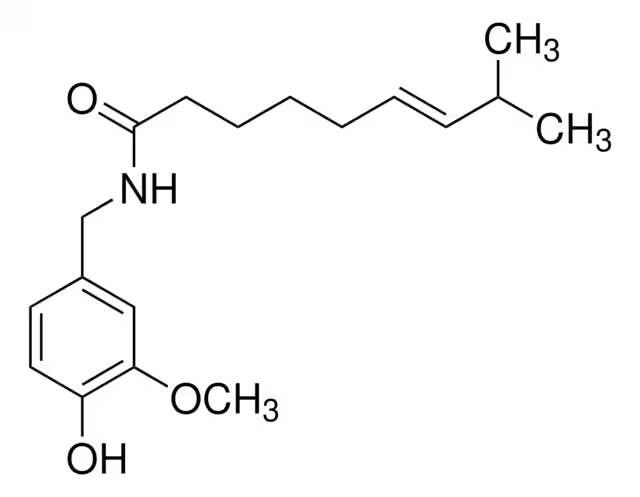
CAS Number404-86-4
Synonyms(E)-Capsaicin; 8-Methyl-N-vanillyl-trans-6-nonenamide; (E)-8-Methyl-N-vanillyl-6-nonenamide; (6E)-N-(4-Hydroxy-3-methoxybenzyl)-8-methyl-6-nonenamide; (E)-N-((4-Hydroxy-3-methoxyphenyl)methyl)-8-methyl-6-nonenamide; MFCD00017259; CAPSAICINE; Zostrix; trans-Capsaicin; Qutenza; (E)-N-[(4-hydroxy-3-methoxyphenyl)methyl]-8-methylnon-6-enamide; 8-Methyl-N-vanillyl-6-nonenamide; capsaicin; (E)-N-(4-hydroxy-3-methoxybenzyl)-8-methylnon-6-enamide; Transacin; Capsaicin (Natural); trans-8-methyl-n-vanillyl-6-nonenamide; (6E)-N-(4-Hydroxy-3-methoxybenzyl)-8-methylnon-6-enamide; N-vanillyl-8-methyl-non-6-enamide; (1Z,6E)-N-(4-Hydroxy-3-methoxybenzyl)-8-methyl-6-nonenimidic acid; Styptysat; N-[(4-Hydroxy-3-methoxyphenyl)methyl]-8-methyl-6-nonenamide; Axsain; Capsidol; 8-Methyl-N-vanillyl-trans-6-nonena
Molecular Formula(CH3)2CHCH=CH(CH2)4CONHCH2C6H3-4-(OH)-3-(OCH3)
Molecular Weight305.41
Purity95.00%
Density1.0±0.1 g/cm3
Boiling Point469.7±55.0 °C at 760 mmHg
Melting Point62-65 °C (lit.)
Appearancepowder
EINECS206-969-8
Symbol
Signal WordWarning
| Chemical & Physical Properties | |
|---|---|
| CAS Number | 404-86-4 |
| Catalog No. | 2A-9021759 |
| Chinese Name | 辣椒碱 |
| Synonyms | (E)-Capsaicin; 8-Methyl-N-vanillyl-trans-6-nonenamide; (E)-8-Methyl-N-vanillyl-6-nonenamide; (6E)-N-(4-Hydroxy-3-methoxybenzyl)-8-methyl-6-nonenamide; (E)-N-((4-Hydroxy-3-methoxyphenyl)methyl)-8-methyl-6-nonenamide; MFCD00017259; CAPSAICINE; Zostrix; trans-Capsaicin; Qutenza; (E)-N-[(4-hydroxy-3-methoxyphenyl)methyl]-8-methylnon-6-enamide; 8-Methyl-N-vanillyl-6-nonenamide; capsaicin; (E)-N-(4-hydroxy-3-methoxybenzyl)-8-methylnon-6-enamide; Transacin; Capsaicin (Natural); trans-8-methyl-n-vanillyl-6-nonenamide; (6E)-N-(4-Hydroxy-3-methoxybenzyl)-8-methylnon-6-enamide; N-vanillyl-8-methyl-non-6-enamide; (1Z,6E)-N-(4-Hydroxy-3-methoxybenzyl)-8-methyl-6-nonenimidic acid; Styptysat; N-[(4-Hydroxy-3-methoxyphenyl)methyl]-8-methyl-6-nonenamide; Axsain; Capsidol; 8-Methyl-N-vanillyl-trans-6-nonena |
| Molecular Formula | (CH3)2CHCH=CH(CH2)4CONHCH2C6H3-4-(OH)-3-(OCH3) |
| Molecular Weight | 305.41 |
| Purity | 95.00 |
| Density | 1.0±0.1 g/cm3 |
| Boiling Point | 469.7±55.0 °C at 760 mmHg |
| Melting Point | 62-65 °C (lit.) |
| Appearance | powder |
| Water Solubility | insoluble |
| Storage Condition | Store in a cool, dry and dark place. |
| Packaging | II |
| Application | Capsaicin is a TRPV1 agonist with an EC50 of 0.29 μM in HEK293 cells. |
| EINECS | 206-969-8 |
| HTC | 2932999099 |
| PubChem ID | 57647941 |
| MDL Number | MFCD00017259 |
| SMILES | COc1cc(CNC(=O)CCCC\C=C\C(C)C)ccc1O |
| InChI | 1S/C18H27NO3/c1-14(2)8-6-4-5-7-9-18(21)19-13-15-10-11-16(20)17(12-15)22-3/h6,8,10-12,14,20H,4-5,7,9,13H2,1-3H3,(H,19,21)/b8-6+ |
| InChI Key | YKPUWZUDDOIDPM-SOFGYWHQSA-N |
| Beilstein/REAXYS | 2816484 |
| NACRES Code | NA.25 |
| UNSPSC | 12352200 |
| Hazard Symbols | 6.1(a) |
| MSDS | msds/21759_1_404_86_4.pdf |
| Bioactivity | Capsaicin is a TRPV1 agonist with an EC50 of 0.29 μM in HEK293 cells. Related Catalog Signaling Pathways >> Autophagy >> Autophagy Signaling Pathways >> Membrane Transporter/Ion Channel >> TRP Channel Natural Products >> Alkaloid Research Areas >> Cancer Target EC50: 290 nM (hTRPV1, in HEK293 cell)[1] In Vitro Capsaicin is an agonist of transient receptor potential vanilloid subtype 1 (TRPV1), which is expressed in nociceptive sensory neurons and a range of secretory epithelia, including salivary glands. Capsaicin activates TRPV1, which modulates the permeability of tight junctions (TJ) by regulating the expression and function of putative intercellular adhesion molecules in an ERK-dependent manner[2]. Capsaicin is found to inhibit the growth and proliferation of FaDu cells in a dose- and time-dependent manner. Cells treated with 50, 100, 200, and 300 µM Capsaicin show an augmented decrease in cell growth as the Capsaicin dose increases. In addition, the percentage of viable cells decreases as the incubation time increases. The observed IC50 value is around 150 µM[3]. In Vivo Capsaicin (CAP)-treated animals (Group IV) show increased DNA fragmentation suggesting apoptosis when compare with B(a)P-induced lung cancer-bearing animals (Group II) that show reduced DNA fragmentation. CAP-treated Group IV animals show markedly increased expressions of p53, Bax and caspase-3 with remarkable decrease in the levels of anti-apoptotic protein Bcl-2, when compare with B(a)P-administered lung cancer animals of Group II[4]. Capsaicin causes a dose-dependent reduction of tear secretion in female Wistar/ST rats. Significant effects are observed at doses of 20, 50 and 100 mg/kg. In addition, Capsaicin also causes corneal lesions, and significant effects are observed at doses of 50 and 100 mg/kg[5]. Cell Assay FaDu cells are plated at a density of 1×10⁵ cells/well on 24-well plate. After overnight growth, the cells are treated with various concentrations of Capsaicin (0 μM, 50 μM, 100 μM, 150 μM, 200 μM, 250 μM, 300 μM, and 350 μM) for 24, 48 and 72 hours, with medium replacement every 24 hours. At the end of treatment, 30 µL of the tetrazolium compound MTT, and 270 µL of fresh medium are added. After further incubation for 4 hours at 37°C, 200 µL of 0.1 N HCl in 10% SDS is added into each well to dissolve the tetrazolium crystals. Finally, the absorbance at a wavelength of 540 nm is recorded using an ELISA plate reader[3]. Animal Admin Mice[4] Healthy male Swiss albino mice weighing 20-25 g (8-10 weeks old) are divided into four groups of six mice each as follows. Group I: control animals receive olive oil throughout the course of the experiment. Group II: animals are administered with Benzo(a)pyrene (B(a)P) (50 mg/kg body weight dissolved in olive oil) orally twice a week for four successive weeks. Group III: animals receive Capsaicin alone (10 mg/kg body weight dissolved in olive oil) intraperitoneally once in a week for 14 weeks to assess the cytotoxicity (if any) induced by Capsaicin. Group IV: animals receive B(a)P (as in Group II) along with Capsaicin (10 mg/kg b.wt dissolves in olive oil) intraperitoneally. Capsaicin treatment is started one week prior to the first dose of B(a)P administration and continued for 14 weeks. Rats[5] Female Wistar/ST rats, 4 d of age, are used. On postnatal day 4, rats are given a single subcutaneous injection of Capsaicin at a dose of 50 mg/kg (or 20 and 100 mg/kg for the dose-response test) dissolved in physiological saline containing 10% ethanol and 10% Tween 80. Vehicle-treated rats receive the vehicle solution alone. The injected rats are housed with their mothers, who are fed standard rat chow and maintained under normal conditions. At 4 weeks of age, the injected rats are separated and housed in cages, and maintained under normal conditions until the initiation of experiments. References [1]. McNamara FN, et al. Effects of piperine, the pungent component of black pepper, at the human vanilloid receptor (TRPV1). Br J Pharmacol. 2005 Mar;144(6):781-90. [2]. Shin YH, et al. The Effect of Capsaicin on Salivary Gland Dysfunction. Molecules. 2016 Jun 25;21(7). [3]. Le TD, et al. Capsaicin-induced apoptosis of FaDu human pharyngeal squamous carcinoma cells. Yonsei Med J. 2012 Jul 1;53(4):834-41. [4]. Anandakumar P, et al. Capsaicin provokes apoptosis and restricts benzo(a)pyrene induced lung tumorigenesis in Swiss albino mice. Int Immunopharmacol. 2013 Jun 6;17(2):254-259. [5]. Kagawa Y, et al. Investigation of capsaicin-induced superficial punctate keratopathy model due to reduced tear secretion in rats. Curr Eye Res. 2013 Jul;38(7):729-35. [6]. Wang J, et al. Anti-inflammatory and retinal protective effects of capsaicin on ischaemia-induced injuries through the release of endogenous somatostatin. Clin Exp Pharmacol Physiol. 2017 Jul;44(7):803-814. Chemical & Physical Properties Density 1.0±0.1 g/cm3 Boiling Point 469.7±55.0 °C at 760 mmHg Melting Point 62-65 °C(lit.) Molecular Formula C18H27NO3 Molecular Weight 305.412 Flash Point 237.9±31.5 °C Exact Mass 305.199097 PSA 58.56000 LogP 4.27 Vapour Pressure 0.0±1.2 mmHg at 25°C Index of Refraction 1.508 InChIKey YKPUWZUDDOIDPM-SOFGYWHQSA-N SMILES COc1cc(CNC(=O)CCCCC=CC(C)C)ccc1O Stability Stable. Incompatible with strong oxidizing agents. Water Solubility insoluble |
| Use of | Properties Articles303 Name capsaicin Synonym More Synonyms capsaicin Biological Activity Related Catalog Signaling Pathways >> Autophagy >> Autophagy Signaling Pathways >> Membrane Transporter/Ion Channel >> TRP Channel Natural Products >> Alkaloid Research Areas >> Cancer In Vitro Capsaicin is an agonist of transient receptor potential vanilloid subtype 1 (TRPV1), which is expressed in nociceptive sensory neurons and a range of secretory epithelia, including salivary glands. Capsaicin activates TRPV1, which modulates the permeability of tight junctions (TJ) by regulating the expression and function of putative intercellular adhesion molecules in an ERK-dependent manner[2]. Capsaicin is found to inhibit the growth and proliferation of FaDu cells in a dose- and time-dependent manner. Cells treated with 50, 100, 200, and 300 µM Capsaicin show an augmented decrease in cell growth as the Capsaicin dose increases. In addition, the percentage of viable cells decreases as the incubation time increases. The observed IC50 value is around 150 µM[3]. References [1]. McNamara FN, et al. Effects of piperine, the pungent component of black pepper, at the human vanilloid receptor (TRPV1). Br J Pharmacol. 2005 Mar;144(6):781-90. [2]. Shin YH, et al. The Effect of Capsaicin on Salivary Gland Dysfunction. Molecules. 2016 Jun 25;21(7). [3]. Le TD, et al. Capsaicin-induced apoptosis of FaDu human pharyngeal squamous carcinoma cells. Yonsei Med J. 2012 Jul 1;53(4):834-41. [4]. Anandakumar P, et al. Capsaicin provokes apoptosis and restricts benzo(a)pyrene induced lung tumorigenesis in Swiss albino mice. Int Immunopharmacol. 2013 Jun 6;17(2):254-259. [5]. Kagawa Y, et al. Investigation of capsaicin-induced superficial punctate keratopathy model due to reduced tear secretion in rats. Curr Eye Res. 2013 Jul;38(7):729-35. [6]. Wang J, et al. Anti-inflammatory and retinal protective effects of capsaicin on ischaemia-induced injuries through the release of endogenous somatostatin. Clin Exp Pharmacol Physiol. 2017 Jul;44(7):803-814. Chemical & Physical Properties Molecular Formula C18H27NO3 Exact Mass 305.199097 PSA 58.56000 Index of Refraction 1.508 InChIKey YKPUWZUDDOIDPM-SOFGYWHQSA-N Stability Stable. Incompatible with strong oxidizing agents. Water Solubility insoluble |
| Tax Rebate | 13.0% |
| Supervision | None. MFN tariff: 6.5%. Ordinary tariff: 30.0% |
| Transport Info | Shipping Name: UN |
| MSDS Transport Info | Module 14. Shipping information 14.1 United Nations number European Dangerous Regulations for land transport: 2811 International Dangerous Regulations for sea transport: 2811 International Dangerous Regulations for air transport: 2811 14.2 United Nations shipping name European Land Transport Dangerous Regulations: TOXIC SOLID, ORGANIC, N.O.S. (Capsaicin) IMDG Code: TOXIC SOLID, ORGANIC, N.O.S. (Capsaicin) International air transport hazard regulations: Toxic solid, organic, n.o.s. (Capsaicin) 14.3 Transport hazard categories European Land Transport Danger Regulations: 6.1 International Maritime Transport Danger Regulations: 6.1 International Air Transport Danger Regulations: 6.1 14.4 Package group European Land Transport Danger Regulations: III International Maritime Transport Danger Regulations: III International Air Transport Danger Regulations: III 14.5 Environmental hazards European Land Transport Danger Regulations: No International Maritime Danger Regulations International Air Transport Danger Regulations: No Marine pollutants (yes/no): No 14.6 Special precautions No data available |
| Related Products in Alkaloids | ||
|---|---|---|
| DL-Norephedrine hydrochloride | 154-41-6 | 2A-9021037 |
| Ephedrine | 299-42-3 | 2A-9021152 |
| Harmaline | 304-21-2 | 2A-9021188 |
| (-)-Pseudoephedrine | 321-97-1 | 2A-9021272 |
| Brucine | 357-57-3 | 2A-9021483 |
| Harmine | 442-51-3 | 2A-9021859 |
| Isocorydine | 475-67-2 | 2A-9022107 |
| Boldine | 476-70-0 | 2A-9022113 |
| Cytisine | 485-35-8 | 2A-9022181 |
| Cinchonidine | 485-71-2 | 2A-9022185 |
| Browse all Alkaloids products » | ||
Phone:
630-322-8886
630-322-8887
Email:
Office Locations:
Chicago, IL, USA
San Francisco, CA, USA


 EN
EN


 SDS
SDS