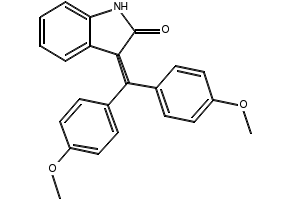
CAS Number193620-69-8
SynonymsTAS-301; 3-[Bis(4-methoxyphenyl)methylene]-1,3-dihydro-2H-indol-2-one; IN1440; 3-Bis-(4-methoxphenyl)methylene-2-indolinone; 3-bis(4-Methoxyphenyl)methylene-2-indolinone
Molecular FormulaC23H19O3N1
Molecular Weight357.41
Density1.2±0.1 g/cm3
Boiling Point573.2±50.0 °C at 760 mmHg
Symbol
Signal WordWarning
| Chemical & Physical Properties | |
|---|---|
| CAS Number | 193620-69-8 |
| Catalog No. | 2A-1198807 |
| Chinese Name | TAS-301 |
| Synonyms | TAS-301; 3-[Bis(4-methoxyphenyl)methylene]-1,3-dihydro-2H-indol-2-one; IN1440; 3-Bis-(4-methoxphenyl)methylene-2-indolinone; 3-bis(4-Methoxyphenyl)methylene-2-indolinone |
| Molecular Formula | C23H19O3N1 |
| Molecular Weight | 357.41 |
| Density | 1.2±0.1 g/cm3 |
| Boiling Point | 573.2±50.0 °C at 760 mmHg |
| Storage Condition | 2-8℃ |
| Application | TAS-301 is a smooth muscle migration and proliferation inhibitor that inhibits PDGF-induced PKC activation. |
| MDL Number | MFCD05865245 |
| SMILES | COc1ccc(C(=C2C(=O)Nc3ccccc32)c2ccc(OC)cc2)cc1 |
| InChI Key | KUEYYIJXBRWZIB-UHFFFAOYSA-N |
| Hazard Symbols | transportation |
| MSDS | msds/200749_1_193620_69_8.pdf |
| Bioactivity | TAS-301 is an inhibitor of smooth muscle cell migration and proliferation, and inhibits PKC activation induced by PDGF. Related Catalog Research Areas >> Cardiovascular Disease Target PKC In Vitro TAS-301 (1-10 μM) concentration-dependently inhibits PKC activation and Ca2+ influx, induced by PDGF, with 62.7% inhibition on PKC activation at 10 μM, and reduces PMA-induced AP-1, with 38% and 67.6% inhibition at 3 and 10 μM, respectively[1]. TAS-301 (0.3-3 μM) dose-dependently reduces the migration of cells induced by growth factors (PDGF-BB, IGF-1,HB-EGF). TAS-301 (1-10 μM) also decreases bFGF-induced BrdU incorporation, especially at 3 and 10 μM[2]. In Vivo TAS-301 (3-100 mg/kg, p.o.) dose-dependently reduces the neointimal thickening and I/M ratio and decreases the level of intimal cells in rats 14 days after balloon injury[2]. Cell Assay Cell proliferation is determined by the incorporation of BrdU by quiescent cells. SMCs are seeded at 1 × 10⁴cells/well in 96-well plates in DMEM containing 10% FBS. Two days after the seeding, their growth is arrested for 3 days in a serum-free DMEM containing 5 μg/mL insulin, 5 μg/mL transferrin and 5 ng/mL sodium selenium (ITS). Then, the DMEM/ITS is removed, and serum-free DMEM containing 0.1% BSA with or without TAS-301 or tranilast is added to the quiescent cells 2 hr before treatment with the growth factor (i.e., bFGF 0.1 ng/mL). At 24 hr after stimulation, BrdU (10 μM) is added to the cells; 24 hr later, the cells are fixed. An ELISA is used to detect and to quantify the incorporated BrdU (n = 6). The drugs are present during the entire experiment[2]. Animal Admin Rats[2] On the 14th day after the balloon injury, the rats are anesthetized with ether so as to avoid any stress to the animals and then perfused transcardially with saline, followed by 10% buffered formalin. Next, the left carotid artery (length from aortic arch to bifurcation) is removed, postfixed and embedded in paraffin. Then, 3-μm-thick artery sections (six sections for each artery) are cut and stained with hematoxylin and eosin. The cross-sectional areas of the intima and the media on photographs are measured by use of a digital analyzer. The average of the ratio of the intimal area to the medial area in each artery is determined. Experimental groups are as follows: Vehicle (n = 9), TAS-301 (3, 10, 30 and 100 mg/kg,n = 9) and tranilast (100 and 300 mg/kg,n = 9). The data on two rats (one in TAS-301 100 mg/kg group and one in tranilast 100 mg/kg group) is omitted from the evaluation because of death due to faulty oral administration[2]. References [1]. Muranaka Y, et al. TAS-301, an inhibitor of smooth muscle cell migration and proliferation, inhibits intimal thickening after balloon injury to rat carotid arteries. J Pharmacol Exp Ther. 1998 Jun;285(3):1280-6. [2]. Sasaki E, et al. TAS-301 blocks receptor-operated calcium influx and inhibits rat vascular smooth muscle cell proliferation induced by basic fibroblast growth factor and platelet-derived growth factor. Jpn J Pharmacol. 2000 Nov;84(3):252-8. Chemical & Physical Properties Density 1.2±0.1 g/cm3 Boiling Point 573.2±50.0 °C at 760 mmHg Molecular Formula C23H19NO3 Molecular Weight 357.402 Flash Point 300.5±30.1 °C Exact Mass 357.136505 PSA 47.56000 LogP 4.72 Vapour Pressure 0.0±1.6 mmHg at 25°C Index of Refraction 1.630 InChIKey KUEYYIJXBRWZIB-UHFFFAOYSA-N SMILES COc1ccc(C(=C2C(=O)Nc3ccccc32)c2ccc(OC)cc2)cc1 Storage condition 2-8℃ |
| Use of | TAS-301 is an inhibitor of smooth muscle cell migration and proliferation, and inhibits PKC activation induced by PDGF. Properties Name 3-[bis(4-methoxyphenyl)methylidene]-1H-indol-2-one Synonym More Synonyms TAS 301 Biological Activity Description TAS-301 is an inhibitor of smooth muscle cell migration and proliferation, and inhibits PKC activation induced by PDGF. Related Catalog Research Areas >> Cardiovascular Disease In Vitro TAS-301 (1-10 μM) concentration-dependently inhibits PKC activation and Ca2+ influx, induced by PDGF, with 62.7% inhibition on PKC activation at 10 μM, and reduces PMA-induced AP-1, with 38% and 67.6% inhibition at 3 and 10 μM, respectively[1]. TAS-301 (0.3-3 μM) dose-dependently reduces the migration of cells induced by growth factors (PDGF-BB, IGF-1,HB-EGF). TAS-301 (1-10 μM) also decreases bFGF-induced BrdU incorporation, especially at 3 and 10 μM[2]. References [1]. Muranaka Y, et al. TAS-301, an inhibitor of smooth muscle cell migration and proliferation, inhibits intimal thickening after balloon injury to rat carotid arteries. J Pharmacol Exp Ther. 1998 Jun;285(3):1280-6. [2]. Sasaki E, et al. TAS-301 blocks receptor-operated calcium influx and inhibits rat vascular smooth muscle cell proliferation induced by basic fibroblast growth factor and platelet-derived growth factor. Jpn J Pharmacol. 2000 Nov;84(3):252-8. Chemical & Physical Properties Molecular Formula C23H19NO3 Exact Mass 357.136505 PSA 47.56000 Index of Refraction 1.630 InChIKey KUEYYIJXBRWZIB-UHFFFAOYSA-N Storage condition 2-8℃ |
| Transport Info | Product name: Purity: 99.0% |
| MSDS Transport Info | Module 14. Shipping information 14.1 UN dangerous goods number European Land Transport Dangerous Regulations: -International Maritime Dangerous Regulations: -International Air Transport Dangerous Regulations: - 14.2 Names specified by the United Nations (UN) European Land Transport Dangerous Regulations: Non-dangerous goods IMDG Code: Non-dangerous goods International air transport dangerous goods regulations: non-dangerous goods 14.3 Transport hazard categories European Land Transport Dangerous Regulations: -International Maritime Dangerous Regulations: -International Air Transport Dangerous Regulations: - 14.4 Package group European Land Transport Dangerous Regulations: -International Maritime Dangerous Regulations: -International Air Transport Dangerous Regulations: - 14.5 Environmental hazards European Land Transport Dangerous Regulations: No International Maritime Transport Dangerous Regulations Maritime Pollutants: No International Air Transport Risk Regulations: No 14.6 Special reminder to users No data available |
| Related Products in Specialty Chemicals | ||
|---|---|---|
| LRRK2-IN-1 | 1234480-84-2 | 2A-1198802 |
| TMP269 | 1314890-29-3 | 2A-1198803 |
| Tubastatin-A | 1252003-15-8 | 2A-1198804 |
| Y320 | 288250-47-5 | 2A-1198805 |
| 2-AMino-6-chloro-α-cyano-3-(ethoxycarbonyl)-4H-1-benzopyran-4-acetic Acid Ethyl Ester | 305834-79-1 | 2A-1198806 |
| IC 261 | 186611-52-9 | 2A-1198808 |
| NSC 600157 | 31083-55-3 | 2A-1198809 |
| Dimethylenastron | 863774-58-7 | 2A-1198810 |
| JNJ 63533054 | 1802326-66-4 | 2A-1198811 |
| KENPAULLONE | 142273-20-9 | 2A-1198812 |
| Browse all Specialty Chemicals products » | ||
Phone:
630-322-8886
630-322-8887
Email:
Office Locations:
Chicago, IL, USA
San Francisco, CA, USA


 EN
EN


 SDS
SDS