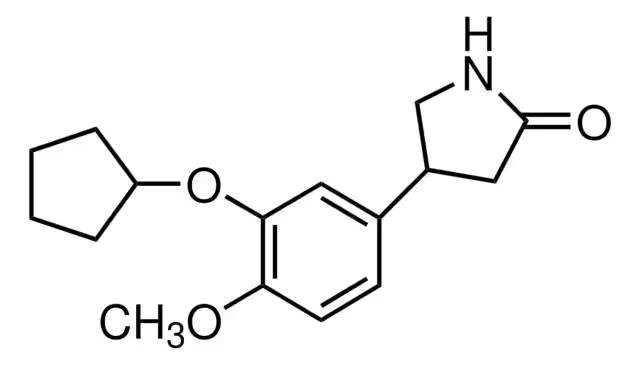
CAS Number61413-54-5
Synonyms4-[3-(Cyclopentyloxy)-4-methoxyphenyl]pyrrolidin-2-one; (R,S)-Rolipram; 4-(3-cyclopentyloxy-4-methoxy-phenyl)-pyrrolidin-2-one; (±)-Rolipram; Adeo; [3H]-Rolipram; Rolipram; 4-(3-cyclopentyloxy-4-methoxyphenyl)pyrrolidin-2-one; 4-[3-(Cyclopentyloxy)-4-methoxyphenyl]-2-pyrrolidinone; EINECS 262-771-1; Rolipramum [Latin]; MFCD00270906
Molecular FormulaC16H21NO3
Molecular Weight275.34
Purity≥98 (HPLC)%
Density1.2±0.1 g/cm3
Boiling Point472.7±45.0 °C at 760 mmHg
Melting Point127-133ºC
Appearancesolid
EINECS262-771-1
Symbol
Signal WordWarning
| Chemical & Physical Properties | |
|---|---|
| CAS Number | 61413-54-5 |
| Catalog No. | 2A-1193117 |
| Chinese Name | 咯利普兰 |
| Synonyms | 4-[3-(Cyclopentyloxy)-4-methoxyphenyl]pyrrolidin-2-one; (R,S)-Rolipram; 4-(3-cyclopentyloxy-4-methoxy-phenyl)-pyrrolidin-2-one; (±)-Rolipram; Adeo; [3H]-Rolipram; Rolipram; 4-(3-cyclopentyloxy-4-methoxyphenyl)pyrrolidin-2-one; 4-[3-(Cyclopentyloxy)-4-methoxyphenyl]-2-pyrrolidinone; EINECS 262-771-1; Rolipramum [Latin]; MFCD00270906 |
| Molecular Formula | C16H21NO3 |
| Molecular Weight | 275.34 |
| Purity | ≥98 (HPLC) |
| Density | 1.2±0.1 g/cm3 |
| Boiling Point | 472.7±45.0 °C at 760 mmHg |
| Melting Point | 127-133ºC |
| Appearance | solid |
| Water Solubility | H2O: 0.2 mg/mL |
| Storage Condition | 0-6℃ |
| Packaging | III |
| Application | Rolipram is a selective phosphodiesterase PDE4 inhibitor, inhibiting PDE4A, PDE4B and PDE4D with IC50 of 3 nM, 130 nM and 240 nM respectively. |
| EINECS | 262-771-1 |
| HTC | 2933790090 |
| PubChem ID | 24278196 |
| MDL Number | MFCD00270906 |
| SMILES | COc1ccc(cc1OC2CCCC2)C3CNC(=O)C3 |
| InChI | 1S/C16H21NO3/c1-19-14-7-6-11(12-9-16(18)17-10-12)8-15(14)20-13-4-2-3-5-13/h6-8,12-13H,2-5,9-10H2,1H3,(H,17,18) |
| InChI Key | HJORMJIFDVBMOB-UHFFFAOYSA-N |
| NACRES Code | NA.77 |
| UNSPSC | 41106305 |
| Hazard Symbols | 6.1(b) |
| MSDS | msds/194681_1_61413_54_5.pdf |
| Bioactivity | Rolipram is a selective phosphodiesterases PDE4 inhibitor with IC50s of 3 nM, 130 nM and 240 nM for PDE4A, PDE4B, and PDE4D, respectively. Related Catalog Signaling Pathways >> Metabolic Enzyme/Protease >> Phosphodiesterase (PDE) Research Areas >> Neurological Disease Target IC50: 3 nM (PDE4A), 130 nM (PDE4B), 240 nM (PDE4D)[1] In Vitro The PDE4 selective inhibitor, Rolipram, inhibits immunopurified PDE4B and PDE4D activities similarly, with IC50s of approx. 130 nM and 240 nM respectively. In contrast, Rolipram inhibits immunopurified PDE4A activity with a dramatically lower IC50 of around 3 nM. Rolipram increases phosphorylation of cAMP-response-element-binding protein (CREB) in U937 cells in a dose-dependent fashion, which implies the presence of both high affinity (IC50 approx. 1 nM) and low affinity (IC50 approx. 120 nM) components. Rolipram dose-dependently inhibits the IFN-gamma-stimulated phosphorylation of p38 MAPK in a simple monotonic fashion with an IC50 of approx. 290 nM[1]. Rolipram is a selective PDE4 inhibitor that inhibits all PDE4 isoforms A, B, C and D. Rolipram inhibits LPS-induced TNF production in a dose-dependent manner (IC50 25.9 nM), and maximal/submaximal inhibition is observed with 2 μM drug concentration in J774 cells[2]. In Vivo TNF mRNA and protein expression is induced by LPS in peritoneal macrophages (PM) from WT mice, and that is clearly (by 74 and 63% for TNF mRNA and TNF protein, respectively) inhibited by Rolipram. LPS-induced TNF production is enhanced in PM from MKP-1(-/-) mice as compared to that in PM from WT mice, which is in line with the published results. Interestingly, the inhibition of TNF mRNA and protein expression by Rolipram is markedly attenuated in PM from MKP-1(-/-) mice and does not reach statistical significance[2]. Repeated administration of Rolipram (1.25 mg/kg, i.p.) reduces the number of escape failures in learned helplessness rats[3]. Cell Assay J774 murine macrophages (ATCC) are cultured at 37°C in 5% CO2 atmosphere in DMEM supplemented with glutamax-1 containing 10% heat-inactivated FBS, 100 U/mL penicillin, 100 μg/mL streptomycin and 250 ng/mL amphotericin B. For experiments, cells are seeded on 24-well plates at a density of 2×10⁵ cells per well. Cell monolayers are grown for 72 h before the experiments are started. Rolipram, IBMX and BIRB 796 are dissolved in DMSO, and 8-Br-cAMP in HBSS. LPS (10 ng/mL) or the compounds of interest at concentrations indicated or the solvent (DMSO, 0.1% v/v) are added to the cells in fresh culture medium containing 10% FBS and the supplements. Cells are further incubated for the time indicated. The effect of LPS and the tested chemicals on cell viability is evaluated by Cell Proliferation Kit II (XTT)[2]. Animal Admin Mice[2] Inbred C57BL/6 MKP-1(-/-) mice are used. C57BL/6 mice (20-25 g) are divided into groups of six mice and treated with 200 μL of PBS or Rolipram (100 mg/kg in PBS) by an i.p. injection 2 h before applying carrageenan. Before the administration of carrageenan, the mice are anaesthetized by i.p. injection of 0.5 mg/kg of medetomidine and 75 mg/kg of ketamine. The mice receive a 30 μL i.d. injection of carrageenan (1.5%, dissolved in normal saline) in one hind paw. The contralateral paw receive 30 μL of saline and it is used as a control. Paw volume is measured before and 3 h after the carrageenan injection with a plethysmometer. Oedema is expressed as a change in paw volume over time. References [1]. MacKenzie SJ, et al. Action of rolipram on specific PDE4 cAMP phosphodiesterase isoforms and on the phosphorylation of cAMP-response-element-binding protein (CREB) and p38 mitogen-activated protein (MAP) kinase in U937 monocyticcells. Biochem J. 2000 Apr [2]. Korhonen R, et al. Attenuation of TNF production and experimentally induced inflammation by PDE4 inhibitor rolipram is mediated by MAPK phosphatase-1. Br J Pharmacol. 2013 Aug;169(7):1525-36. [3]. Shalaby AM, et al. Effect of rolipram, a phosphodiesterase enzyme type-4 inhibitor, on γ-amino butyric acid content of the frontal cortex in mice exposed to chronic mild stress. J Pharmacol Pharmacother. 2012 Apr;3(2):132-7. Chemical & Physical Properties Density 1.2±0.1 g/cm3 Boiling Point 472.7±45.0 °C at 760 mmHg Melting Point 127-133ºC Molecular Formula C16H21NO3 Molecular Weight 275.343 Flash Point 239.7±28.7 °C Exact Mass 275.152130 PSA 47.56000 LogP 1.43 Vapour Pressure 0.0±1.2 mmHg at 25°C Index of Refraction 1.552 InChIKey HJORMJIFDVBMOB-UHFFFAOYSA-N SMILES COc1ccc(C2CNC(=O)C2)cc1OC1CCCC1 Storage condition 0-6°C Water Solubility H2O: 0.2 mg/mL |
| Use of | Rolipram is a selective phosphodiesterases PDE4 inhibitor with IC50s of 3 nM, 130 nM and 240 nM for PDE4A, PDE4B, and PDE4D, respectively. Properties Articles107 Name rolipram Synonym More Synonyms rolipram Biological Activity Description Rolipram is a selective phosphodiesterases PDE4 inhibitor with IC50s of 3 nM, 130 nM and 240 nM for PDE4A, PDE4B, and PDE4D, respectively. Related Catalog Signaling Pathways >> Metabolic Enzyme/Protease >> Phosphodiesterase (PDE) Research Areas >> Neurological Disease IC50: 3 nM (PDE4A), 130 nM (PDE4B), 240 nM (PDE4D)[1] References [2]. Korhonen R, et al. Attenuation of TNF production and experimentally induced inflammation by PDE4 inhibitor rolipram is mediated by MAPK phosphatase-1. Br J Pharmacol. 2013 Aug;169(7):1525-36. [3]. Shalaby AM, et al. Effect of rolipram, a phosphodiesterase enzyme type-4 inhibitor, on γ-amino butyric acid content of the frontal cortex in mice exposed to chronic mild stress. J Pharmacol Pharmacother. 2012 Apr;3(2):132-7. Chemical & Physical Properties Molecular Formula C16H21NO3 Exact Mass 275.152130 PSA 47.56000 Index of Refraction 1.552 InChIKey HJORMJIFDVBMOB-UHFFFAOYSA-N |
| Tax Rebate | 9.0% |
| Supervision | None MFN tariff: 9.0% Ordinary tariff: 20.0% |
| Transport Info | Product name: Purity: 97.0% |
| MSDS Transport Info | Module 14. Shipping information 14.1 UN dangerous goods number European Land Transport Dangerous Regulations: -International Maritime Dangerous Regulations: -International Air Transport Dangerous Regulations: - 14.2 Names specified by the United Nations (UN) European Land Transport Dangerous Regulations: Non-dangerous goods IMDG Code: Non-dangerous goods International air transport dangerous goods regulations: non-dangerous goods 14.3 Transport hazard categories European Land Transport Dangerous Regulations: -International Maritime Dangerous Regulations: -International Air Transport Dangerous Regulations: - 14.4 Package group European Land Transport Dangerous Regulations: -International Maritime Dangerous Regulations: -International Air Transport Dangerous Regulations: - 14.5 Environmental hazards European Land Transport Dangerous Regulations: No International Maritime Transport Dangerous Regulations Maritime Pollutants: No International Air Transport Risk Regulations: No 14.6 Special reminder to users No data available See reverse side of invoice or packing slip. |
| Related Products in Specialty Chemicals | ||
|---|---|---|
| 1,4,4-Trimethyl-6-nitro-3,4-dihydro-1H-quinolin-2-one | 144583-89-1 | 2A-1193103 |
| 5-chloro-1-phenylpentan-1-one | 942-93-8 | 2A-1193107 |
| (4-Methoxybenzyloxy)acetic acid | 88920-24-5 | 2A-1193114 |
| Alcohols, C9-11, ethoxylated propoxylated | 103818-93-5 | 2A-1193115 |
| 3,5-Difluoro-D-phenylalanine | 266360-63-8 | 2A-1193116 |
| DICHLOROACETIC ANHYDRIDE | 4124-30-5 | 2A-1193116 |
| FLURANDRENOLONE ACETATE | 2802-11-1 | 2A-1193119 |
| 3-SULFOLENE | 77-79-2 | 2A-1193124 |
| Bromhexine hydrobromide | 31611-41-3 | 2A-1193125 |
| METHYL PICOLINIMIDATE HCL | 403612-90-8 | 2A-1193129 |
| Browse all Specialty Chemicals products » | ||
Phone:
630-322-8886
630-322-8887
Email:
Office Locations:
Chicago, IL, USA
San Francisco, CA, USA


 EN
EN


 SDS
SDS