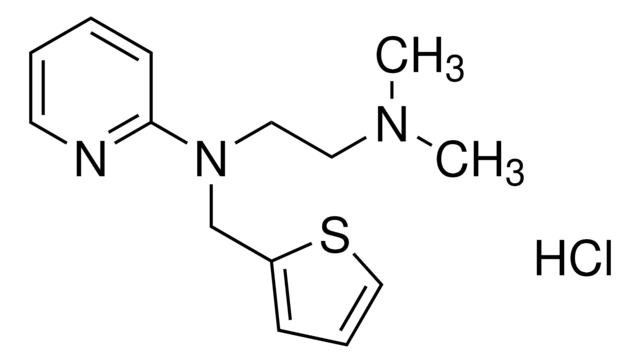
CAS Number135-23-9
SynonymsN,N-dimethyl-N'-pyridin-2-yl-N'-(thiophen-2-ylmethyl)ethane-1,2-diamine,hydrochloride; Methoxylene; EINECS 205-184-8; Methacon; Lullamin; Histadyl; Somnicaps; Barhist; Coryzol; Capathyn; MFCD00050665; METHAPYRILENE HYDROCHLORIDE; Methapyrilene HCl
Molecular FormulaC14H20ClN3S
Molecular Weight297.84700
Density1.148g/cm3
Boiling Point389.6ºC at 760 mmHg
Melting Point162°
Appearancesolid
Symbol
Signal WordWarning
| Chemical & Physical Properties | |
|---|---|
| CAS Number | 135-23-9 |
| Catalog No. | 2A-2181331 |
| Chinese Name | 盐酸美沙吡林 |
| Synonyms | N,N-dimethyl-N'-pyridin-2-yl-N'-(thiophen-2-ylmethyl)ethane-1,2-diamine,hydrochloride; Methoxylene; EINECS 205-184-8; Methacon; Lullamin; Histadyl; Somnicaps; Barhist; Coryzol; Capathyn; MFCD00050665; METHAPYRILENE HYDROCHLORIDE; Methapyrilene HCl |
| Molecular Formula | C14H20ClN3S |
| Molecular Weight | 297.84700 |
| Density | 1.148g/cm3 |
| Boiling Point | 389.6ºC at 760 mmHg |
| Melting Point | 162° |
| Appearance | solid |
| Storage Condition | room temp |
| Packaging | III |
| Application | Metypyramine (thienylpyramine) hydrochloride is an orally active H1-receptor antihistamine and pyridine anticholinergic. Methapyrine hydrochloride is hepatotoxic and can cause periportal liver necrosi |
| PubChem ID | 8149944 |
| SMILES | CN(C)CCN(Cc1cccs1)c1ccccn1.Cl |
| InChI | InChI=1S/C14H19N3S.ClH/c1-16(2)9-10-17(12-13-6-5-11-18-13)14-7-3-4-8-15-14;/h3-8,11H,9-10,12H2,1-2H3;1H |
| InChI Key | BONORRGKLJBGRV-UHFFFAOYSA-N |
| Hazard Symbols | 6.1(b) |
| Bioactivity | Methapyrilene (Thenylpyramine) hydrochloride is an orally active H1-receptor antihistamine and an anticholinergic agent of the pyridine chemical class. Methapyrilene hydrochloride has hepatotoxicity and can be used as a hepatotoxin that cause periportal hepatic necrosis in vivo[2] Related Catalog Signaling Pathways >> Immunology/Inflammation >> Histamine Receptor Research Areas >> Inflammation/Immunology Signaling Pathways >> GPCR/G Protein >> Histamine Receptor Target H1 Receptor In Vitro Methapyrilene hydrochloride (650 μM) results in a down-regulation of TF and up-regulation of FTL, while the level of HMOX1 is not changed. Additionally, the levels of CD44 and SOX9 proteins and the expression of PROM1 (CD133), hepatic stem cell-associated markers are increased[1]. Methapyrilene hydrochloride (650 μM) decreases CYP2E1, CYP3A4, NR1l3, ALB, mRNA expression and increases CD133 expression[1]. In Vivo Methapyrilene hydrochloride (oral gavage; 40 or 80 mg/kg; 5 days per week; 6 weeks) results in changes in the expression of classic hepatotoxicity-related marker genes and iron homeostasis-related genes, especially a prominent, dose-dependent down-regulation of the transferrin (Tf) gene and an up-regulation of the ferritin, light chain (FTL) gene in rats[1]. Methapyrilene hydrochloride (oral gavage; 150 mg/kg; 3 days) causes periportal liver necrosis at high dosage. Methapyrilene is sufficient to induce liver necrosis, or a subtoxic dose of 50 mg/kg/day[2]. References [1]. Iryna Kindrat, et al.Effect of methapyrilene hydrochloride on hepatic intracellular iron metabolism in vivo and in vitro. Toxicol Lett. 2017 Nov 5;281:65-73. [2]. Andrew Craig, et al. Systems toxicology: integrated genomic, proteomic and metabonomic analysis of methapyrilene induced hepatotoxicity in the rat. J Proteome Res. 2006 Jul;5(7):1586-601. [3]. Shawkat-Muhialdin Jangi, et al. H1 histamine receptor antagonists induce genotoxic and caspase-2-dependent apoptosis in human melanoma cells. Carcinogenesis. 2006 Sep;27(9):1787-96. Chemical & Physical Properties Density 1.148g/cm3 Boiling Point 389.6ºC at 760 mmHg Melting Point 162° Molecular Formula C14H20ClN3S Molecular Weight 297.84700 Flash Point 189.4ºC Exact Mass 297.10700 PSA 47.61000 LogP 3.51330 Vapour Pressure 2.82E-06mmHg at 25°C InChIKey BONORRGKLJBGRV-UHFFFAOYSA-N SMILES CN(C)CCN(Cc1cccs1)c1ccccn1.Cl Storage condition room temp |
| Use of | Methapyrilene (Thenylpyramine) hydrochloride is an orally active H1-receptor antihistamine and an anticholinergic agent of the pyridine chemical class. Methapyrilene hydrochloride has hepatotoxicity and can be used as a hepatotoxin that cause periportal hepatic necrosis in vivo[2] Properties Name methapyrilene hydrochloride Synonym More Synonyms Methapyrilene Hydrochloride Biological Activity Description Methapyrilene (Thenylpyramine) hydrochloride is an orally active H1-receptor antihistamine and an anticholinergic agent of the pyridine chemical class. Methapyrilene hydrochloride has hepatotoxicity and can be used as a hepatotoxin that cause periportal hepatic necrosis in vivo[2] Related Catalog Signaling Pathways >> Immunology/Inflammation >> Histamine Receptor Research Areas >> Inflammation/Immunology Signaling Pathways >> GPCR/G Protein >> Histamine Receptor H1 Receptor References [1]. Iryna Kindrat, et al.Effect of methapyrilene hydrochloride on hepatic intracellular iron metabolism in vivo and in vitro. Toxicol Lett. 2017 Nov 5;281:65-73. [2]. Andrew Craig, et al. Systems toxicology: integrated genomic, proteomic and metabonomic analysis of methapyrilene induced hepatotoxicity in the rat. J Proteome Res. 2006 Jul;5(7):1586-601. [3]. Shawkat-Muhialdin Jangi, et al. H1 histamine receptor antagonists induce genotoxic and caspase-2-dependent apoptosis in human melanoma cells. Carcinogenesis. 2006 Sep;27(9):1787-96. Chemical & Physical Properties Exact Mass 297.10700 PSA 47.61000 LogP 3.51330 InChIKey BONORRGKLJBGRV-UHFFFAOYSA-N Storage condition room temp |
| Transport Info | Shipping Name: UN |
| MSDS Transport Info | Module 14. Shipping information European Dangerous Regulations for land transport: 2811 International Dangerous Regulations for sea transport: 2811 International Dangerous Regulations for air transport: 2811 14.2 United Nations shipping name European Land Transport Dangerous Regulations: TOXIC SOLID, ORGANIC, N.O.S. (Methapyrilene hydrochloride) IMDG: TOXIC SOLID, ORGANIC, N.O.S. (Methapyrilene hydrochloride) International air transport hazard regulations: Toxic solid, organic, n.o.s. (Methapyrilene hydrochloride) 14.3 Transport hazard categories European Land Transport Danger Regulations: 6.1 International Maritime Transport Danger Regulations: 6.1 International Air Transport Danger Regulations: 6.1 14.4 Package group European Land Transport Danger Regulations: III International Maritime Transport Danger Regulations: III International Air Transport Danger Regulations: III 14.5 Environmental hazards European Land Transport Danger Regulations: No International Maritime Danger Regulations International Air Transport Danger Regulations: No Marine pollutants (yes/no): No 14.6 Special reminder to users No data available The above information is believed to be correct, but is not all-inclusive and should be used as a guide only. The information in this document is based on our current knowledge and is |
| Related Products in Specialty Chemicals | ||
|---|---|---|
| L-(+)-Erythrulose | 533-50-6 | 2A-2181324 |
| Butoctamide | 32838-26-9 | 2A-2181326 |
| diamfenetide | 36141-82-9 | 2A-2181327 |
| Octadecanoic acid, 10-oxo- | 4158-12-7 | 2A-2181328 |
| 4-METHYLHEXANOIC ACID | 1561-11-1 | 2A-2181330 |
| 3-NITROPROPIONIC ACID | 504-88-1 | 2A-1181333 |
| 9-oxodecanoic acid | 1422-26-0 | 2A-2181333 |
| 10-Oxoundecanoic acid | 676-00-6 | 2A-2181334 |
| 6-METHYLOCTANOIC ACID | 504-99-4 | 2A-2181337 |
| 4-[(4-chloro-2-nitrophenyl)azo]-3-hydroxy-N-(2-methylphenyl)naphthalene-2-carboxamide | 6471-50-7 | 2A-2181338 |
| Browse all Specialty Chemicals products » | ||
Phone:
630-322-8886
630-322-8887
Email:
Office Locations:
Chicago, IL, USA
San Francisco, CA, USA


 EN
EN


 SDS
SDS