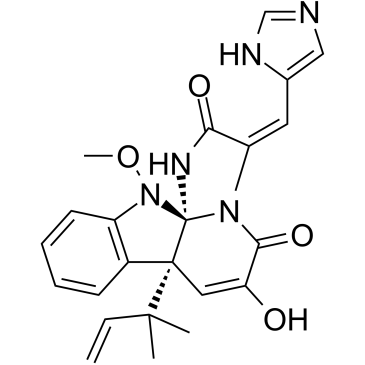
| Chemical & Physical Properties | |
|---|---|
| CAS Number | 71751-77-4 |
| Catalog No. | 2A-1177731 |
| Chinese Name | Meleagrin |
| Synonyms | 8,9-dehydroneoxaline; MELEAGRIN; Meleagrine |
| Molecular Formula | C23H23N5O4 |
| Molecular Weight | 433.46000 |
| Density | 1.47g/cm3 |
| Storage Condition | Sealed in a cool, dry environment |
| Application | Meleagri is a roquefortine C-derived alkaloid produced by the fungus Penicillium with antimicrobial and antiproliferative activity. Meleagrin is a class of FabI inhibitors. Meleagri is a major c-Met i |
| SMILES | C=CC(C)(C)C12C=C(O)C(=O)N3C(=Cc4cnc[nH]4)C(=O)NC31N(OC)c1ccccc12 |
| InChI | InChI=1S/C23H23N5O4/c1-5-21(2,3)22-11-18(29)20(31)27-17(10-14-12-24-13-25-14)19(30)26-23(22,27)28(32-4)16-9-7-6-8-15(16)22/h5-13,29H,1H2,2-4H3,(H,24,25)(H,26,30)/b17-10- |
| InChI Key | JTJJJLSLKZFEPJ-ZAYCRUKZSA-N |
| Hazard Symbols | transportation |
| Bioactivity | Meleagrin is a roquefortine C-derived alkaloid produced by fungi of the genus Penicillium and has antimicrobial and anti-proliferative activities. Meleagrin is a class of FabI inhibitor. Meleagrin is a lead c-Met inhibitory entity useful for the control of c-Met-dependent metastatic and invasive breast malignancies[1][2][3]. Related Catalog Research Areas >> Cancer Research Areas >> Infection Signaling Pathways >> Protein Tyrosine Kinase/RTK >> c-Met/HGFR Signaling Pathways >> Anti-infection >> Bacterial In Vitro Meleagrin inhibits the growth of the human breast cancer cell lines MDA-MB-231, MDA-468, BT-474, SK BR-3, MCF7 and MCF7-dox[3]. Meleagrin causes a dose-dependent inhibition of HGF-induced cell migration, and invasion of breast cancer cell lines[3]. In Vivo Meleagrin potently suppresses the invasive triple negative breast tumor cell growth in an orthotopic athymic nude mice model[3]. References [1]. Newmister SA, et al. Unveiling sequential late-stage methyltransferase reactions in the meleagrin/oxaline biosyntheticpathway. Org Biomol Chem. 2018 Sep 11;16(35):6450-6459. [2]. Zheng CJ, et al. Meleagrin, a new FabI inhibitor from Penicillium chryosogenum with at least one additional mode of action. PLoS One. 2013 Nov 28;8(11):e78922. [3]. Mady MS, et al. The indole alkaloid meleagrin, from the olive tree endophytic fungus Penicillium chrysogenum, as a novel lead for the control of c-Met-dependent breast cancer proliferation, migration and invasion. Bioorg Med Chem. 2016 Jan 15;24(2):113-22. Chemical & Physical Properties Density 1.47g/cm3 Molecular Formula C23H23N5O4 Molecular Weight 433.46000 Exact Mass 433.17500 PSA 110.79000 LogP 2.68160 Index of Refraction 1.717 InChIKey JTJJJLSLKZFEPJ-ZAYCRUKZSA-N SMILES C=CC(C)(C)C12C=C(O)C(=O)N3C(=Cc4cnc[nH]4)C(=O)NC31N(OC)c1ccccc12 |
| Use of | Meleagrin is a roquefortine C-derived alkaloid produced by fungi of the genus Penicillium and has antimicrobial and anti-proliferative activities. Meleagrin is a class of FabI inhibitor. Meleagrin is a lead c-Met inhibitory entity useful for the control of c-Met-dependent metastatic and invasive breast malignancies[1][2][3]. Properties Name meleagrine Synonym More Synonyms Meleagrin Biological Activity Description Meleagrin is a roquefortine C-derived alkaloid produced by fungi of the genus Penicillium and has antimicrobial and anti-proliferative activities. Meleagrin is a class of FabI inhibitor. Meleagrin is a lead c-Met inhibitory entity useful for the control of c-Met-dependent metastatic and invasive breast malignancies[1][2][3]. Related Catalog Research Areas >> Cancer Research Areas >> Infection Signaling Pathways >> Protein Tyrosine Kinase/RTK >> c-Met/HGFR Signaling Pathways >> Anti-infection >> Bacterial In Vitro Meleagrin inhibits the growth of the human breast cancer cell lines MDA-MB-231, MDA-468, BT-474, SK BR-3, MCF7 and MCF7-dox[3]. Meleagrin causes a dose-dependent inhibition of HGF-induced cell migration, and invasion of breast cancer cell lines[3]. In Vivo Meleagrin potently suppresses the invasive triple negative breast tumor cell growth in an orthotopic athymic nude mice model[3]. References [1]. Newmister SA, et al. Unveiling sequential late-stage methyltransferase reactions in the meleagrin/oxaline biosyntheticpathway. Org Biomol Chem. 2018 Sep 11;16(35):6450-6459. [2]. Zheng CJ, et al. Meleagrin, a new FabI inhibitor from Penicillium chryosogenum with at least one additional mode of action. PLoS One. 2013 Nov 28;8(11):e78922. [3]. Mady MS, et al. The indole alkaloid meleagrin, from the olive tree endophytic fungus Penicillium chrysogenum, as a novel lead for the control of c-Met-dependent breast cancer proliferation, migration and invasion. Bioorg Med Chem. 2016 Jan 15;24(2):113-22. Chemical & Physical Properties Molecular Formula C23H23N5O4 Exact Mass 433.17500 PSA 110.79000 LogP 2.68160 Index of Refraction 1.717 InChIKey JTJJJLSLKZFEPJ-ZAYCRUKZSA-N |
| Transport Info | Shipping Name: UN |
| MSDS Transport Info | Module 14. Shipping information European Land Transport Dangerous Regulations: -International Maritime Dangerous Regulations: -International Air Transport Dangerous Regulations: - 14.2 United Nations shipping name European Land Transport Dangerous Regulations: Non-dangerous goods IMDG Code: Non-dangerous goods International air transport dangerous goods regulations: non-dangerous goods 14.3 Transport hazard categories European Land Transport Dangerous Regulations: -International Maritime Dangerous Regulations: -International Air Transport Dangerous Regulations: - 14.4 Package group European Land Transport Dangerous Regulations: -International Maritime Dangerous Regulations: -International Air Transport Dangerous Regulations: - 14.5 Environmental hazards European Land Transport Danger Regulations: No International Maritime Danger Regulations International Air Transport Danger Regulations: No Marine pollutants (yes/no): No 14.6 Special reminder to users No data available |
| Related Products in Specialty Chemicals | ||
|---|---|---|
| GLIOTOXIN | 67-99-2 | 2A-1177726 |
| HC TOXIN | 83209-65-8 | 2A-1177727 |
| HELVOLIC ACID FROM CEPHALOSPORIUM*CAERULENS | 29400-42-8 | 2A-1177728 |
| aminopentol | 145040-09-1 | 2A-1177729 |
| N/A | 147985-10-2 | 2A-1177730 |
| 1-HYDROXYCLOBUT-1-ENE-3,4-DIONE SODIUM SALT | 71376-34-6 | 2A-1177732 |
| MYRIOCIN | 35891-70-4 | 2A-1177733 |
| NIVALENOL | 23282-20-4 | 2A-1177734 |
| OCHRATOXIN A | 303-47-9 | 2A-1177735 |
| OCHRATOXIN B | 4825-86-9 | 2A-1177736 |
| Browse all Specialty Chemicals products » | ||
Phone:
630-322-8886
630-322-8887
Email:
Office Locations:
Chicago, IL, USA
San Francisco, CA, USA


 EN
EN


 SDS
SDS