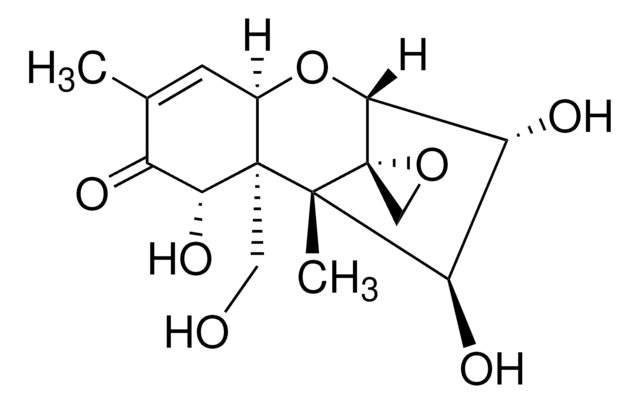
CAS Number23282-20-4
SynonymsNivalenol from Fusarium nivale; MFCD10567355; 12,13-epoxy-3,4,7,15-tetrahydroxytrichothec-9-en-8-one; Nivalenol hydrate; fusarenon-X; NIV; Nivalenol in acetonitrile; (3β,4α,7α,12ξ)-3,4,7,15-Tetrahydroxy-12,13-epoxytrichothec-9-en-8-one; nivalenol solution
Molecular FormulaC15H20O7
Molecular Weight312.32
Density1.6±0.1 g/cm3
Boiling Point585.1±50.0 °C at 760 mmHg
Melting Point222-223ºC
AppearanceWhite crystalline powder
EINECS200-835-2
Symbol
Signal WordWarning
| Chemical & Physical Properties | |
|---|---|
| CAS Number | 23282-20-4 |
| Catalog No. | 2A-1177734 |
| Chinese Name | 瓜萎镰菌醇 |
| Synonyms | Nivalenol from Fusarium nivale; MFCD10567355; 12,13-epoxy-3,4,7,15-tetrahydroxytrichothec-9-en-8-one; Nivalenol hydrate; fusarenon-X; NIV; Nivalenol in acetonitrile; (3β,4α,7α,12ξ)-3,4,7,15-Tetrahydroxy-12,13-epoxytrichothec-9-en-8-one; nivalenol solution |
| Molecular Formula | C15H20O7 |
| Molecular Weight | 312.32 |
| Density | 1.6±0.1 g/cm3 |
| Boiling Point | 585.1±50.0 °C at 760 mmHg |
| Melting Point | 222-223ºC |
| Appearance | White crystalline powder |
| Storage Condition | 2-8℃ |
| Packaging | I |
| Application | Nivalenol is a B trichotecenes toxin produced by Fusarium graminearum and is a fungal metabolite present in agricultural products. Nivalenol induces cell death through caspase-dependent mechanisms and |
| EINECS | 200-835-2 |
| HTC | 38220090 |
| PubChem ID | 329754837 |
| MDL Number | MFCD00133673 |
| SMILES | [H][C@]12O[C@]3([H])[C@H](O)[C@@H](O)[C@@](C)([C@]34CO4)[C@@]1(CO)[C@H](O)C(=O)C(C)=C2 |
| InChI | 1S/C15H20O7/c1-6-3-7-14(4-16,11(20)8(6)17)13(2)10(19)9(18)12(22-7)15(13)5-21-15/h3,7,9-12,16,18-20H,4-5H2,1-2H3/t7-,9-,10-,11-,12-,13-,14-,15+/m1/s1 |
| InChI Key | UKOTXHQERFPCBU-XBXCNEFVSA-N |
| NACRES Code | NA.24 |
| UNSPSC | 85151701 |
| Hazard Symbols | 6.1(a) |
| Bioactivity | Nivalenol, classified as type B trichotecenes toxins produced by Fusarium graminearum, is a fungal metabolite present in agricultural product[1]. Nivalenol induces cell death through caspase-dependent mechanisms and via the intrinsic apoptotic pathway. Nivalenol affects the immune system, causes emesis, growth retardation, reproductive disorders and has a haematotoxic/myelotoxic effect[2]. Related Catalog Signaling Pathways >> Apoptosis >> Apoptosis Signaling Pathways >> Apoptosis >> Caspase Research Areas >> Inflammation/Immunology Target Caspase References [1]. Bryła M, et al. Natural Occurrence of Nivalenol, Deoxynivalenol, and Deoxynivalenol-3-Glucoside in Polish Winter Wheat. Toxins (Basel). 2018 Feb 13;10(2). [2]. Aupanun S, et al. Individual and combined mycotoxins deoxynivalenol, nivalenol, and fusarenon-X induced apoptosis in lymphoid tissues of mice after oral exposure. Toxicon. 2019 Jul;165:83-94. Chemical & Physical Properties Density 1.6±0.1 g/cm3 Boiling Point 585.1±50.0 °C at 760 mmHg Melting Point 222-223ºC Molecular Formula C15H20O7 Molecular Weight 312.315 Flash Point 221.9±23.6 °C Exact Mass 312.120911 PSA 119.75000 LogP -0.75 Vapour Pressure 0.0±3.7 mmHg at 25°C Index of Refraction 1.658 InChIKey UKOTXHQERFPCBU-NLQGNSOMSA-N SMILES CC1=CC2OC3C(O)C(O)C(C)(C34CO4)C2(CO)C(O)C1=O Storage condition -20°C |
| Use of | Nivalenol, classified as type B trichotecenes toxins produced by Fusarium graminearum, is a fungal metabolite present in agricultural product[1]. Nivalenol induces cell death through caspase-dependent mechanisms and via the intrinsic apoptotic pathway. Nivalenol affects the immune system, causes emesis, growth retardation, reproductive disorders and has a haematotoxic/myelotoxic effect[2]. Properties Articles34 Name nivalenol Synonym More Synonyms Nivalenol Biological Activity Description Nivalenol, classified as type B trichotecenes toxins produced by Fusarium graminearum, is a fungal metabolite present in agricultural product[1]. Nivalenol induces cell death through caspase-dependent mechanisms and via the intrinsic apoptotic pathway. Nivalenol affects the immune system, causes emesis, growth retardation, reproductive disorders and has a haematotoxic/myelotoxic effect[2]. Related Catalog Signaling Pathways >> Apoptosis >> Apoptosis Signaling Pathways >> Apoptosis >> Caspase Research Areas >> Inflammation/Immunology References [1]. Bryła M, et al. Natural Occurrence of Nivalenol, Deoxynivalenol, and Deoxynivalenol-3-Glucoside in Polish Winter Wheat. Toxins (Basel). 2018 Feb 13;10(2). [2]. Aupanun S, et al. Individual and combined mycotoxins deoxynivalenol, nivalenol, and fusarenon-X induced apoptosis in lymphoid tissues of mice after oral exposure. Toxicon. 2019 Jul;165:83-94. Chemical & Physical Properties Molecular Formula C15H20O7 Exact Mass 312.120911 PSA 119.75000 LogP -0.75 Index of Refraction 1.658 InChIKey UKOTXHQERFPCBU-NLQGNSOMSA-N |
| Transport Info | Shipping Name: UN |
| MSDS Transport Info | Module 14. Shipping information 14.1 UN dangerous goods number European Dangerous Regulations for land transport: 2811 International Dangerous Regulations for sea transport: 2811 International Dangerous Regulations for air transport: 2811 14.2 United Nations shipping name European land transport hazard regulations: TOXIC SOLID, ORGANIC, N.O.S. (Nivalenol hydrate) IMDG: TOXIC SOLID, ORGANIC, N.O.S. (Nivalenol hydrate) International air transport hazard regulations: Toxic solid, organic, n.o.s. (Nivalenol hydrate) 14.3 Transport hazard categories European Land Transport Danger Regulations: 6.1 International Maritime Transport Danger Regulations: 6.1 International Air Transport Danger Regulations: 6.1 14.4 Package group European Dangerous Regulations for land transport: I International Dangerous Regulations for sea transport: I International Dangerous Regulations for air transport: I 14.5 Environmental hazards European Land Transport Danger Regulations: No International Maritime Danger Regulations International Air Transport Danger Regulations: No Marine pollutants (yes/no): No 14.6 Special reminder to users No data available |
| Related Products in Specialty Chemicals | ||
|---|---|---|
| aminopentol | 145040-09-1 | 2A-1177729 |
| N/A | 147985-10-2 | 2A-1177730 |
| MELEAGRIN | 71751-77-4 | 2A-1177731 |
| 1-HYDROXYCLOBUT-1-ENE-3,4-DIONE SODIUM SALT | 71376-34-6 | 2A-1177732 |
| MYRIOCIN | 35891-70-4 | 2A-1177733 |
| OCHRATOXIN A | 303-47-9 | 2A-1177735 |
| OCHRATOXIN B | 4825-86-9 | 2A-1177736 |
| ROQUEFORTINE C | 58735-64-1 | 2A-1177737 |
| T-2 TETRAOL | 34114-99-3 | 2A-1177738 |
| 3-ACETYL-5-SEC-BUTYL-4-HYDROXY-3-PYRROLIN-2-ONE COPPER SALT | 12427-40-6 | 2A-1177739 |
| Browse all Specialty Chemicals products » | ||
Phone:
630-322-8886
630-322-8887
Email:
Office Locations:
Chicago, IL, USA
San Francisco, CA, USA


 EN
EN


 SDS
SDS