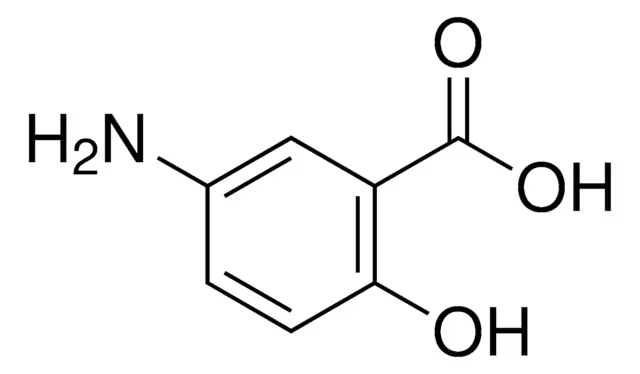
CAS Number89-57-6
Synonyms5-Aminosalicylic Acid; Mesalamine; 5-AMINOSALICILIC ACID; 5-AMINO SALICYLIC ACID; Mesalamine (Lialda); Bactylan; Pasalon-rakeet; 5-amino-2-hydroxybenzoic acid; Tubersan; Salvis; Paracipan; EINECS 201-919-1; 4-Amino-2-hydroxybenzoic acid; MFCD00007877; Sanipirol; Lepasen; PASA; 2-Cyanobenzoic acid; Pasmicina; Rezipas; ZR CQ DVQ; Passodico; 5-Aminosalicylicacid; 5-AMINOSALICYLIC ACID (MESALAZINE); 5-Aminosalicglic acid; Mesalazine; Aminosalicylic Acid; 5-AMINOSALICYLIC ACID , CRM STANDARD; Aminacyl; Paser
Molecular FormulaH2NC6H3-2-(OH)CO2H
Molecular Weight153.14
Purity≥99%
Density1.5±0.1 g/cm3
Boiling Point380.8±32.0 °C at 760 mmHg
Melting Point275-280 °C (dec.) (lit.)
Appearancepowder
EINECS201-919-1
Symbol
Signal WordWarning
| Chemical & Physical Properties | |
|---|---|
| CAS Number | 89-57-6 |
| Catalog No. | 2A-9017615 |
| Chinese Name | 5-氨基水杨酸 |
| Synonyms | 5-Aminosalicylic Acid; Mesalamine; 5-AMINOSALICILIC ACID; 5-AMINO SALICYLIC ACID; Mesalamine (Lialda); Bactylan; Pasalon-rakeet; 5-amino-2-hydroxybenzoic acid; Tubersan; Salvis; Paracipan; EINECS 201-919-1; 4-Amino-2-hydroxybenzoic acid; MFCD00007877; Sanipirol; Lepasen; PASA; 2-Cyanobenzoic acid; Pasmicina; Rezipas; ZR CQ DVQ; Passodico; 5-Aminosalicylicacid; 5-AMINOSALICYLIC ACID (MESALAZINE); 5-Aminosalicglic acid; Mesalazine; Aminosalicylic Acid; 5-AMINOSALICYLIC ACID , CRM STANDARD; Aminacyl; Paser |
| Molecular Formula | H2NC6H3-2-(OH)CO2H |
| Molecular Weight | 153.14 |
| Purity | ≥99 |
| Density | 1.5±0.1 g/cm3 |
| Boiling Point | 380.8±32.0 °C at 760 mmHg |
| Melting Point | 275-280 °C (dec.) (lit.) |
| Appearance | powder |
| Water Solubility | <0.1 g/100 mL at 21 ºC |
| Storage Condition | This product should be sealed and stored at 4℃. |
| Application | 5-Aminosalicylic acid is a specific PPARγ agonist and also inhibits p21-activated kinase 1 (PAK1) and NF-κB. |
| EINECS | 201-919-1 |
| HTC | 29225000 |
| PubChem ID | 24890780 |
| MDL Number | MFCD00007877 |
| SMILES | Nc1ccc(O)c(c1)C(O)=O |
| InChI | 1S/C7H7NO3/c8-4-1-2-6(9)5(3-4)7(10)11/h1-3,9H,8H2,(H,10,11) |
| InChI Key | KBOPZPXVLCULAV-UHFFFAOYSA-N |
| Beilstein/REAXYS | 2090421 |
| NACRES Code | NA.83 |
| UNSPSC | 12352204 |
| Hazard Symbols | Transport |
| MSDS | msds/17615_1_89_57_6.pdf |
| Bioactivity | 5-Aminosalicylic acid acts as a specific PPARγ agonist and also inhibits p21-activated kinase 1 (PAK1) and NF-κB. Related Catalog Signaling Pathways >> Cell Cycle/DNA Damage >> PAK Signaling Pathways >> Cytoskeleton >> PAK Research Areas >> Inflammation/Immunology Target PPARγ PAK1 p65 In Vitro 5-Aminosalicylic acid (5-ASA) is a specific agonist for PPARγ, and only PPARγ but not PPARα or PPARδ induces p65 degradation. 5-Aminosalicylic acid induces degradation of p65 protein indicative of PPARγ's E3 ubiquitin ligase activity. 5-Aminosalicylic acid also inhibits PAK1 at the mRNA level which is suggestive of an additional mechanism independent of PPARγ ligand activation. 5-Aminosalicylic acid blocks NF-κB in intestinal epithelial cells (IECs) through inhibition of PAK1[1]. Pretreatment with 5-Aminosalicylic acid (5-ASA) or Nimesulide at different concentration (10-1000 μmol/L) for 12-96 h, inhibits the growth of HT-29 colon carcinoma cells in a dose and time-dependent manner. However, the suppression of 5-Aminosalicylic acid or Nimesulide has no statistical significance. The growth of HT-29 colon carcinoma cells is inhibited dose-dependently when pretreated with different doses of combined 5-Aminosalicylic acid and Nimesulide. Combined 5-Aminosalicylic acid (final concentration 100 μM) and Nimesulide (final concentration 10-1000 μM) inhibits the proliferation of HT-29 colon carcinoma cells in a dose-dependent manner, being more potent than corresponding dose of Nimesulide. Similarly, combined Nimesulide (final concentration 100 μM) and 5-Aminosalicylic acid (final concentration 10-1000 μM) also inhibits the proliferation of these cells dose-dependently, being more potent than corresponding dose of 5-Aminosalicylic acid[2]. In Vivo 5-Aminosalicylic acid (5-ASA) has an antineoplastic effect in a xenograft tumor model. To evaluate the in vivo antineoplasic effect of 5-Aminosalicylic acid, SCID mice engrafted with HT-29 colon cancer cells are treated daily for 21 consecutive days with 5-Aminosalicylic acid at 50 mM. At the end of the treatment, a reduction of 80-86% of tumor weight and volume is observed in SCID mice receiving 5-Aminosalicylic acid compared with control mice or mice treated with GW9662 alone. The antineoplastic effect of 5-Aminosalicylic acid is already detectable after 10 days of 5-Aminosalicylic acid treatment. Similar results are obtained with mice treated with 5-Aminosalicylic acid at 5 mM. Antitumorigenic effect of 5-Aminosalicylic acid is completely abolished at 21 days by simultaneous intraperitoneal administration of GW9662. Thus, the observed antineoplastic effect of 5-Aminosalicylic acid is at least partially dependent on PPARγ[3]. Cell Assay Cytostatic effects are measured by MTT assay. HT-29 colon carcinoma cells are detached with a 0.25% trypsin solution for 5 min. Subsequently, the cells are seeded onto 96-well plates (1×10⁶ cells/well), supplemented with 10% FCS and allowed to attach for 24 h before the addition of test compounds (5-Aminosalicylic acid 10, 50, 100, 500, and 1000 μM; Nimesulide; and their combination). Test compounds are diluted in serum-free culture medium. Then the cells are incubated in a medium or at different concentrations of drugs for 48 h, 20 μL of MTT solution (5 g/L) in PBS is added. Four hours later, the medium in each well is removed, and 120 μL of 0.04 mM muriatic isopropanol is added, slightly concussed for 10 min. Dye uptake is measured at 490 nm with an ELISA reader. Five wells are used for each concentration or as a control group. On the other hand, the cells are seeded onto 96-well plates (1×10⁶ cells/well) and allowed to attach for 24 h, then treated with test compounds (5-Aminosalicylic acid, Nimesulide, and their combination). The final concentration is 100 μM. The same medium is added into the control group and dye uptake is then measured. Five wells are used for each test compound or control group[2]. Animal Admin Mice[3] Six to seven weeks old pathogen-free BALB/c SCID mice are used. Human colon cancer cells (107 HT-29 cells) pretreated or not with GW9662 for 24 h are implanted subcutaneously in the flank of animals. Two days after cell inoculation, mice are treated with 5-Aminosalicylic acid (5 or 50 mM) administered daily by peritumoral injection for 10 or 21 days. The effect of PPARγ during 5-Aminosalicylic acid treatment is evaluated by daily intraperitoneal injection of GW9662 (1 mg/kg/day). The control group receives saline instead of 5-Aminosalicylic acid. Mice are checked three times a week for tumor development. After killing at 10 or 21 days, tumor size and volume are calculated. Tumors are weighted before paraffin embedding for histological examination. References [1]. Dammann K, et al. PAK1 modulates a PPARγ/NF-κB cascade in intestinal inflammation. Biochim Biophys Acta. 2015 Oct;1853(10 Pt A):2349-60. [2]. Fang HM, et al. 5-aminosalicylic acid in combination with Nimesulide inhibits proliferation of colon carcinoma cells in vitro. World J Gastroenterol. 2007 May 28;13(20):2872-7. [3]. Rousseaux C, et al. The 5-aminosalicylic acid antineoplastic effect in the intestine is mediated by PPARγ. Carcinogenesis. 2013 Nov;34(11):2580-6. Chemical & Physical Properties Density 1.5±0.1 g/cm3 Boiling Point 380.8±32.0 °C at 760 mmHg Melting Point 275-280 °C (dec.)(lit.) Molecular Formula C7H7NO3 Molecular Weight 153.135 Flash Point 184.1±25.1 °C Exact Mass 153.042587 PSA 83.55000 LogP 1.14 Vapour Pressure 0.0±0.9 mmHg at 25°C Index of Refraction 1.691 InChIKey KBOPZPXVLCULAV-UHFFFAOYSA-N SMILES Nc1ccc(O)c(C(=O)O)c1 Water Solubility <0.1 g/100 mL at 21 ºC |
| Use of | 5-Aminosalicylic acid acts as a specific PPARγ agonist and also inhibits p21-activated kinase 1 (PAK1) and NF-κB. Properties Articles154 Name mesalamine Synonym More Synonyms 5-Aminosalicylic Acid Biological Activity Description 5-Aminosalicylic acid acts as a specific PPARγ agonist and also inhibits p21-activated kinase 1 (PAK1) and NF-κB. Related Catalog Signaling Pathways >> Cell Cycle/DNA Damage >> PAK Signaling Pathways >> Cytoskeleton >> PAK Research Areas >> Inflammation/Immunology References [2]. Fang HM, et al. 5-aminosalicylic acid in combination with Nimesulide inhibits proliferation of colon carcinoma cells in vitro. World J Gastroenterol. 2007 May 28;13(20):2872-7. [3]. Rousseaux C, et al. The 5-aminosalicylic acid antineoplastic effect in the intestine is mediated by PPARγ. Carcinogenesis. 2013 Nov;34(11):2580-6. Chemical & Physical Properties Molecular Formula C7H7NO3 Exact Mass 153.042587 PSA 83.55000 Index of Refraction 1.691 InChIKey KBOPZPXVLCULAV-UHFFFAOYSA-N |
| Tax Rebate | 13.0% |
| Supervision | A. Customs clearance form for inbound goods B. Customs clearance form for outbound goods |
| Inspection | R. Hygiene supervision and inspection of imported food S. Hygiene supervision and inspection of exported food |
| Transport Info | Shipping Name: UN |
| MSDS Transport Info | Module 14. Shipping information 14.1 UN dangerous goods number European Land Transport Dangerous Regulations: -International Maritime Dangerous Regulations: -International Air Transport Dangerous Regulations: - 14.2 United Nations shipping name European Land Transport Dangerous Regulations: Non-dangerous goods IMDG Code: Non-dangerous goods International air transport dangerous goods regulations: non-dangerous goods 14.3 Transport hazard categories European Land Transport Dangerous Regulations: -International Maritime Dangerous Regulations: -International Air Transport Dangerous Regulations: - 14.4 Package group European Land Transport Dangerous Regulations: -International Maritime Dangerous Regulations: -International Air Transport Dangerous Regulations: - 14.5 Environmental hazards European Land Transport Danger Regulations: No International Maritime Danger Regulations International Air Transport Danger Regulations: No Marine pollutants (yes/no): No 14.6 Special reminder to users No data available |
| Related Products in Specialty Chemicals | ||
|---|---|---|
| 5-Phenylhydantoin | 89-24-7 | 2A-9017600 |
| 4-Methoxy-3-nitrobenzoic acid | 89-41-8 | 2A-9017607 |
| N-Acetylanthranilic acid | 89-52-1 | 2A-9017611 |
| 5-Amino-2-chlorobenzoic acid | 89-54-3 | 2A-9017612 |
| 5-Bromosalicylic acid | 89-55-4 | 2A-0201446 |
| 4-Methyl-2-nitroaniline | 89-62-3 | 2A-9017620 |
| Methyl o-toluate | 89-71-4 | 2A-9017626 |
| 2-sec-Butylphenol | 89-72-5 | 2A-9017627 |
| Salicylhydroxamic acid | 89-73-6 | 2A-9017628 |
| Menthone | 89-80-5 | 2A-9017633 |
| Browse all Specialty Chemicals products » | ||
Phone:
630-322-8886
630-322-8887
Email:
Office Locations:
Chicago, IL, USA
San Francisco, CA, USA


 EN
EN


 SDS
SDS