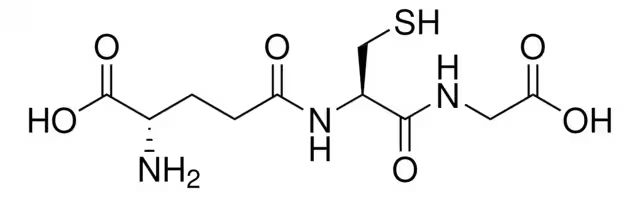
CAS Number70-18-8
SynonymsL-Glutathione Reduced; Tathion; Deltathione; L-γ-Glutamyl-L-cysteinylglycine; Copren; Isethion; Glutathione reduced; GSH; Glutathione; Reduced glutathione; (2S)-2-amino-5-[[(2R)-1-(carboxymethylamino)-1-oxo-3-sulfanylpropan-2-yl]amino]-5-oxopentanoic acid; L-γ-Glutamyl-L-cysteiylglycin; Glutathiol; MFCD00065939; EINECS 200-725-4; Glutathione-SH; N-(N-L-g-Glutamyl-L-cysteinyl)glycine; Glutinal; L-Glutathione; γ-glutamyl-cysteinyl-glycine
Molecular FormulaH2NCH(CO2H)CH2CH2CONHCH(CH2SH)CONHCH2CO2H
Molecular Weight307.32
Purity≥98.0%
Density1.4±0.1 g/cm3
Boiling Point754.5±60.0 °C at 760 mmHg
Melting Point192-195 °C (dec.) (lit.)
Appearancepowder
EINECS200-725-4
Symbol
Signal WordWarning
| Chemical & Physical Properties | |
|---|---|
| CAS Number | 70-18-8 |
| Catalog No. | 2A-9016997 |
| Chinese Name | 谷胱甘肽/5-L-谷氨酰-L-半胱氨酰甘氨酸 |
| Synonyms | L-Glutathione Reduced; Tathion; Deltathione; L-γ-Glutamyl-L-cysteinylglycine; Copren; Isethion; Glutathione reduced; GSH; Glutathione; Reduced glutathione; (2S)-2-amino-5-[[(2R)-1-(carboxymethylamino)-1-oxo-3-sulfanylpropan-2-yl]amino]-5-oxopentanoic acid; L-γ-Glutamyl-L-cysteiylglycin; Glutathiol; MFCD00065939; EINECS 200-725-4; Glutathione-SH; N-(N-L-g-Glutamyl-L-cysteinyl)glycine; Glutinal; L-Glutathione; γ-glutamyl-cysteinyl-glycine |
| Molecular Formula | H2NCH(CO2H)CH2CH2CONHCH(CH2SH)CONHCH2CO2H |
| Molecular Weight | 307.32 |
| Purity | ≥98.0 |
| Density | 1.4±0.1 g/cm3 |
| Boiling Point | 754.5±60.0 °C at 760 mmHg |
| Melting Point | 192-195 °C (dec.) (lit.) |
| Appearance | powder |
| Storage Condition | This product should be kept sealed. Storage temper |
| Application | L-Glutathione reduced (GSH; γ-L-Glutamyl-L-cysteinyl-glycine) is an endogenous antioxidant that can scavenge oxygen free radicals. |
| EINECS | 200-725-4 |
| HTC | 2930909090 |
| PubChem ID | 24895241 |
| MDL Number | MFCD00065939 |
| SMILES | N[C@@H](CCC(=O)N[C@@H](CS)C(=O)NCC(O)=O)C(O)=O |
| InChI | 1S/C10H17N3O6S/c11-5(10(18)19)1-2-7(14)13-6(4-20)9(17)12-3-8(15)16/h5-6,20H,1-4,11H2,(H,12,17)(H,13,14)(H,15,16)(H,18,19)/t5-,6-/m0/s1 |
| InChI Key | RWSXRVCMGQZWBV-WDSKDSINSA-N |
| Beilstein/REAXYS | 1729812 |
| NACRES Code | NA.26 |
| UNSPSC | 12352209 |
| Hazard Symbols | Transport |
| MSDS | msds/16997_1_70_18_8.pdf |
| Bioactivity | L-Glutathione reduced (GSH; γ-L-Glutamyl-L-cysteinyl-glycine) is an endogenous antioxidant and is capable of scavenging oxygen-derived free radicals. Related Catalog Research Areas >> Cardiovascular Disease Research Areas >> Inflammation/Immunology Biochemical Assay Reagents Research Areas >> Cancer Research Areas >> Neurological Disease Natural Products >> Others Target Human Endogenous Metabolite In Vitro L-Glutathione reduced is a non-protein thiol widely exists in living cells. L-Glutathione reduced plays important biological functions in the organism, including protein and DNA synthesis, enzyme activity, metabolism and cell protection. L-Glutathione reduced is capable of scavenging oxygen-derived free radicals and is established to be a marker of oxidative stress[1]. References [1]. Pereira-Rodrigues N, et al. Electrocatalytic activity of cobalt phthalocyanine CoPc adsorbed on a graphite electrode for the oxidation of reduced L-glutathione (GSH) and the reduction of its disulfide (GSSG) at physiological pH. Bioelectrochemistry. 2007 Jan;70(1):147-54. Chemical & Physical Properties Density 1.4±0.1 g/cm3 Boiling Point 754.5±60.0 °C at 760 mmHg Melting Point 182-192ºC Molecular Formula C10H17N3O6S Molecular Weight 307.323 Flash Point 410.1±32.9 °C Exact Mass 307.083801 PSA 197.62000 LogP -0.87 Vapour Pressure 0.0±5.5 mmHg at 25°C Index of Refraction 1.572 InChIKey RWSXRVCMGQZWBV-WDSKDSINSA-N SMILES NC(CCC(=O)NC(CS)C(=O)NCC(=O)O)C(=O)O |
| Use of | L-Glutathione reduced (GSH; γ-L-Glutamyl-L-cysteinyl-glycine) is an endogenous antioxidant and is capable of scavenging oxygen-derived free radicals. Properties Articles2087 Name Glutathione Synonym More Synonyms Glutathione Biological Activity Description L-Glutathione reduced (GSH; γ-L-Glutamyl-L-cysteinyl-glycine) is an endogenous antioxidant and is capable of scavenging oxygen-derived free radicals. Related Catalog Research Areas >> Cardiovascular Disease Research Areas >> Inflammation/Immunology Biochemical Assay Reagents Research Areas >> Cancer Research Areas >> Neurological Disease Natural Products >> Others Human Endogenous Metabolite In Vitro L-Glutathione reduced is a non-protein thiol widely exists in living cells. L-Glutathione reduced plays important biological functions in the organism, including protein and DNA synthesis, enzyme activity, metabolism and cell protection. L-Glutathione reduced is capable of scavenging oxygen-derived free radicals and is established to be a marker of oxidative stress[1]. References [1]. Pereira-Rodrigues N, et al. Electrocatalytic activity of cobalt phthalocyanine CoPc adsorbed on a graphite electrode for the oxidation of reduced L-glutathione (GSH) and the reduction of its disulfide (GSSG) at physiological pH. Bioelectrochemistry. 2007 Jan;70(1):147-54. Chemical & Physical Properties Molecular Formula C10H17N3O6S Exact Mass 307.083801 PSA 197.62000 LogP -0.87 Index of Refraction 1.572 InChIKey RWSXRVCMGQZWBV-WDSKDSINSA-N SMILES NC(CCC(=O)NC(CS)C(=O)NCC(=O)O)C(=O)O |
| Tax Rebate | 13.0% |
| Supervision | None. MFN tariff: 6.5%. Ordinary tariff: 30.0% |
| Transport Info | Shipping Name: UN |
| MSDS Transport Info | Module 14. Shipping information 14.1 UN dangerous goods number European Land Transport Dangerous Regulations: -International Maritime Dangerous Regulations: -International Air Transport Dangerous Regulations: - 14.2 United Nations shipping name European Land Transport Dangerous Regulations: Non-dangerous goods IMDG Code: Non-dangerous goods International air transport dangerous goods regulations: non-dangerous goods 14.3 Transport hazard categories European Land Transport Dangerous Regulations: -International Maritime Dangerous Regulations: -International Air Transport Dangerous Regulations: - 14.4 Package group European Land Transport Dangerous Regulations: -International Maritime Dangerous Regulations: -International Air Transport Dangerous Regulations: - 14.5 Environmental hazards European Land Transport Danger Regulations: No International Maritime Danger Regulations International Air Transport Danger Regulations: No Marine pollutants (yes/no): No 14.6 Special reminder to users No data available |
| Related Products in Specialty Chemicals | ||
|---|---|---|
| Maltose | 69-79-4 | 2A-0202342 |
| Carbazochrome | 69-81-8 | 2A-9016991 |
| Mephenoxalone | 70-07-5 | 2A-9016994 |
| 6-Chloro-1,2-benzisothiazol-3(2H)-one | 70-10-0 | 2A-9016995 |
| 2-Bromoacetophenone | 70-11-1 | 2A-9016996 |
| 1-Methyl-3-nitro-1-nitrosoguanidine | 70-25-7 | 2A-9016999 |
| Hexachlorophene | 70-30-4 | 2A-9017001 |
| L-Asparagine | 70-47-3 | 2A-9017003 |
| Mercaptosuccinic acid | 70-49-5 | 2A-9017004 |
| DL-Lysine monohydrochloride | 70-53-1 | 2A-9017006 |
| Browse all Specialty Chemicals products » | ||
Phone:
630-322-8886
630-322-8887
Email:
Office Locations:
Chicago, IL, USA
San Francisco, CA, USA


 EN
EN


 SDS
SDS