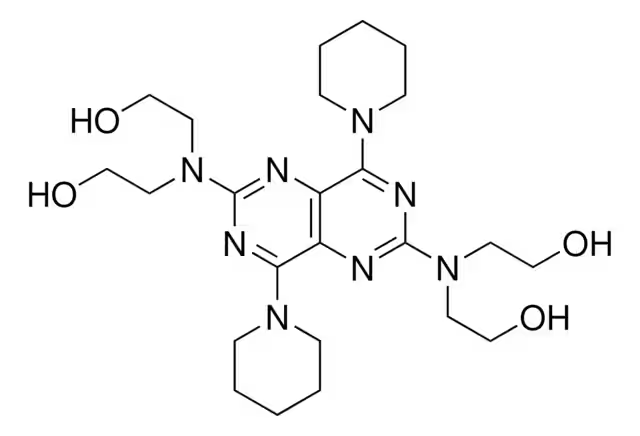
CAS Number58-32-2
Synonyms2,2',2'',2'''-[(4,8-Dipiperidin-1-ylpyrimido[5,4-d]pyrimidin-2,6-diyl)dinitrilo]tetraethanol; RA 8; Piroan; EINECS 200-374-7; Dipyridamole; Coridil; Dypyridamole; Apricor; Anginal; Natyl; 2,2',2'',2'''-{[4,8-Di(piperidin-1-yl)pyrimido[5,4-d]pyrimidine-2,6-diyl]dinitrilo}tetraethanol; 2,2',2'',2'''-{[4,8-Di(1-piperidinyl)pyrimido[5,4-d]pyrimidine-2,6-diyl]dinitrilo}tetraethanol; Corosan; Coroxin; MFCD00010555; Coribon
Molecular FormulaC24H40N8O4
Molecular Weight504.63
Purity≥98 (HPLC)%
Density1.4±0.1 g/cm3
Boiling Point806.5±75.0 °C at 760 mmHg
Melting Point165-166 °C (lit.)
Appearancepowder
EINECS200-374-7
Symbol
Signal WordWarning
| Chemical & Physical Properties | |
|---|---|
| CAS Number | 58-32-2 |
| Catalog No. | 2A-9016774 |
| Chinese Name | 双嘧达莫 |
| Synonyms | 2,2',2'',2'''-[(4,8-Dipiperidin-1-ylpyrimido[5,4-d]pyrimidin-2,6-diyl)dinitrilo]tetraethanol; RA 8; Piroan; EINECS 200-374-7; Dipyridamole; Coridil; Dypyridamole; Apricor; Anginal; Natyl; 2,2',2'',2'''-{[4,8-Di(piperidin-1-yl)pyrimido[5,4-d]pyrimidine-2,6-diyl]dinitrilo}tetraethanol; 2,2',2'',2'''-{[4,8-Di(1-piperidinyl)pyrimido[5,4-d]pyrimidine-2,6-diyl]dinitrilo}tetraethanol; Corosan; Coroxin; MFCD00010555; Coribon |
| Molecular Formula | C24H40N8O4 |
| Molecular Weight | 504.63 |
| Purity | ≥98 (HPLC) |
| Density | 1.4±0.1 g/cm3 |
| Boiling Point | 806.5±75.0 °C at 760 mmHg |
| Melting Point | 165-166 °C (lit.) |
| Appearance | powder |
| Water Solubility | DMSO: soluble |
| Storage Condition | This product should be sealed and stored dry and b |
| Application | Dipyridamole (Persantine) is a phosphodiesterase inhibitor that blocks the absorption and metabolism of adenosine by red blood cells and vascular endothelial cells. |
| EINECS | 200-374-7 |
| HTC | 2933990090 |
| PubChem ID | 24277705 |
| MDL Number | MFCD00010555 |
| SMILES | OCCN(CCO)c1nc(N2CCCCC2)c3nc(nc(N4CCCCC4)c3n1)N(CCO)CCO |
| InChI | 1S/C24H40N8O4/c33-15-11-31(12-16-34)23-26-20-19(21(27-23)29-7-3-1-4-8-29)25-24(32(13-17-35)14-18-36)28-22(20)30-9-5-2-6-10-30/h33-36H,1-18H2 |
| InChI Key | IZEKFCXSFNUWAM-UHFFFAOYSA-N |
| NACRES Code | NA.77 |
| UNSPSC | 41106305 |
| Hazard Symbols | Transport |
| Risk Codes | R36/37/38 |
| Safety Description | S26;S36 |
| MSDS | msds/16774_1_58_32_2.pdf |
| Bioactivity | Dipyridamole (Persantine) is a phosphodiesterase inhibitor that blocks uptake and metabolism of adenosine by erythrocytes and vascular endothelial cells.Target: Phosphodiesterase (PDE)Dipyridamole concentrations of 1 nmol/ml blood caused 90% inhibition of adenosine metabolism. Dipyridamole at therapeutic concentrations causes significant inhibition of adenosine metabolism in whole blood [1]. Dipyridamole has a dose-dependent inhibitory effect on thromboxane synthesis which was independent of aggregation. Dipyridamole also inhibited malonyldialdehyde production in response to both thrombin and arachidonic acid [2]. Dipyridamole enhances platelet inhibition by amplifying the signaling of the NO donor sodium nitroprusside. These data support the concept that enhancement of endothelium-dependent NO/cGMP-mediated signaling may be an important in vivo component of dipyridamole action [3]. Related Catalog Signaling Pathways >> Metabolic Enzyme/Protease >> Phosphodiesterase (PDE) Research Areas >> Cardiovascular Disease References [1]. Klabunde, R.E., Dipyridamole inhibition of adenosine metabolism in human blood. Eur J Pharmacol, 1983. 93(1-2): p. 21-6. [2]. Best, L.C., et al., Mode of action of dipyridamole on human platelets. Thromb Res, 1979. 16(3-4): p. 367-79. [3]. Aktas, B., et al., Dipyridamole enhances NO/cGMP-mediated vasodilator-stimulated phosphoprotein phosphorylation and signaling in human platelets: in vitro and in vivo/ex vivo studies. Stroke, 2003. 34(3): p. 764-9. Chemical & Physical Properties Density 1.4±0.1 g/cm3 Boiling Point 806.5±75.0 °C at 760 mmHg Melting Point 165-166ºC Molecular Formula C24H40N8O4 Molecular Weight 504.626 Flash Point 441.5±37.1 °C Exact Mass 504.317261 PSA 145.44000 LogP -1.22 Vapour Pressure 0.0±3.0 mmHg at 25°C Index of Refraction 1.670 InChIKey IZEKFCXSFNUWAM-UHFFFAOYSA-N SMILES OCCN(CCO)c1nc(N2CCCCC2)c2nc(N(CCO)CCO)nc(N3CCCCC3)c2n1 Storage condition −20°C Water Solubility DMSO: soluble |
| Use of | Dipyridamole (Persantine) is a phosphodiesterase inhibitor that blocks uptake and metabolism of adenosine by erythrocytes and vascular endothelial cells.Target: Phosphodiesterase (PDE)Dipyridamole concentrations of 1 nmol/ml blood caused 90% inhibition of adenosine metabolism. Dipyridamole at therapeutic concentrations causes significant inhibition of adenosine metabolism in whole blood [1]. Dipyridamole has a dose-dependent inhibitory effect on thromboxane synthesis which was independent of aggregation. Dipyridamole also inhibited malonyldialdehyde production in response to both thrombin and arachidonic acid [2]. Dipyridamole enhances platelet inhibition by amplifying the signaling of the NO donor sodium nitroprusside. These data support the concept that enhancement of endothelium-dependent NO/cGMP-mediated signaling may be an important in vivo component of dipyridamole action [3]. Properties Articles119 Name dipyridamole Synonym More Synonyms Dipyridamole Biological Activity Description Dipyridamole (Persantine) is a phosphodiesterase inhibitor that blocks uptake and metabolism of adenosine by erythrocytes and vascular endothelial cells.Target: Phosphodiesterase (PDE)Dipyridamole concentrations of 1 nmol/ml blood caused 90% inhibition of adenosine metabolism. Dipyridamole at therapeutic concentrations causes significant inhibition of adenosine metabolism in whole blood [1]. Dipyridamole has a dose-dependent inhibitory effect on thromboxane synthesis which was independent of aggregation. Dipyridamole also inhibited malonyldialdehyde production in response to both thrombin and arachidonic acid [2]. Dipyridamole enhances platelet inhibition by amplifying the signaling of the NO donor sodium nitroprusside. These data support the concept that enhancement of endothelium-dependent NO/cGMP-mediated signaling may be an important in vivo component of dipyridamole action [3]. Related Catalog Signaling Pathways >> Metabolic Enzyme/Protease >> Phosphodiesterase (PDE) Research Areas >> Cardiovascular Disease References [1]. Klabunde, R.E., Dipyridamole inhibition of adenosine metabolism in human blood. Eur J Pharmacol, 1983. 93(1-2): p. 21-6. [2]. Best, L.C., et al., Mode of action of dipyridamole on human platelets. Thromb Res, 1979. 16(3-4): p. 367-79. [3]. Aktas, B., et al., Dipyridamole enhances NO/cGMP-mediated vasodilator-stimulated phosphoprotein phosphorylation and signaling in human platelets: in vitro and in vivo/ex vivo studies. Stroke, 2003. 34(3): p. 764-9. Chemical & Physical Properties Molecular Formula C24H40N8O4 Exact Mass 504.317261 PSA 145.44000 LogP -1.22 Index of Refraction 1.670 InChIKey IZEKFCXSFNUWAM-UHFFFAOYSA-N Water Solubility DMSO: soluble |
| Tax Rebate | 13.0% |
| Supervision | None. MFN tariff: 6.5%. Ordinary tariff: 20.0% |
| Transport Info | Shipping Name: UN |
| MSDS Transport Info | Module 14. Shipping information 14.1 UN dangerous goods number European Land Transport Dangerous Regulations: -International Maritime Dangerous Regulations: -International Air Transport Dangerous Regulations: - 14.2 United Nations shipping name European Land Transport Dangerous Regulations: Non-dangerous goods IMDG Code: Non-dangerous goods International air transport dangerous goods regulations: non-dangerous goods 14.3 Transport hazard categories European Land Transport Dangerous Regulations: -International Maritime Dangerous Regulations: -International Air Transport Dangerous Regulations: - 14.4 Package group European Land Transport Dangerous Regulations: -International Maritime Dangerous Regulations: -International Air Transport Dangerous Regulations: - 14.5 Environmental hazards European Land Transport Danger Regulations: No International Maritime Danger Regulations International Air Transport Danger Regulations: No Marine pollutants (yes/no): No 14.6 Special reminder to users No data available |
| Related Products in Specialty Chemicals | ||
|---|---|---|
| 2-Oxetanone | 57-57-8 | 2A-9016749 |
| Sulfamethazine | 57-68-1 | 2A-9016754 |
| 7,12-Dimethylbenz[a]anthracene | 57-97-6 | 2A-9016763 |
| Pyrimethamine | 58-14-0 | 2A-9016766 |
| Aminophenazone | 58-15-1 | 2A-9016767 |
| 10,10-Oxybisphenoxarsine | 58-36-6 | 2A-9016776 |
| Aminopromazine | 58-37-7 | 2A-9016777 |
| Promazine | 58-40-2 | 2A-9016779 |
| Tetrabenazine | 58-46-8 | 2A-9016780 |
| Angiotensin acetate | 58-49-1 | 2A-9016781 |
| Browse all Specialty Chemicals products » | ||
Phone:
630-322-8886
630-322-8887
Email:
Office Locations:
Chicago, IL, USA
San Francisco, CA, USA


 EN
EN


 SDS
SDS