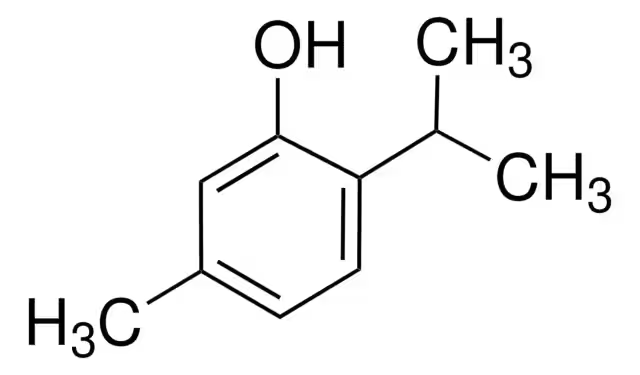
CAS Number89-83-8
Synonyms6-Isopropyl-3-methylphenol; 6-Isopropyl-m-cresol; 3-methyl-6-isopropyl-phenol; 5-methyl-2-(propan-2-yl)phenol; MFCD00005869; Thyme camphor; 2-isopropyl-5-methylphenol; 5-methyl-2-(1-methylethyl)phenol; 1-methyl-4-isopropyl-3-hydroxybenzene; Isopropyl cresol; 3-p-Cymenol; EINECS 201-944-8; 5-methyl-2-propan-2-ylphenol; THYMOL; 2-Isopropyl-5-methyl-phenol; Thymic acid; 5-Methyl-2-isopropylphenol; 1-hydroxy-2-isopropyl-5-methylbenzene
Molecular Formula2-[(CH3)2CH]C6H3-5-(CH3)OH
Molecular Weight150.22
Purity≥98.5%
Density1.0±0.1 g/cm3
Boiling Point232 °C (lit.)
Melting Point48-51 °C (lit.)
Appearancepowder or crystals
EINECS201-944-8
Symbol
Signal WordWarning
| Chemical & Physical Properties | |
|---|---|
| CAS Number | 89-83-8 |
| Catalog No. | 2A-9012694 |
| Chinese Name | 麝香草酚 |
| Synonyms | 6-Isopropyl-3-methylphenol; 6-Isopropyl-m-cresol; 3-methyl-6-isopropyl-phenol; 5-methyl-2-(propan-2-yl)phenol; MFCD00005869; Thyme camphor; 2-isopropyl-5-methylphenol; 5-methyl-2-(1-methylethyl)phenol; 1-methyl-4-isopropyl-3-hydroxybenzene; Isopropyl cresol; 3-p-Cymenol; EINECS 201-944-8; 5-methyl-2-propan-2-ylphenol; THYMOL; 2-Isopropyl-5-methyl-phenol; Thymic acid; 5-Methyl-2-isopropylphenol; 1-hydroxy-2-isopropyl-5-methylbenzene |
| Molecular Formula | 2-[(CH3)2CH]C6H3-5-(CH3)OH |
| Molecular Weight | 150.22 |
| Purity | ≥98.5 |
| Density | 1.0±0.1 g/cm3 |
| Boiling Point | 232 °C (lit.) |
| Melting Point | 48-51 °C (lit.) |
| Appearance | powder or crystals |
| Water Solubility | 0.1 g/100 mL (20 ºC) |
| Storage Condition | Sealed packaging in glass bottles. Store in a cool |
| Packaging | III |
| Application | Thymol is the major monoterpene phenol present in essential oils isolated from plants belonging to the Lamiaceae family, as well as other plants such as Verbenaceae, Scrophulariaceae, Ranunculaceae, a |
| EINECS | 201-944-8 |
| HTC | 29071900 |
| UN(IATA) | UN 无资料 |
| PubChem ID | 57654643 |
| MDL Number | MFCD00002309 |
| SMILES | CC(C)c1ccc(C)cc1O |
| InChI | 1S/C10H14O/c1-7(2)9-5-4-8(3)6-10(9)11/h4-7,11H,1-3H3 |
| InChI Key | MGSRCZKZVOBKFT-UHFFFAOYSA-N |
| Beilstein/REAXYS | 1907135 |
| NACRES Code | NA.47 |
| UNSPSC | 12171500 |
| Hazard Symbols | 8 |
| MSDS | msds/12694_1_89_83_8.pdf |
| Bioactivity | Thymol is the main monoterpene phenol occurring in essential oils isolated from plants belonging to the Lamiaceae family, and other plants such as those belonging to the Verbenaceae, Scrophulariaceae, Ranunculaceae and Apiaceae families. Thymol has antioxidant, anti-inflammatory, antibacterial and antifungal effects[1]. Related Catalog Research Areas >> Infection Signaling Pathways >> Others >> Others References [1]. Marchese A, et al. Antibacterial and antifungal activities of thymol: A brief review of the literature. Food Chem. 2016 Nov 1;210:402-14. Chemical & Physical Properties Density 1.0±0.1 g/cm3 Boiling Point 233.0±0.0 °C at 760 mmHg Melting Point 48-51 °C(lit.) Molecular Formula C10H14O Molecular Weight 150.218 Flash Point 102.2±0.0 °C Exact Mass 150.104462 PSA 20.23000 LogP 3.28 Vapour Pressure 0.0±0.4 mmHg at 25°C Index of Refraction 1.523 InChIKey MGSRCZKZVOBKFT-UHFFFAOYSA-N SMILES Cc1ccc(C(C)C)c(O)c1 Storage condition Store at RT. Stability Stable. Incompatible with strong oxidizing agents, organic materials, strong bases. Water Solubility 0.1 g/100 mL (20 ºC) |
| Use of | Thymol is the main monoterpene phenol occurring in essential oils isolated from plants belonging to the Lamiaceae family, and other plants such as those belonging to the Verbenaceae, Scrophulariaceae, Ranunculaceae and Apiaceae families. Thymol has antioxidant, anti-inflammatory, antibacterial and antifungal effects[1]. Properties Articles109 Name thymol Synonym More Synonyms Thymol Biological Activity Description Thymol is the main monoterpene phenol occurring in essential oils isolated from plants belonging to the Lamiaceae family, and other plants such as those belonging to the Verbenaceae, Scrophulariaceae, Ranunculaceae and Apiaceae families. Thymol has antioxidant, anti-inflammatory, antibacterial and antifungal effects[1]. Related Catalog Research Areas >> Infection Signaling Pathways >> Others >> Others References [1]. Marchese A, et al. Antibacterial and antifungal activities of thymol: A brief review of the literature. Food Chem. 2016 Nov 1;210:402-14. Chemical & Physical Properties Molecular Formula C10H14O Exact Mass 150.104462 PSA 20.23000 Index of Refraction 1.523 InChIKey MGSRCZKZVOBKFT-UHFFFAOYSA-N Storage condition Store at RT. Stability Stable. Incompatible with strong oxidizing agents, organic materials, strong bases. |
| Tax Rebate | 9.0% |
| Supervision | None MFN tariff: 5.5% Ordinary tariff: 30.0% |
| Transport Info | Product name: 3-Hydroxy-1-methyl-4-isopropyl benzene; Isopropyl-cresol; Thyme camphor; 2-Isopropyl-5-methyl phenol; 3-Hydroxy-p-cymene |
| Related Products in Specialty & Botanical Ingredients | ||
|---|---|---|
| DL-menthol | 15356-70-4 | 2A-9010212 |
| Irone | 79-69-6 | 2A-9011029 |
| Notoginseng Leaf Triterpenes | 2A-302804 | 2A-9011721 |
| Notoginseng Triterpenes | 88105-29-7 | 2A-9011722 |
| Perospirone | 129273-38-7 | 2A-9011941 |
| Thymol iodide | 552-22-7 | 2A-9012695 |
| p-Anisaldehyde,p-Methoxybenzaldhyde; 4-Methoxybenzaldehyde | 123-11-5 | 2A-9015253 |
| l-borneol | 464-45-9 | 2A-0202026 |
| Bromothymol Blue | 76-59-5 | 2A-9017145 |
| Thymol Blue | 76-61-9 | 2A-9017147 |
| Browse all Specialty & Botanical Ingredients products » | ||
Phone:
630-322-8886
630-322-8887
Email:
Office Locations:
Chicago, IL, USA
San Francisco, CA, USA


 EN
EN


 SDS
SDS