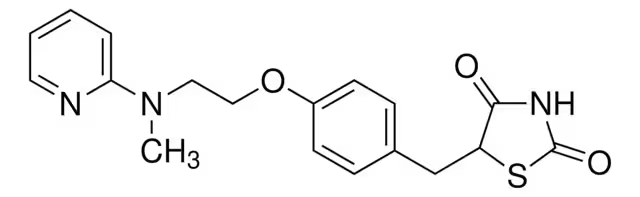
CAS Number122320-73-4
SynonymsAvandia; 5-(4-{2-[Methyl(2-pyridinyl)amino]ethoxy}benzyl)-1,3-thiazolidine-2,4-dione; MFCD00871760; 5-(4-{2-[methyl(pyridin-2-yl)amino]ethoxy}benzyl)-1,3-thiazolidine-2,4-dione; 5-[[4-[2-[methyl(pyridin-2-yl)amino]ethoxy]phenyl]methyl]-1,3-thiazolidine-2,4-dione; 5-(4-(2-(Methyl(pyridin-2-yl)amino)ethoxy)benzyl)thiazolidine-2,4-dione
Molecular FormulaC18H19N3O3S
Molecular Weight357.43
Purity≥98 (HPLC)%
Density1.3±0.1 g/cm3
Boiling Point585.0±35.0 °C at 760 mmHg
Melting Point153-155ºC
Appearancepowder
Symbol
Signal WordWarning
| Chemical & Physical Properties | |
|---|---|
| CAS Number | 122320-73-4 |
| Catalog No. | 2A-9012344 |
| Chinese Name | 罗格列酮 |
| Synonyms | Avandia; 5-(4-{2-[Methyl(2-pyridinyl)amino]ethoxy}benzyl)-1,3-thiazolidine-2,4-dione; MFCD00871760; 5-(4-{2-[methyl(pyridin-2-yl)amino]ethoxy}benzyl)-1,3-thiazolidine-2,4-dione; 5-[[4-[2-[methyl(pyridin-2-yl)amino]ethoxy]phenyl]methyl]-1,3-thiazolidine-2,4-dione; 5-(4-(2-(Methyl(pyridin-2-yl)amino)ethoxy)benzyl)thiazolidine-2,4-dione |
| Molecular Formula | C18H19N3O3S |
| Molecular Weight | 357.43 |
| Purity | ≥98 (HPLC) |
| Density | 1.3±0.1 g/cm3 |
| Boiling Point | 585.0±35.0 °C at 760 mmHg |
| Melting Point | 153-155ºC |
| Appearance | powder |
| Storage Condition | 2-8°C |
| Packaging | II |
| Application | Rosiglitazone (BRL49653) is a potent thiazolidinedione insulin sensitizer. Rosiglitazone is a selective PPARγ agonist with EC50s of 30 nM, 100 nM and 60 nM for PPARγ1, PPARγ2 and PPARγ respectively. |
| HTC | 2934999090 |
| PubChem ID | 329824017 |
| MDL Number | MFCD00871760 |
| SMILES | CN(CCOc1ccc(CC2SC(=O)NC2=O)cc1)c3ccccn3 |
| InChI | 1S/C18H19N3O3S/c1-21(16-4-2-3-9-19-16)10-11-24-14-7-5-13(6-8-14)12-15-17(22)20-18(23)25-15/h2-9,15H,10-12H2,1H3,(H,20,22,23) |
| InChI Key | YASAKCUCGLMORW-UHFFFAOYSA-N |
| NACRES Code | NA.77 |
| UNSPSC | 12352200 |
| Hazard Symbols | 6.1 |
| MSDS | msds/12344_1_122320_73_4.pdf |
| Bioactivity | Rosiglitazone (BRL49653) is a potent thiazolidinedione insulin sensitizer. Rosiglitazone is a selective PPARγ agonist with EC50s of 30 nM, 100 nM and 60 nM for PPARγ1, PPARγ2, and PPARγ, respectively. Related Catalog Signaling Pathways >> Autophagy >> Autophagy Signaling Pathways >> Cell Cycle/DNA Damage >> PPAR Signaling Pathways >> Membrane Transporter/Ion Channel >> TRP Channel Research Areas >> Inflammation/Immunology Research Areas >> Metabolic Disease Target PPARγ1:30 nM (EC50) PPARγ2:100 nM (EC50) In Vitro Rosiglitazone is a potent and selective activator of PPARγ, with EC50s of 30 nM and 100 nM for PPARγ1 and PPARγ2, respectively, and a Kd of appr 40 nM for PPARγ. Rosiglitazone (BRL49653, 0.1, 1,10 μM) promotes differentiation of C3H10T1/2 stem cells to adipocytes[1]. Rosiglitazone (Compound 6) activates PPARγ, with an EC50 of 60 nM[2]. Rosiglitazone (1 μM) activates PPARγ, which binds to NF-α1 promoter to activate gene transcription in neurons. Rosiglitazone (1 μM) also protects Neuro2A cells and hippocampal neurons against oxidative stress, and up-regulates BCL-2 expression in an NF-α1-dependent manner[3]. Rosiglitazone completely inhibits TRPM3 with IC50 values of 9.5 and 4.6 μM against nifedipine- and PregS-evoked activity, but such effects are not via PPARγ. Rosiglitazone inhibits TRPM2 at higher concentration, with an IC50 of appr 22.5 μM. Rosiglitazone is a strong stimulator of TRPC5 channels, with an EC50 of ∼30 μM[4]. In Vivo Rosiglitazone (5 mg/kg, p.o.) decreases the serum glucose in diabetic rats. Rosiglitazone also decreases IL-6, TNF-α, and VCAM-1 levels in diabetic group. Rosiglitazone in combination with losartan increases glucose compared to diabetic and Los-treated groups. Rosiglitazone significantly ameliorates endothelial dysfunction indicated by a significantly lower contractile response to PE and Ang II and enhancement of ACh-provoked relaxation in aortas isolated from diabetic rats[5]. Kinase Assay cDNA encoding amino acids 174-475 of PPARγ1 is amplified via polymerase chain reaction and inserted into bacterial expression vector pGEX-2T. GST-PPARγ LBD is expressed in BL21(DE3)plysS cells and extracts. For saturation binding analysis, bacterial extracts (100 μg of protein) are incubated at 4°C for 3 h in buffer containing 10 mM Tris (pH 8.0), 50 mM KCl, 10 mM dithiothreitol with [3H]-BRL49653 (specific activity, 40 Ci/mmol) in the presence or absence of unlabeled Rosiglitazone. Bound is separated from free radioactivity by elution through 1-mL Sephadex G-25 desalting columns. Bound radioactivity eluted in the column void volume and is quantitated by liquid scintillation counting[1]. Cell Assay C3H10T1/2 cells are grown in a 24-well plate in DME medium supplemented with 10% fetal calf serum. Medium and compound (Rosiglitazone) are exchanged every 3 days. Cells are stained at day 7 with Oil Red O and photographed[1]. Animal Admin Rats are intravenously injected with 38 mg/kg streptozotocin and after 48 h, diabetes is identified by urinary glucosuria and then random blood sugar is measured and this day is regarded as day 0. Animals with a serum glucose level of 220-300 mg/dL are selected to be used in this study. Rats are randomly separated into five groups for daily drug administration for 8 weeks: group 1: control nondiabetic rats given a vehicle only (0.5 mL/kg of 0.5% carboxy methyl celleluse orally), group 2: control diabetic rats given a vehicle, group 3: diabetic rats receiving Rosiglitazone (5 mg/kg orally), group 4: diabetic rats receiving losartan (2 mg/kg, orally), and group 5: diabetic rats receiving both Rosiglitazone and losartan[2]. References [1]. Lehmann JM, et al. An antidiabetic thiazolidinedione is a high affinity ligand for peroxisome proliferator-activated receptor gamma (PPAR gamma). J Biol Chem. 1995 Jun 2;270(22):12953-6. [2]. Willson TM, et al. The structure-activity relationship between peroxisome proliferator-activated receptor gamma agonism and the antihyperglycemic activity of thiazolidinediones. J Med Chem. 1996 Feb 2;39(3):665-8. [3]. Thouennon E, et al. Rosiglitazone-activated PPARγ induces neurotrophic factor-α1 transcription contributing to neuroprotection. J Neurochem. 2015 Aug;134(3):463-70. [4]. Majeed Y, et al. Rapid and contrasting effects of rosiglitazone on transient receptor potential TRPM3 and TRPC5 channels. Mol Pharmacol. 2011 Jun;79(6):1023-30. [5]. Ateyya H, et al. Beneficial effects of rosiglitazone and losartan combination in diabetic rats. Can J Physiol Pharmacol. 2018 Mar;96(3):215-220. Chemical & Physical Properties Density 1.3±0.1 g/cm3 Boiling Point 585.0±35.0 °C at 760 mmHg Melting Point 153-155ºC Molecular Formula C18H19N3O3S Molecular Weight 357.427 Flash Point 307.6±25.9 °C Exact Mass 357.114716 PSA 96.83000 LogP 2.56 Vapour Pressure 0.0±1.6 mmHg at 25°C Index of Refraction 1.642 InChIKey YASAKCUCGLMORW-UHFFFAOYSA-N SMILES CN(CCOc1ccc(CC2SC(=O)NC2=O)cc1)c1ccccn1 Storage condition 2-8°C |
| Use of | Rosiglitazone (BRL49653) is a potent thiazolidinedione insulin sensitizer. Rosiglitazone is a selective PPARγ agonist with EC50s of 30 nM, 100 nM and 60 nM for PPARγ1, PPARγ2, and PPARγ, respectively. Properties Articles198 Name Rosiglitazone Synonym More Synonyms Rosiglitazone Biological Activity Description Rosiglitazone (BRL49653) is a potent thiazolidinedione insulin sensitizer. Rosiglitazone is a selective PPARγ agonist with EC50s of 30 nM, 100 nM and 60 nM for PPARγ1, PPARγ2, and PPARγ, respectively. Related Catalog Signaling Pathways >> Autophagy >> Autophagy Signaling Pathways >> Cell Cycle/DNA Damage >> PPAR Signaling Pathways >> Membrane Transporter/Ion Channel >> TRP Channel Research Areas >> Inflammation/Immunology Research Areas >> Metabolic Disease PPARγ1:30 nM (EC50) PPARγ2:100 nM (EC50) References [1]. Lehmann JM, et al. An antidiabetic thiazolidinedione is a high affinity ligand for peroxisome proliferator-activated receptor gamma (PPAR gamma). J Biol Chem. 1995 Jun 2;270(22):12953-6. [3]. Thouennon E, et al. Rosiglitazone-activated PPARγ induces neurotrophic factor-α1 transcription contributing to neuroprotection. J Neurochem. 2015 Aug;134(3):463-70. [5]. Ateyya H, et al. Beneficial effects of rosiglitazone and losartan combination in diabetic rats. Can J Physiol Pharmacol. 2018 Mar;96(3):215-220. Chemical & Physical Properties Molecular Formula C18H19N3O3S Exact Mass 357.114716 PSA 96.83000 Index of Refraction 1.642 InChIKey YASAKCUCGLMORW-UHFFFAOYSA-N |
| Tax Rebate | 13.0% |
| Supervision | None. MFN tariff: 6.5%. Ordinary tariff: 20.0% |
| Transport Info | Product name: Purity: 98.0% |
| MSDS Transport Info | Module 14. Shipping information United Nations classification: inconsistent with United Nations classification standards UN number: not specified |
| Related Products in API & Advanced Intermediates | ||
|---|---|---|
| Ritonavir | 155213-67-5 | 2A-9012321 |
| Rivastigmine | 123441-03-2 | 2A-9012322 |
| Rivastigmine tartrate | 129101-54-8 | 2A-9012323 |
| Rofecoxib | 162011-90-7 | 2A-9012330 |
| Rolitetracycline | 751-97-3 | 2A-9012333 |
| Rosuvastatin | 287714-41-4 | 2A-9012346 |
| Rosuvastatin calcium | 147098-20-2 | 2A-9012347 |
| Saquinavir | 127779-20-8 | 2A-9012391 |
| Saquinavir mesylate | 149845-06-7 | 2A-9012392 |
| Sertraline | 79617-96-2 | 2A-9012427 |
| Browse all API & Advanced Intermediates products » | ||
Phone:
630-322-8886
630-322-8887
Email:
Office Locations:
Chicago, IL, USA
San Francisco, CA, USA


 EN
EN


 SDS
SDS