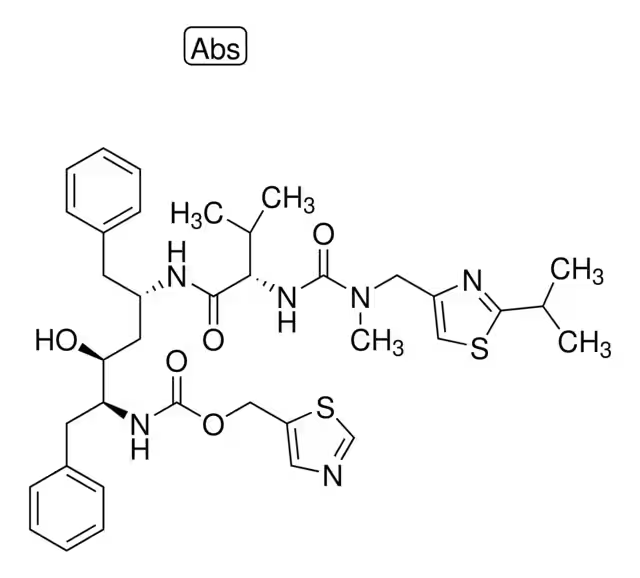
CAS Number155213-67-5
SynonymsNorvir; Ritonavir; EINECS 208-127-9; Ritonavi; ABT-538; Liponavir Core; A-84538 ABT-538 Abbott 84538; Norvi; RITONA; MFCD04115732
Molecular FormulaC37H48N6O5S2
Molecular Weight720.94
Purity≥98 (HPLC)%
Density1.2±0.1 g/cm3
Boiling Point947.0±65.0 °C at 760 mmHg
Melting Point120-122°C
Appearancepowder
Symbol
Signal WordWarning
| Chemical & Physical Properties | |
|---|---|
| CAS Number | 155213-67-5 |
| Catalog No. | 2A-9012321 |
| Chinese Name | 利托那韦 |
| Synonyms | Norvir; Ritonavir; EINECS 208-127-9; Ritonavi; ABT-538; Liponavir Core; A-84538 ABT-538 Abbott 84538; Norvi; RITONA; MFCD04115732 |
| Molecular Formula | C37H48N6O5S2 |
| Molecular Weight | 720.94 |
| Purity | ≥98 (HPLC) |
| Density | 1.2±0.1 g/cm3 |
| Boiling Point | 947.0±65.0 °C at 760 mmHg |
| Melting Point | 120-122°C |
| Appearance | powder |
| Water Solubility | Water solubility: insoluble; easily soluble in: et |
| Storage Condition | -20°C Freezer |
| Application | Ritonavir is an inhibitor of HIV protease used to treat HIV infection and AIDS. |
| HTC | 2942000000 |
| PubChem ID | 329825441 |
| MDL Number | MFCD00927142 |
| SMILES | O=C(OCC1=CN=CS1)N[C@H]([C@@H](O)C[C@@H](NC([C@@H](NC(N(CC2=CSC(C(C)C)=N2)C)=O)C(C)C)=O)CC3=CC=CC=C3)CC4=CC=CC=C4 |
| InChI | 1S/C37H48N6O5S2/c1-24(2)33(42-36(46)43(5)20-29-22-49-35(40-29)25(3)4)34(45)39-28(16-26-12-8-6-9-13-26)18-32(44)31(17-27-14-10-7-11-15-27)41-37(47)48-21-30-19-38-23-50-30/h6-15,19,22-25,28,31-33,44H,16-18,20-21H2,1-5H3,(H,39,45)(H,41,47)(H,42,46)/t28-,31-,32-,33-/m0/s1 |
| InChI Key | NCDNCNXCDXHOMX-XGKFQTDJSA-N |
| NACRES Code | NA.77 |
| UNSPSC | 12352200 |
| Hazard Symbols | Transport |
| MSDS | msds/12321_1_155213_67_5.pdf |
| Bioactivity | Ritonavir is an inhibitor of HIV protease used to treat HIV infection and AIDS. Related Catalog Signaling Pathways >> Metabolic Enzyme/Protease >> HIV Protease Signaling Pathways >> Anti-infection >> HIV Research Areas >> Infection In Vitro Ritonavir is an inhibitor of CYP3A4 mediated testosterone 6β-hydroxylation with mean Ki of 19 nM and also inhibits tolbutamide hydroxylation with IC50 of 4.2 μM[1]. Ritonavir is found to be a potent inhibitor of CYP3A-mediated biotransformations (nifedipine oxidation with IC50 of 0.07 mM, 17alpha-ethynylestradiol 2-hydroxylation with IC50 of 2 mM; terfenadine hydroxylation with IC50 of 0.14 mM). Ritonavir is also an inhibitor of the reactions mediated by CYP2D6 (IC50=2.5 mM) and CYP2C9/10 (IC50=8.0 mM)[2]. Ritonavir results in an increase in cell viability in uninfected human PBMC cultures. Ritonavir markedly decreases the susceptibility of PBMCs to apoptosis correlated with lower levels of caspase-1 expression, decreases in annexin V staining, and reduces caspase-3 activity in uninfected human PBMC cultures. Ritonavir inhibits induction of tumor necrosis factor (TNF) production by PBMCs and monocytes in a time- and dose-dependent manner at nontoxic concentrations[3]. Ritonavir inhibits p-glycoprotein-mediated extrusion of saquinavir with an IC50 of 0.2 μM, indicating a high affinity of ritonavir for p-glycoprotein[4]. Ritonavir inhibits human liver microsomal metabolism of ABT-378 potently with Ki of 13 nM. Ritonavir combined with ABT-378 (at 3:1 and 29:1 ratios) inhibits CYP3A (IC50=1.1 and 4.6 μM), albeit less potently than Ritonavir (IC50=0.14 μM)[5]. References [1]. Eagling VA, et al. Differential inhibition of cytochrome P450 isoforms by the protease inhibitors, ritonavir, saquinavir and indinavir. Br J Clin Pharmacol. 1997 Aug;44(2):190-4. [2]. Kumar GN, et al. Cytochrome P450-mediated metabolism of the HIV-1 protease inhibitor ritonavir (ABT-538) in human liver microsomes. J Pharmacol Exp Ther. 1996 Apr;277(1):423-31. [3]. Weichold FF, et al. HIV-1 protease inhibitor ritonavir modulates susceptibility to apoptosis of uninfected T cells. J Hum Virol. 1999 Sep-Oct;2(5):261-9. [4]. Drewe J, et al. HIV protease inhibitor ritonavir: a more potent inhibitor of P-glycoprotein than the cyclosporine analog SDZ PSC 833. Biochem Pharmacol. 1999 May 15;57(10):1147-52. [5]. Kumar GN, et al. Potent inhibition of the cytochrome P-450 3A-mediated human liver microsomal metabolism of a novel HIV protease inhibitor by ritonavir: A positive drug-drug interaction. Drug Metab Dispos. 1999 Aug;27(8):902-8. Chemical & Physical Properties Density 1.2±0.1 g/cm3 Boiling Point 947.0±65.0 °C at 760 mmHg Melting Point 120-122°C Molecular Formula C37H48N6O5S2 Molecular Weight 720.944 Flash Point 526.6±34.3 °C Exact Mass 720.312744 PSA 202.26000 LogP 5.28 Vapour Pressure 0.0±0.3 mmHg at 25°C Index of Refraction 1.600 InChIKey NCDNCNXCDXHOMX-XGKFQTDJSA-N SMILES CC(C)c1nc(CN(C)C(=O)NC(C(=O)NC(Cc2ccccc2)CC(O)C(Cc2ccccc2)NC(=O)OCc2cncs2)C(C)C)cs1 Storage condition -20°C Freezer |
| Use of | Ritonavir is an inhibitor of HIV protease used to treat HIV infection and AIDS. Properties Articles39 Name ritonavir Synonym More Synonyms Ritonavir Biological Activity Description Ritonavir is an inhibitor of HIV protease used to treat HIV infection and AIDS. Related Catalog Signaling Pathways >> Metabolic Enzyme/Protease >> HIV Protease Signaling Pathways >> Anti-infection >> HIV Research Areas >> Infection References [1]. Eagling VA, et al. Differential inhibition of cytochrome P450 isoforms by the protease inhibitors, ritonavir, saquinavir and indinavir. Br J Clin Pharmacol. 1997 Aug;44(2):190-4. [2]. Kumar GN, et al. Cytochrome P450-mediated metabolism of the HIV-1 protease inhibitor ritonavir (ABT-538) in human liver microsomes. J Pharmacol Exp Ther. 1996 Apr;277(1):423-31. [3]. Weichold FF, et al. HIV-1 protease inhibitor ritonavir modulates susceptibility to apoptosis of uninfected T cells. J Hum Virol. 1999 Sep-Oct;2(5):261-9. [4]. Drewe J, et al. HIV protease inhibitor ritonavir: a more potent inhibitor of P-glycoprotein than the cyclosporine analog SDZ PSC 833. Biochem Pharmacol. 1999 May 15;57(10):1147-52. [5]. Kumar GN, et al. Potent inhibition of the cytochrome P-450 3A-mediated human liver microsomal metabolism of a novel HIV protease inhibitor by ritonavir: A positive drug-drug interaction. Drug Metab Dispos. 1999 Aug;27(8):902-8. Chemical & Physical Properties Molecular Formula C37H48N6O5S2 Exact Mass 720.312744 PSA 202.26000 Index of Refraction 1.600 InChIKey NCDNCNXCDXHOMX-XGKFQTDJSA-N |
| Transport Info | Product name: Purity: 98.0% |
| MSDS Transport Info | Module 14. Shipping information 14.1 UN dangerous goods number European Land Transport Dangerous Regulations: -International Maritime Dangerous Regulations: -International Air Transport Dangerous Regulations: - 14.2 Names specified by the United Nations (UN) European Land Transport Dangerous Regulations: Non-dangerous goods IMDG Code: Non-dangerous goods International air transport dangerous goods regulations: non-dangerous goods 14.3 Transport hazard categories European Land Transport Dangerous Regulations: -International Maritime Dangerous Regulations: -International Air Transport Dangerous Regulations: - 14.4 Package group European Land Transport Dangerous Regulations: -International Maritime Dangerous Regulations: -International Air Transport Dangerous Regulations: - 14.5 Environmental hazards European Land Transport Dangerous Regulations: No International Maritime Transport Dangerous Regulations Maritime Pollutants: No International Air Transport Risk Regulations: No 14.6 Special reminder to users No data available |
| Related Products in API & Advanced Intermediates | ||
|---|---|---|
| Ranitidine | 66357-35-5 | 2A-9012267 |
| Remifentanil | 132875-61-7 | 2A-9012280 |
| Ribavirin | 36791-04-5 | 2A-9012297 |
| Rifabutin | 72559-06-9 | 2A-0201665 |
| Risedronate sodium | 115436-72-1 | 2A-9012314 |
| Rivastigmine | 123441-03-2 | 2A-9012322 |
| Rivastigmine tartrate | 129101-54-8 | 2A-9012323 |
| Rofecoxib | 162011-90-7 | 2A-9012330 |
| Rolitetracycline | 751-97-3 | 2A-9012333 |
| Rosiglitazone | 122320-73-4 | 2A-9012344 |
| Browse all API & Advanced Intermediates products » | ||
Phone:
630-322-8886
630-322-8887
Email:
Office Locations:
Chicago, IL, USA
San Francisco, CA, USA


 EN
EN


 SDS
SDS