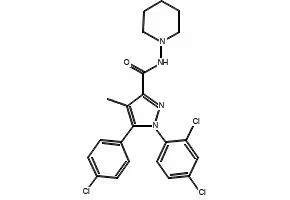
CAS Number168273-06-1
Synonyms5-(4-chlorophenyl)-1-(2,4-dichlorophenyl)-4-methyl-N-(piperidin-1-yl)-1H-pyrazole-3-carboxamide; rimonabant; 5-(4-Chlorophenyl)-1-(2,4-dichlorophenyl)-4-methyl-N-(1-piperidinyl)-1H-pyrazole-3-carboxamide; Acomplia; Unii-rml78en3xe; SR-141716A; SR141716A; Zimulti; MFCD04034714; A 281
Molecular FormulaC22H21O1N4Cl3
Molecular Weight463.79
Purity98%
Density1.4±0.1 g/cm3
Boiling Point627.6ºC at 760 mmHg
Melting Point230-240ºC
AppearanceWhite or almost white crystalline powder
| Chemical & Physical Properties | |
|---|---|
| CAS Number | 168273-06-1 |
| Catalog No. | 2A-9012310 |
| Chinese Name | 利莫纳班 |
| Synonyms | 5-(4-chlorophenyl)-1-(2,4-dichlorophenyl)-4-methyl-N-(piperidin-1-yl)-1H-pyrazole-3-carboxamide; rimonabant; 5-(4-Chlorophenyl)-1-(2,4-dichlorophenyl)-4-methyl-N-(1-piperidinyl)-1H-pyrazole-3-carboxamide; Acomplia; Unii-rml78en3xe; SR-141716A; SR141716A; Zimulti; MFCD04034714; A 281 |
| Molecular Formula | C22H21O1N4Cl3 |
| Molecular Weight | 463.79 |
| Purity | 98 |
| Density | 1.4±0.1 g/cm3 |
| Boiling Point | 627.6ºC at 760 mmHg |
| Melting Point | 230-240ºC |
| Appearance | White or almost white crystalline powder |
| Storage Condition | 2~8°C |
| Application | Rimonabant (SR141716) is a central CB1 receptor inverse agonist with Ki of 1.8 nM. |
| HTC | 2942000000 |
| MDL Number | MFCD04034714 |
| SMILES | Cc1c(C(=O)NN2CCCCC2)nn(-c2ccc(Cl)cc2Cl)c1-c1ccc(Cl)cc1 |
| InChI | InChI=1S/C22H21Cl3N4O/c1-14-20(22(30)27-28-11-3-2-4-12-28)26-29(19-10-9-17(24)13-18(19)25)21(14)15-5-7-16(23)8-6-15/h5-10,13H,2-4,11-12H2,1H3,(H,27,30) |
| InChI Key | JZCPYUJPEARBJL-UHFFFAOYSA-N |
| MSDS | msds/12310_1_168273_06_1.pdf |
| Bioactivity | Rimonabant(SR141716) is a selective central cannabinoid (CB1) receptor inverse agonist with Ki of 1.8 nM.IC50 Value: 1.8 nM(Ki)Target: CB1 Receptorin vitro: Rimonabant dose-dependently reduces ACAT activity in Raw264.7macrophages with IC50 of 2.9 μM and isolated peritoneal macrophages. Rimonabant inhibits ACATactivity in intact CHO-ACAT1 and CHO-ACAT2 cells and in cell-free assays with approximately equal efficiency with IC50 of 1.5 μM and 2.2 μM for CHO-ACAT1 and CHO-ACAT2, respectively. Consistent with ACAT inhibition, Rimonabant treatment blocks ACAT dependent processes in macrophages, oxysterol-induced apoptosis and acetylated-LDL induced foam cell formation. Rimonabant antagonizes the inhibitory effects of cannabinoid receptor agonists on both mouse vas deferens contractions and adenylyl cyclase activity in rat brain membranes in a concentration-dependent manner.in vivo: Rimonabant (10 mg/kg by gavage) is fed for 2 weeks to 3-month-old male obese Zucker rats as an impaired glucose tolerance model and for 10 weeks to 6-month-old male obese Zucker rats as a model of the metabolic syndrome. RANTES (Regulated upon Activation, Normal T cell Expressed, and Secreted) and MCP-1 (monocyte chemotactic protein-1) serum levels are increased in obese vs lean Zucker rats and significantly reduced by long-term treatment with Rimonabant, which slowes weight gain in rats with the metabolic syndrome. Neutrophils and monocytes are significantly increased in young and old obese vs lean Zucker rats and lowered by Rimonabant. Platelet-bound fibrinogen is significantly enhanced in obese vs lean Zucker rats of both age, and is reduced by Rimonabant. Platelets from obese rats are more sensitive to thrombin-induced aggregation and adhesion to fibrinogen, which are both attenuated by Rimonabant therapy. Related Catalog Signaling Pathways >> GPCR/G Protein >> Cannabinoid Receptor Research Areas >> Metabolic Disease References [1]. Heppenstall C, Bunce S, Smith JC. Relationships between glucose, energy intake and dietary composition in obese adults with type 2 diabetes receiving the cannabinoid 1 (CB1) receptor antagonist, rimonabant. Nutr J. 2012 Jul 23;11(1):50. [2]. Seely KA, Brents LK, Franks LN, Rajasekaran M, Zimmerman SM, Fantegrossi WE, Prather PL. AM-251 and rimonabant act as direct antagonists at mu-opioid receptors: Implications for opioid/cannabinoid interaction studies. Neuropharmacology. 2012 Oct;63(5):9 [3]. Mandhane S, Nayak P, Soni D, Jain S, Ashton JC, Rajamannar T. Induction of glucose intolerance by acute administration of rimonabant. Pharmacology. 2012;89(5-6):339-47. [4]. Leite, C.E., Mocelin, C.A., Petersen, G.O., et al. Rimonabant: An antagonist drug of the endocannabinoid system for the treatment of obesity. Pharmacol Rep 61 217-224 (2009). [5]. Erdozain, A. M. et al. The inverse agonist effect of rimonabant on G protein activation is not mediated by the cannabinoid CB1 receptor: Evidence from postmortem human brain Biochemical Pharmacology (2012), 83(2), 260-268. Chemical & Physical Properties Density 1.4±0.1 g/cm3 Boiling Point 627.6ºC at 760 mmHg Melting Point 230-240ºC Molecular Formula C22H21Cl3N4O Molecular Weight 463.787 Flash Point 333.3ºC Exact Mass 462.078094 PSA 50.16000 LogP 6.01 Index of Refraction 1.668 InChIKey JZCPYUJPEARBJL-UHFFFAOYSA-N SMILES Cc1c(C(=O)NN2CCCCC2)nn(-c2ccc(Cl)cc2Cl)c1-c1ccc(Cl)cc1 Storage condition 2~8°C |
| Use of | Properties Name Rimonabant Synonym More Synonyms Rimonabant Biological Activity Related Catalog Signaling Pathways >> GPCR/G Protein >> Cannabinoid Receptor Research Areas >> Metabolic Disease References [1]. Heppenstall C, Bunce S, Smith JC. Relationships between glucose, energy intake and dietary composition in obese adults with type 2 diabetes receiving the cannabinoid 1 (CB1) receptor antagonist, rimonabant. Nutr J. 2012 Jul 23;11(1):50. [2]. Seely KA, Brents LK, Franks LN, Rajasekaran M, Zimmerman SM, Fantegrossi WE, Prather PL. AM-251 and rimonabant act as direct antagonists at mu-opioid receptors: Implications for opioid/cannabinoid interaction studies. Neuropharmacology. 2012 Oct;63(5):9 [3]. Mandhane S, Nayak P, Soni D, Jain S, Ashton JC, Rajamannar T. Induction of glucose intolerance by acute administration of rimonabant. Pharmacology. 2012;89(5-6):339-47. [4]. Leite, C.E., Mocelin, C.A., Petersen, G.O., et al. Rimonabant: An antagonist drug of the endocannabinoid system for the treatment of obesity. Pharmacol Rep 61 217-224 (2009). [5]. Erdozain, A. M. et al. The inverse agonist effect of rimonabant on G protein activation is not mediated by the cannabinoid CB1 receptor: Evidence from postmortem human brain Biochemical Pharmacology (2012), 83(2), 260-268. Chemical & Physical Properties Exact Mass 462.078094 PSA 50.16000 Index of Refraction 1.668 InChIKey JZCPYUJPEARBJL-UHFFFAOYSA-N |
| Tax Rebate | 13.0% |
| Supervision | None. MFN tariff: 6.5%. Ordinary tariff: 20.0% |
| Transport Info | Product name: Summary 2933990090. heterocyclic compounds with nitrogen hetero-atom(s) only. VAT:17.0%. Tax rebate rate:13.0%. . MFN tariff:6.5%. General tariff:20.0% |
| Related Products in Specialty Chemicals | ||
|---|---|---|
| Rilmakalim | 132014-21-2 | 2A-9012305 |
| Rilmenidine | 54187-04-1 | 2A-9012306 |
| Rilozarone | 79282-39-6 | 2A-9012307 |
| Rimantadine | 13392-28-4 | 2A-9012308 |
| Rimantadine hydrochloride | 1501-84-4 | 2A-9012309 |
| Rimonabant hydrochloride | 158681-13-1 | 2A-9012311 |
| Ripisartan | 148504-51-2 | 2A-9012313 |
| Risotilide | 120688-08-6 | 2A-9012315 |
| Risperidal | 106266-06-2 | 2A-9012316 |
| Ristianol | 78092-65-6 | 2A-9012317 |
| Browse all Specialty Chemicals products » | ||
Phone:
630-322-8886
630-322-8887
Email:
Office Locations:
Chicago, IL, USA
San Francisco, CA, USA


 EN
EN


 SDS
SDS