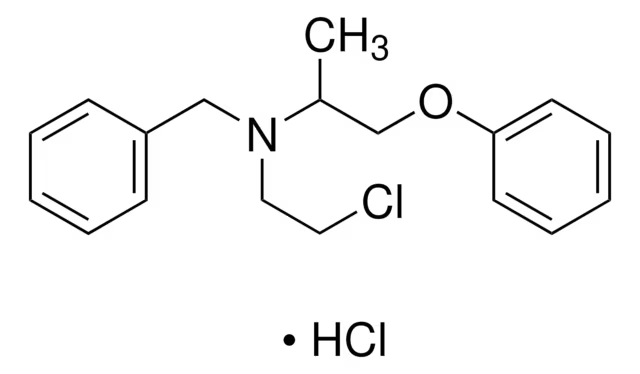
CAS Number63-92-3
SynonymsBenzylamine, N-(2-chloroethyl)-N-(1-methyl-2-phenoxyethyl)-, hydrochloride; Benzenemethanamine, N-(2-chloroethyl)-N-(1-methyl-2-phenoxyethyl)-, hydrochloride (1:1); N-benzyl-N-(2-chloroéthyl)-1-phénoxypropan-2-amine chlorhydrate; MFCD00599580; N-benzyl-N-(2-chloroethyl)-1-phenoxypropan-2-amine,hydrochloride; Bensylyte Hydrochloride; N-Benzyl-N-(2-chlorethyl)-1-phenoxypropan-2-aminhydrochlorid; Dibenyline; Benzenemethanamine, N- (2-chloroethyl)-N-(1-methyl-2-phenoxyethyl)-, hydrochloride; Benzylamine, N- (2-chloroethyl)-N-(1-methyl-2-phenoxyethyl)-, hydrochloride; Phenoxybenzamine HCl; N-(2-Chloroethyl)-N-(1-methyl-2-phenoxyethyl)benzylamine, hydrochloride; (±)-Phenoxybenzamine Hydrochloride; N-Phenoxyisopropyl-N-benzyl-b-chloroethylamine Hydrochloride; N-Benzyl-N-(2-chloroethyl)-1-phenoxyp
Molecular FormulaC18H23Cl2NO
Molecular Weight340.29
Purity≥97%
Boiling Point381.5ºC at 760 mmHg
Melting Point137.5°C
Appearancepowder
EINECS200-569-7
Symbol
Signal WordWarning
| Chemical & Physical Properties | |
|---|---|
| CAS Number | 63-92-3 |
| Catalog No. | 2A-9011972 |
| Chinese Name | 苯氧苄胺 |
| Synonyms | Benzylamine, N-(2-chloroethyl)-N-(1-methyl-2-phenoxyethyl)-, hydrochloride; Benzenemethanamine, N-(2-chloroethyl)-N-(1-methyl-2-phenoxyethyl)-, hydrochloride (1:1); N-benzyl-N-(2-chloroéthyl)-1-phénoxypropan-2-amine chlorhydrate; MFCD00599580; N-benzyl-N-(2-chloroethyl)-1-phenoxypropan-2-amine,hydrochloride; Bensylyte Hydrochloride; N-Benzyl-N-(2-chlorethyl)-1-phenoxypropan-2-aminhydrochlorid; Dibenyline; Benzenemethanamine, N- (2-chloroethyl)-N-(1-methyl-2-phenoxyethyl)-, hydrochloride; Benzylamine, N- (2-chloroethyl)-N-(1-methyl-2-phenoxyethyl)-, hydrochloride; Phenoxybenzamine HCl; N-(2-Chloroethyl)-N-(1-methyl-2-phenoxyethyl)benzylamine, hydrochloride; (±)-Phenoxybenzamine Hydrochloride; N-Phenoxyisopropyl-N-benzyl-b-chloroethylamine Hydrochloride; N-Benzyl-N-(2-chloroethyl)-1-phenoxyp |
| Molecular Formula | C18H23Cl2NO |
| Molecular Weight | 340.29 |
| Purity | ≥97 |
| Boiling Point | 381.5ºC at 760 mmHg |
| Melting Point | 137.5°C |
| Appearance | powder |
| Water Solubility | H2O: slightly soluble | <0.01 g/100 mL at 18.5 ºC |
| Storage Condition | This product should be sealed and stored in a cool |
| Application | Phenoxybenzamine hydrochloride is a selective inhibitor of α-adrenoceptor and calmodulin and is a commonly used antihypertensive drug. |
| EINECS | 200-569-7 |
| HTC | 2922299090 |
| PubChem ID | 24277760 |
| MDL Number | MFCD00055152 |
| SMILES | Cl[H].CC(COc1ccccc1)N(CCCl)Cc2ccccc2 |
| InChI | 1S/C18H22ClNO.ClH/c1-16(15-21-18-10-6-3-7-11-18)20(13-12-19)14-17-8-4-2-5-9-17;/h2-11,16H,12-15H2,1H3;1H |
| InChI Key | VBCPVIWPDJVHAN-UHFFFAOYSA-N |
| NACRES Code | NA.77 |
| UNSPSC | 12352116 |
| Hazard Symbols | Transport |
| MSDS | msds/11972_1_63_92_3.pdf |
| Bioactivity | Phenoxybenzamine hydrochloride is a selective antagonist of both α-adrenoceptor and calmodulin that is commonly used for the treatment of hypertension, specifically caused by pheochromocytoma. Related Catalog Signaling Pathways >> GPCR/G Protein >> Adrenergic Receptor Research Areas >> Cardiovascular Disease In Vitro The IC50 (100 nM) derived from the blockade of [3H]yohimbine binding by Phenoxybenzamine hydrochloride is significantly less than the IC50 (550 nM) for the corresponding reversal by Phenoxybenzamine hydrochloride of the effects of norepinephrine on cyclic AMP accumulation[1]. Phenoxybenzamine hydrochloride (50 nM) in conbination with Phenoxybenzamine hydrochloridetolamine (1000 nM) enhances Phenoxybenzamine hydrochlorideylephrine-induced contraction compared with pretreatment with Phenoxybenzamine hydrochloride (50 nM) alone in endothelium-intact aortae. Combined treatment with either dexmedetomidine (300 or 1000 nM) and Phenoxybenzamine hydrochloride (50 nM) or Phenoxybenzamine hydrochloridetolamine (1000 nM) and Phenoxybenzamine hydrochloride (50 nM) enhance Phenoxybenzamine hydrochlorideylephrine-induced contraction compared with Phenoxybenzamine hydrochloride alone (50 nM). In addition, combined treatment with Phenoxybenzamine hydrochloridetolamine and Phenoxybenzamine hydrochloride enhances Phenoxybenzamine hydrochlorideylephrine-induced contraction compared with dexmedetomidine (1000 nM) and Phenoxybenzamine hydrochloride combined treatment. Combined treatment with high concentrations of dexmedetomidine (1000 nM) and Phenoxybenzamine hydrochloride enhances Phenoxybenzamine hydrochlorideylephrine-induced contraction compared with combined treatment with low concentrations of dexmedetomidine (300 nM) and Phenoxybenzamine hydrochloride[2]. Phenoxybenzamine hydrochloride (0.1-100 μM) inhibits glioma proliferation, migration, and invasion and suppresses the tumorigenesis capacity. Phenoxybenzamine hydrochloride also inhibits self-renewal of glioma stem-like cells. Phenoxybenzamine hydrochloride activates LINGO-1 and inhibits the TrkB-Akt pathway[3]. Phenoxybenzamine hydrochloride (0.1 μM-1 mM) preserves primary neurons within the CA1, CA3 and dentate gyrus and produces a robust neuroprotective effect, and prevents neuronal death from OGD in all regions of the hippocampus when delivered at 2, 4, and 8 h post-OGD at 100 μM[4]. In Vivo Phenoxybenzamine hydrochloride (20 nM, s.c.) effectively suppresses the tumorigenesis of glioma cells in mice and the cell density in Phenoxybenzamine hydrochloride-U87MG xenografts decreases significantly[3]. Phenoxybenzamine hydrochloride (1 mg/kg, i.v.) treated rats shows significant improvements in NSS and foot fault scoring[4]. Cell Assay After cytometry, 1×3 cells are implanted in a 96-well plate in 100 μL DMEM supplemented with 10 % FBS. Ten microliter (10 % of the total volume) WST-1 (Water Soluble Tetrazolium) is added to cells and incubated at 37°C for 30 min before colorimetric assay with 450 nm excitation and 630 nm emission at 24 h intervals up to 96 h. The mean fluorescence value is counted, and the cell number is determined using the standard curve. Animal Admin U87MG cells are injected into both flanks of the nude mice subcutaneously at a dose of 2.0×3/200 μL per side. Eight days after injection, neoplasm growth is observed macroscopically on both sides of the mice. Then, 20 nM phenoxybenzamine hydrochloride is injected into the right side subcutaneously at a 2-day interval, and the dissolvent DMSO is used as control. The tumor volume (V) is determined by measuring the length (a) and the width (b) and calculated using the equation: V=(ab)2/2. References [1]. Lenox, R.H., et al, Alpha 2-adrenergic receptor-mediated regulation of adenylate cyclase in the intact human platelet. Evidence for a receptor reserve. Mol Pharmacol, 1985. 27(1): p. 1-9. [2]. Byon HJ, et al. Dexmedetomidine Inhibits Phenylephrine-induced Contractions via Alpha-1 Adrenoceptor Blockade and Nitric Oxide Release in Isolated Rat Aortae. Int J Med Sci. 2017 Feb 7;14(2):143-149. [3]. Lin XB, et al. Anti-tumor activity of phenoxybenzamine hydrochloride on malignant glioma cells. Tumour Biol. 2016 Mar;37(3):2901-8. [4]. Rau TF, et al. Phenoxybenzamine is neuroprotective in a rat model of severe traumatic brain injury. Int J Mol Sci. 2014 Jan 20;15(1):1402-17. Chemical & Physical Properties Boiling Point 381.5ºC at 760 mmHg Melting Point 137.5°C Molecular Formula C18H23Cl2NO Molecular Weight 340.287 Flash Point 184.5ºC Exact Mass 339.115662 PSA 12.47000 LogP 4.99690 InChIKey VBCPVIWPDJVHAN-UHFFFAOYSA-N SMILES CC(COc1ccccc1)N(CCCl)Cc1ccccc1.Cl Storage condition 2-8°C Water Solubility H2O: slightly soluble | <0.01 g/100 mL at 18.5 ºC |
| Use of | Phenoxybenzamine hydrochloride is a selective antagonist of both α-adrenoceptor and calmodulin that is commonly used for the treatment of hypertension, specifically caused by pheochromocytoma. Properties Articles35 Name Phenoxybenzamine hydrochloride Synonym More Synonyms Phenoxybenzamine HCl Biological Activity Description Phenoxybenzamine hydrochloride is a selective antagonist of both α-adrenoceptor and calmodulin that is commonly used for the treatment of hypertension, specifically caused by pheochromocytoma. Related Catalog Signaling Pathways >> GPCR/G Protein >> Adrenergic Receptor Research Areas >> Cardiovascular Disease References [1]. Lenox, R.H., et al, Alpha 2-adrenergic receptor-mediated regulation of adenylate cyclase in the intact human platelet. Evidence for a receptor reserve. Mol Pharmacol, 1985. 27(1): p. 1-9. [2]. Byon HJ, et al. Dexmedetomidine Inhibits Phenylephrine-induced Contractions via Alpha-1 Adrenoceptor Blockade and Nitric Oxide Release in Isolated Rat Aortae. Int J Med Sci. 2017 Feb 7;14(2):143-149. [3]. Lin XB, et al. Anti-tumor activity of phenoxybenzamine hydrochloride on malignant glioma cells. Tumour Biol. 2016 Mar;37(3):2901-8. [4]. Rau TF, et al. Phenoxybenzamine is neuroprotective in a rat model of severe traumatic brain injury. Int J Mol Sci. 2014 Jan 20;15(1):1402-17. Chemical & Physical Properties Exact Mass 339.115662 PSA 12.47000 LogP 4.99690 InChIKey VBCPVIWPDJVHAN-UHFFFAOYSA-N |
| Tax Rebate | 13.0% |
| Supervision | None. MFN tariff: 6.5%. Ordinary tariff: 30.0% |
| Transport Info | Product name: Purity: 98.0% |
| MSDS Transport Info | Module 14. Shipping information 14.1 UN dangerous goods number European Land Transport Dangerous Regulations: -International Maritime Dangerous Regulations: -International Air Transport Dangerous Regulations: - 14.2 Names specified by the United Nations (UN) European Land Transport Dangerous Regulations: Non-dangerous goods IMDG Code: Non-dangerous goods International air transport dangerous goods regulations: non-dangerous goods 14.3 Transport hazard categories European Land Transport Dangerous Regulations: -International Maritime Dangerous Regulations: -International Air Transport Dangerous Regulations: - 14.4 Package group European Land Transport Dangerous Regulations: -International Maritime Dangerous Regulations: -International Air Transport Dangerous Regulations: - 14.5 Environmental hazards European Land Transport Dangerous Regulations: No International Maritime Transport Dangerous Regulations Maritime Pollutants: No International Air Transport Risk Regulations: No 14.6 Special reminder to users No data available See reverse side of invoice or packing slip. |
| Related Products in Specialty Chemicals | ||
|---|---|---|
| Phenobutiodil | 554-24-5 | 2A-9011967 |
| Phenothiazine | 92-84-2 | 2A-9011968 |
| Phenothrin | 26002-80-2 | 2A-9011969 |
| Phenoxazine | 135-67-1 | 2A-9011970 |
| Phenoxy benzamine | 59-96-1 | 2A-9011971 |
| Phenprocoumon | 435-97-2 | 2A-9011973 |
| Phenpromethaminum | 93-88-9 | 2A-9011974 |
| Phenthoate | 2597-03-7 | 2A-9011975 |
| Phentolamine | 50-60-2 | 2A-9011976 |
| Phentolamine mesylate | 65-28-1 | 2A-9011977 |
| Browse all Specialty Chemicals products » | ||
Phone:
630-322-8886
630-322-8887
Email:
Office Locations:
Chicago, IL, USA
San Francisco, CA, USA


 EN
EN


 SDS
SDS