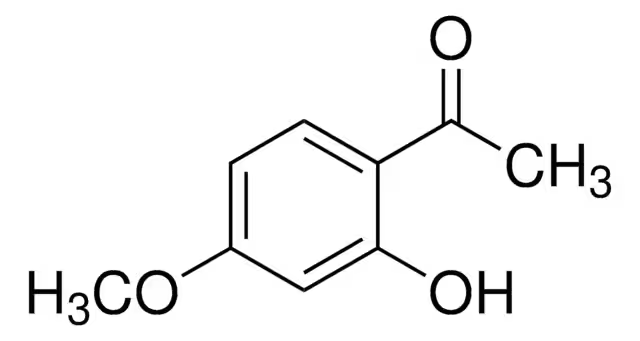
CAS Number552-41-0
Synonyms1-(2-Hydroxy-4-methoxyphenyl)ethanone; 2-Acetyl-5-methoxy-phenol; EINECS 209-012-2; Paeonol; MFCD00008730; 1-(2-Hydroxy-4-methoxyphenyl)ethan-1-one
Molecular FormulaHOC6H3(OCH3)COCH3
Molecular Weight166.17
Purity99%
Density1.2±0.1 g/cm3
Boiling Point301.9±22.0 °C at 760 mmHg
Melting Point48-50 °C (lit.)
AppearanceWhite to beige crystalline powder
EINECS209-012-2
Symbol
Signal WordWarning
| Chemical & Physical Properties | |
|---|---|
| CAS Number | 552-41-0 |
| Catalog No. | 2A-9011852 |
| Chinese Name | 丹皮酚 |
| Synonyms | 1-(2-Hydroxy-4-methoxyphenyl)ethanone; 2-Acetyl-5-methoxy-phenol; EINECS 209-012-2; Paeonol; MFCD00008730; 1-(2-Hydroxy-4-methoxyphenyl)ethan-1-one |
| Molecular Formula | HOC6H3(OCH3)COCH3 |
| Molecular Weight | 166.17 |
| Purity | 99 |
| Density | 1.2±0.1 g/cm3 |
| Boiling Point | 301.9±22.0 °C at 760 mmHg |
| Melting Point | 48-50 °C (lit.) |
| Appearance | White to beige crystalline powder |
| Storage Condition | Closed, cool, dry and ventilated, away from incomp |
| Application | Paeonol is an active extract of peony root. Paeonol inhibits MAO-A and MAO-B with IC50 of 54.6 μM and 42.5 μM, respectively. |
| EINECS | 209-012-2 |
| HTC | 2914509090 |
| PubChem ID | 24895579 |
| MDL Number | MFCD00008730 |
| SMILES | O=C(C)C1=CC=C(OC)C=C1O |
| InChI | 1S/C9H10O3/c1-6(10)8-4-3-7(12-2)5-9(8)11/h3-5,11H,1-2H3 |
| InChI Key | UILPJVPSNHJFIK-UHFFFAOYSA-N |
| NACRES Code | NA.22 |
| UNSPSC | 12352100 |
| Hazard Symbols | Transport |
| MSDS | msds/11852_1_552_41_0.pdf |
| Bioactivity | Paeonol is an active extraction from the root of Paeonia suffruticosa, Paeonol inhibits MAO-A and MAO-B with IC50 of 54.6 μM and 42.5 μM, respectively. Related Catalog Signaling Pathways >> Neuronal Signaling >> Monoamine Oxidase Research Areas >> Neurological Disease Natural Products >> Phenols Target IC50: 42.5 μM (MAO-B), 54.6 μM (MAO-A)[1] In Vitro Paeonol is found to be inhibitory against MAO A in a dose-dependent manner with IC50 value of 54.6 μM. Paeonol is shown to inhibit MAO-B in a dose-dependent manner with the IC50 of 42.5 μM. For Paeonol, the Ki is estimated to be 51.1 μM. The inhibition of Paeonol on MAO B is of competitive type with Ki value of 38.2 μM[1]. In Vivo The 200 mg/kg Paeonol+I/R group [AN/V (%): 7.6±2.2, p<0.01] and 100 mg/kg Paeonol+I/R group [AN/V (%): 9.4±2.8, p<0.05] both show lesser extents of no-reflow area in the ventricles compared with the I/R group [AN/V (%): 18.2±2.9]. In particular, the 200 mg/kg Paeonol + I/R group experienced markedly alleviated no-reflow in the whole heart [AN/WH (%): 4.6±1, p<0.05] compared with the I/R group [AN/WH (%): 10.0±1.9][2]. Animal Admin Mice[2] Male Wistar rats (180-220 g, average age of 8 week) are randomly divided into four groups: (1) sham group, thoracotomy without left anterior descending coronary artery (LAD) occlusion or Paeonol pretreatment; (2) I/R group, LAD occlusion (ischemia) for 4 h followed by reperfusion for 8 h; (3) Paeonol (100 mg/kg)+I/R group, oral administration of 100 mg/kg Paeonol (1 mL/kg) for 7 days using a intragastric tube prior to I/R procedure; (4) Paeonol (200 mg/kg) + I/R group, oral administration of 200 mg/kg Paeonol (1 mL/kg) for 7 days using a intragastric tube prior to I/R procedure. In addition, rats in the sham and I/R groups received a dosage of DMSO equal to that with which the Paeonol was dissolved in for the other two groups. DMSO was also administered intragastrically for 7 consecutive days. A minimum of eight rats were assigned to each group. An ischemia group without reperfusion is not included since our present study mainly focuses on the effect of Paeonol on the cardiac injuries after reperfusion, which is closely related to the real-world situation of no-reflow after coronary revascularization. However, future studies may include a group subjected only to 4 h of ischemia to differentiate, in terms of damage to the cardiac function, which was due to the ischemia and which was due to the no-reflow. References [1]. Kong LD, et al. Inhibition of MAO A and B by some plant-derived alkaloids, phenols and anthraquinones. J Ethnopharmacol. 2004 Apr;91(2-3):351-5. [2]. Ma L, et al. Paeonol Protects Rat Heart by Improving Regional Blood Perfusion during No-Reflow. Front Physiol. 2016 Jul 21;7:298. Chemical & Physical Properties Density 1.2±0.1 g/cm3 Boiling Point 301.9±22.0 °C at 760 mmHg Melting Point 48-50 °C(lit.) Molecular Formula C9H10O3 Molecular Weight 166.174 Flash Point 122.3±15.8 °C Exact Mass 166.062988 PSA 46.53000 LogP 2.16 Vapour Pressure 0.0±0.7 mmHg at 25°C Index of Refraction 1.538 InChIKey UILPJVPSNHJFIK-UHFFFAOYSA-N SMILES COc1ccc(C(C)=O)c(O)c1 |
| Use of | Paeonol is an active extraction from the root of Paeonia suffruticosa, Paeonol inhibits MAO-A and MAO-B with IC50 of 54.6 μM and 42.5 μM, respectively. Properties Articles27 Name Paeonol Synonym More Synonyms Paeonol Biological Activity Description Paeonol is an active extraction from the root of Paeonia suffruticosa, Paeonol inhibits MAO-A and MAO-B with IC50 of 54.6 μM and 42.5 μM, respectively. Related Catalog Signaling Pathways >> Neuronal Signaling >> Monoamine Oxidase Research Areas >> Neurological Disease Natural Products >> Phenols IC50: 42.5 μM (MAO-B), 54.6 μM (MAO-A)[1] In Vitro Paeonol is found to be inhibitory against MAO A in a dose-dependent manner with IC50 value of 54.6 μM. Paeonol is shown to inhibit MAO-B in a dose-dependent manner with the IC50 of 42.5 μM. For Paeonol, the Ki is estimated to be 51.1 μM. The inhibition of Paeonol on MAO B is of competitive type with Ki value of 38.2 μM[1]. References [1]. Kong LD, et al. Inhibition of MAO A and B by some plant-derived alkaloids, phenols and anthraquinones. J Ethnopharmacol. 2004 Apr;91(2-3):351-5. [2]. Ma L, et al. Paeonol Protects Rat Heart by Improving Regional Blood Perfusion during No-Reflow. Front Physiol. 2016 Jul 21;7:298. Chemical & Physical Properties Molecular Formula C9H10O3 Exact Mass 166.062988 PSA 46.53000 Index of Refraction 1.538 InChIKey UILPJVPSNHJFIK-UHFFFAOYSA-N |
| Tax Rebate | 9.0% |
| Supervision | None MFN tariff: 5.5% Ordinary tariff: 30.0% |
| Transport Info | Shipping Name: UN |
| MSDS Transport Info | Module 14. Shipping information 14.1 UN dangerous goods number European Land Transport Dangerous Regulations: -International Maritime Dangerous Regulations: -International Air Transport Dangerous Regulations: - 14.2 United Nations shipping name European Land Transport Dangerous Regulations: Non-dangerous goods IMDG Code: Non-dangerous goods International air transport dangerous goods regulations: non-dangerous goods 14.3 Transport hazard categories European Land Transport Dangerous Regulations: -International Maritime Dangerous Regulations: -International Air Transport Dangerous Regulations: - 14.4 Package group European Land Transport Dangerous Regulations: -International Maritime Dangerous Regulations: -International Air Transport Dangerous Regulations: - 14.5 Environmental hazards European Land Transport Danger Regulations: No International Maritime Danger Regulations International Air Transport Danger Regulations: No Marine pollutants (yes/no): No 14.6 Special reminder to users No data available |
| Related Products in Specialty Chemicals | ||
|---|---|---|
| Ozagrel | 82571-53-7 | 2A-9011846 |
| Ozagrel hydrochloride | 78712-43-3 | 2A-9011847 |
| Ozagrel sodium | 130952-46-4 | 2A-9011848 |
| Pachycarpine | 492-08-0 | 2A-9011849 |
| Pacrinolol | 65655-59-6 | 2A-9011851 |
| Pafenolol | 75949-61-0 | 2A-9011853 |
| Pagoclone | 133737-48-1 | 2A-9011854 |
| Palatrigine | 98410-36-7 | 2A-9011855 |
| Palmitoyl serinol | 126127-31-9 | 2A-9011857 |
| Palmoxiric acid | 68170-97-8 | 2A-0201882 |
| Browse all Specialty Chemicals products » | ||
Phone:
630-322-8886
630-322-8887
Email:
Office Locations:
Chicago, IL, USA
San Francisco, CA, USA


 EN
EN


 SDS
SDS