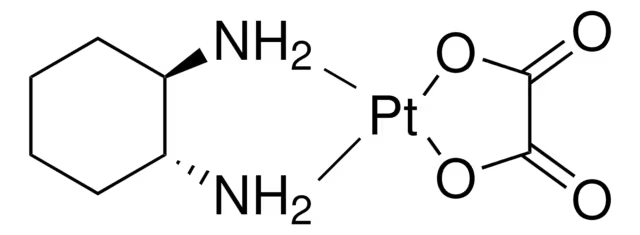
CAS Number61825-94-3
SynonymsDacplat; Oxaliplatin; MFCD00866327; Platinum(2+) ethanedioate - (1R,2R)-1,2-cyclohexanediamine (1:1); Platinum(2+) ethanedioate (1R,2R)-1,2-cyclohexanediamine (1:1); [Ethanedioato(2-)-κO,O]platinum - (1R,2R)-cyclohexane-1,2-diamine (1:1); Platinum(2+) ethanedioate (1R,2R)-1,2-cyclohexanediamine (1:1:1); Elocatin
Molecular FormulaC8H12N2O4Pt
Molecular Weight397.29
Purity99%
Boiling Point193.6ºC at 760 mmHg
Appearancepowder
Symbol
Signal WordWarning
| Chemical & Physical Properties | |
|---|---|
| CAS Number | 61825-94-3 |
| Catalog No. | 2A-9011806 |
| Chinese Name | 奥沙利铂 |
| Synonyms | Dacplat; Oxaliplatin; MFCD00866327; Platinum(2+) ethanedioate - (1R,2R)-1,2-cyclohexanediamine (1:1); Platinum(2+) ethanedioate (1R,2R)-1,2-cyclohexanediamine (1:1); [Ethanedioato(2-)-κO,O]platinum - (1R,2R)-cyclohexane-1,2-diamine (1:1); Platinum(2+) ethanedioate (1R,2R)-1,2-cyclohexanediamine (1:1:1); Elocatin |
| Molecular Formula | C8H12N2O4Pt |
| Molecular Weight | 397.29 |
| Purity | 99 |
| Boiling Point | 193.6ºC at 760 mmHg |
| Appearance | powder |
| Water Solubility | Slightly soluble in water, very slightly soluble i |
| Storage Condition | Sealed in a cool, dry environment |
| Packaging | II |
| Application | Oxaliplatin is a DNA synthesis inhibitor. It causes DNA cross-link damage, prevents DNA replication and transcription and leads to cell death. |
| HTC | 28439000 |
| PubChem ID | 329818942 |
| MDL Number | MFCD00866327 |
| SMILES | O=C1O[Pt]OC1=O.N[C@@H]2CCCC[C@H]2N |
| InChI | 1S/C6H14N2.C2H2O4.Pt/c7-5-3-1-2-4-6(5)8;3-1(4)2(5)6;/h5-6H,1-4,7-8H2;(H,3,4)(H,5,6);/q;;+2/p-2/t5-,6-;;/m1../s1 |
| InChI Key | ZROHGHOFXNOHSO-BNTLRKBRSA-L |
| NACRES Code | NA.77 |
| UNSPSC | 12352200 |
| Hazard Symbols | Transport |
| MSDS | msds/11806_1_61825_94_3.pdf |
| Bioactivity | Oxaliplatin is a DNA synthesis inhibitor. It causes DNA crosslinking damage, prevents DNA replication and transcription and causes cell death. Related Catalog Signaling Pathways >> Autophagy >> Autophagy Signaling Pathways >> Cell Cycle/DNA Damage >> DNA Alkylator/Crosslinker Research Areas >> Cancer In Vitro Oxaliplatin acts through the formation of DNA-adducts. Oxaliplatin induces primary and secondary DNA lesions leading to cell apoptosis[1]. Oxaliplatin inhibits human melanoma cell lines C32 and G361 with IC50 values of 0.98 mM and 0.14 mM, respectively[2]. Oxaliplatin potently inhibits bladder carcinoma cell lines RT4 and TCCSUP, ovarian carcinoma cell line A2780, colon carcinoma cell line HT-29, glioblastoma cell lines U-373MG and U-87MG, and melanoma cell lines SK-MEL-2 and HT-144 with IC50 of 11 μM, 15 μM, 0.17 μM, 0.97 μM, 2.95 μM, 17.6 μM, 30.9 μM and 7.85 μM, respectively[3]. In Vivo Oxaliplatin (10 mg/kg, i.p.) significantly reduces tumor volume and apoptotic index in the nude mice bearing hepatocellular HCCLM3 tumors[4]. Oxaliplatin (5 mg/kg, i.v.) is effective on T-leukemia-lymphoma L40 AKR with T/C of 1.77. Oxaliplatin is efficient on intracerebrally grafted L1210 leukemia, MA 16-C xenografts, B16 melanoma xenografts, Lewis lung xenografts and C26 colon carcinoma xenografts[5]. Oxaliplatin induces impairment of retrograde neuronal transport in mice[6]. Cell Assay Typically, cells are plated into 96-well plates on day 0 and exposed to Oxaliplatin on day 1; the sulforhodamine-B assay is carried out 48 h after Oxaliplatin exposure. The plates are incubated at 37°C in 5% CO2 and 100% relative humidity at all times except when adding Oxaliplatin and during the final assay period. The initial number of cells plated for the assay ranged from 2-20×103 cells/50/nL/well. The numbers of cells for plating and the drug exposure time are based on pilot studies using the criteria that (a) the cells in control wells are still in the log phase of growth on the day of the assay; (b) the maximum absorbance for the untreated controls on the day of the assay is in the range of 1.0 to 1.5; and (c) cells go through > 2 doublings during the drug exposure. Eight wells are used per concentration. The plates are read at 570 and/or 540 nm using a Biotek Instruments model EL309 microplate reader interfaced with an IBM PC-compatible computer. Animal Admin HCC tumor models produced by HCCLM3 are established in nude mice by subcutaneous injection of 5×10⁵ HCCLM3 cells in 0.2 mL of serum-free culture medium into the left upper flank region. Three days later, the mice are randomLy assigned to receive one of the following three treatments: i) a weekly intraperitoneal (i.p.) injection of distilled water (control group, n=8); ii) a weekly i.p. injection of oxaliplatin at 5 mg/kg (low dose group, n=7); or iii) a weekly i.p. injection of oxaliplatin at 10 mg/kg (high dose group, n=7). Tumor growth is monitored by measuring two bisecting diameters of each tumor with a caliper every 5 days. The tumor volume is calculated using the formula (V=a×b2/2), with a as the larger diameter and b as the smaller diameter. Mice are euthanized by day 32 after oxaliplatin administration. Tumors of each group are completely removed, weighed, photographed, and fixed in 10% formalin/PBS or stored in liquid nitrogen for histological examination. References [1]. Raymond E, et al. Oxaliplatin: a review of preclinical and clinical studies. Ann Oncol. 1998 Oct;9(10):1053-71. [2]. Mohammed MQ, et al. Oxaliplatin is active in vitro against human melanoma cell lines: comparison with cisplatin and carboplatin. Anticancer Drugs. 2000 Nov;11(10):859-63. [3]. Pendyala L, et al. In vitro cytotoxicity, protein binding, red blood cell partitioning, and biotransformation of oxaliplatin. Cancer Res. 1993 Dec 15;53(24):5970-6. [4]. Wang Z, et al. Oxaliplatin induces apoptosis in hepatocellular carcinoma cells and inhibits tumor growth. Expert Opin Investig Drugs. 2009 Nov;18(11):1595-604 [5]. Mathé G, et al. Oxalato-platinum or 1-OHP, a third-generation platinum complex: an experimental and clinical appraisal and preliminary comparison with cis-platinum and carboplatinum. Biomed Pharmacother. 1989;43(4):237-50. [6]. Schellingerhout D, et al. Impairment of retrograde neuronal transport in oxaliplatin-induced neuropathy demonstrated by molecular imaging. PLoS One. 2012;7(9):e45776. doi: 10.1371/journal.pone.0045776. Epub 2012 Sep 20. [7]. Romero HK, et al. Inhibition of α9α10 nicotinic acetylcholine receptors prevents chemotherapy-induced neuropathic pain. Proc Natl Acad Sci U S A. 2017 Mar 7;114(10):E1825-E1832. Chemical & Physical Properties Boiling Point 193.6ºC at 760 mmHg Molecular Formula C8H12N2O4Pt Molecular Weight 395.28 PSA 104.64000 LogP 0.61450 Appearance of Characters solid Storage condition Store at +4°C Stability Stable. Store cool. Incompatible with oxidizing agents. Water Solubility Slightly soluble in water, very slightly soluble in methanol, practically insoluble in anhydrous ethanol. | Soluble in water with heating and/or sonication |
| Use of | Oxaliplatin is a DNA synthesis inhibitor. It causes DNA crosslinking damage, prevents DNA replication and transcription and causes cell death. Properties Articles260 Name oxaliplatin Synonym More Synonyms Oxaliplatin Biological Activity Description Oxaliplatin is a DNA synthesis inhibitor. It causes DNA crosslinking damage, prevents DNA replication and transcription and causes cell death. Related Catalog Signaling Pathways >> Autophagy >> Autophagy Signaling Pathways >> Cell Cycle/DNA Damage >> DNA Alkylator/Crosslinker Research Areas >> Cancer References [1]. Raymond E, et al. Oxaliplatin: a review of preclinical and clinical studies. Ann Oncol. 1998 Oct;9(10):1053-71. [2]. Mohammed MQ, et al. Oxaliplatin is active in vitro against human melanoma cell lines: comparison with cisplatin and carboplatin. Anticancer Drugs. 2000 Nov;11(10):859-63. [3]. Pendyala L, et al. In vitro cytotoxicity, protein binding, red blood cell partitioning, and biotransformation of oxaliplatin. Cancer Res. 1993 Dec 15;53(24):5970-6. [4]. Wang Z, et al. Oxaliplatin induces apoptosis in hepatocellular carcinoma cells and inhibits tumor growth. Expert Opin Investig Drugs. 2009 Nov;18(11):1595-604 [5]. Mathé G, et al. Oxalato-platinum or 1-OHP, a third-generation platinum complex: an experimental and clinical appraisal and preliminary comparison with cis-platinum and carboplatinum. Biomed Pharmacother. 1989;43(4):237-50. [7]. Romero HK, et al. Inhibition of α9α10 nicotinic acetylcholine receptors prevents chemotherapy-induced neuropathic pain. Proc Natl Acad Sci U S A. 2017 Mar 7;114(10):E1825-E1832. Chemical & Physical Properties Molecular Formula C8H12N2O4Pt PSA 104.64000 LogP 0.61450 Appearance of Characters solid Stability Stable. Store cool. Incompatible with oxidizing agents. Water Solubility Slightly soluble in water, very slightly soluble in methanol, practically insoluble in anhydrous ethanol. | Soluble in water with heating and/or sonication |
| Transport Info | Shipping Name: UN |
| MSDS Transport Info | Module 14. Shipping information 14.1 UN dangerous goods number European Land Transport Dangerous Regulations: -International Maritime Dangerous Regulations: -International Air Transport Dangerous Regulations: - 14.2 United Nations shipping name European Land Transport Dangerous Regulations: Non-dangerous goods IMDG Code: Non-dangerous goods International air transport dangerous goods regulations: non-dangerous goods 14.3 Transport hazard categories European Land Transport Dangerous Regulations: -International Maritime Dangerous Regulations: -International Air Transport Dangerous Regulations: - 14.4 Package group European Land Transport Dangerous Regulations: -International Maritime Dangerous Regulations: -International Air Transport Dangerous Regulations: - 14.5 Environmental hazards European Land Transport Danger Regulations: No International Maritime Danger Regulations International Air Transport Danger Regulations: No Marine pollutants (yes/no): No 14.6 Special reminder to users No data available |
| Related Products in API & Advanced Intermediates | ||
|---|---|---|
| Ondansetron hydrochloride | 99614-01-4 | 2A-9011773 |
| Ondansetron hydrochloride dihydrate | 103639-04-9 | 2A-9011774 |
| Ornidazole | 16773-42-5 | 2A-9011790 |
| Oseltamivir | 196618-13-0 | 2A-9011797 |
| Oseltamivir ac | 2A-302881 | 2A-9011798 |
| Oxytetracycline | 79-57-2 | 2A-9011843 |
| Oxytetracycline dihydrate | 6153-64-6 | 2A-9011844 |
| Oxytetracycline hydrochloride | 2058-46-0 | 2A-9011845 |
| Pantoprazole | 102625-70-7 | 2A-0202337 |
| Pantoprazole sodium | 138786-67-1 | 2A-9011872 |
| Browse all API & Advanced Intermediates products » | ||
Phone:
630-322-8886
630-322-8887
Email:
Office Locations:
Chicago, IL, USA
San Francisco, CA, USA


 EN
EN


 SDS
SDS