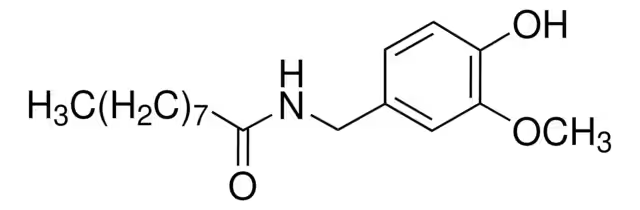
CAS Number2444-46-4
SynonymsN-[(4-hydroxy-3-methoxy-phenyl)methyl]nonanamide; N-vanillyl-nonanamide; Vanillyl pelargonic amide; (N-(4-Hydroxy-3-methoxybenzyl)nonanamide; Nonivamide; Vanillyl-N-nonylamide; Pseudocapsaicin; Capsaicin (Synthetic); N-VANILLYLNONANOAMIDE; Pelargonyl vanillylamide; N-Nonylvanylamide; NonvaMide; Capsaicin std.; nonanoic acid vanillylamide; EINECS 219-484-1; N-(4-Hydroxy-3-methoxybenzyl)nonanamide; Capsaicinoid; N-Pelargonic Acid Vanillylamide; MFCD00017286; Capsaicin synthetic; Pelargonic acid vanillylamide; NONYLVANYLAMIDE; N-Pelargonylvanillylamide; N-Vanillylnonanamide; Vanillyl n-nonoylamide; nonylic acid vanillylamide; PAVA; NON-4-ENE; (1Z)-N-(4-Hydroxy-3-methoxybenzyl)nonanimidic acid; N-Vanillylpelargonamide
Molecular FormulaC17H27NO3
Molecular Weight293.40
Purity≥98.0 (HPLC)%
Density1.0±0.1 g/cm3
Boiling Point450.4±55.0 °C at 760 mmHg
Melting Point54°C
Appearancewhite to brown powder
EINECS219-484-1
Symbol
Signal WordWarning
| Chemical & Physical Properties | |
|---|---|
| CAS Number | 2444-46-4 |
| Catalog No. | 2A-9011697 |
| Chinese Name | 辣椒素 |
| Synonyms | N-[(4-hydroxy-3-methoxy-phenyl)methyl]nonanamide; N-vanillyl-nonanamide; Vanillyl pelargonic amide; (N-(4-Hydroxy-3-methoxybenzyl)nonanamide; Nonivamide; Vanillyl-N-nonylamide; Pseudocapsaicin; Capsaicin (Synthetic); N-VANILLYLNONANOAMIDE; Pelargonyl vanillylamide; N-Nonylvanylamide; NonvaMide; Capsaicin std.; nonanoic acid vanillylamide; EINECS 219-484-1; N-(4-Hydroxy-3-methoxybenzyl)nonanamide; Capsaicinoid; N-Pelargonic Acid Vanillylamide; MFCD00017286; Capsaicin synthetic; Pelargonic acid vanillylamide; NONYLVANYLAMIDE; N-Pelargonylvanillylamide; N-Vanillylnonanamide; Vanillyl n-nonoylamide; nonylic acid vanillylamide; PAVA; NON-4-ENE; (1Z)-N-(4-Hydroxy-3-methoxybenzyl)nonanimidic acid; N-Vanillylpelargonamide |
| Molecular Formula | C17H27NO3 |
| Molecular Weight | 293.40 |
| Purity | ≥98.0 (HPLC) |
| Density | 1.0±0.1 g/cm3 |
| Boiling Point | 450.4±55.0 °C at 760 mmHg |
| Melting Point | 54°C |
| Appearance | white to brown powder |
| Water Solubility | methanol: 100 mg/mL, clear to slightly hazy |
| Storage Condition | 2-8° storage |
| Application | Nonivamide is an agonist with a 4d-EC50 of 5.1 mg/L in static toxicity testing. |
| EINECS | 219-484-1 |
| HTC | 2924299090 |
| PubChem ID | 329751014 |
| MDL Number | MFCD00017286 |
| SMILES | CCCCCCCCC(=O)NCc1ccc(O)c(OC)c1 |
| InChI | 1S/C17H27NO3/c1-3-4-5-6-7-8-9-17(20)18-13-14-10-11-15(19)16(12-14)21-2/h10-12,19H,3-9,13H2,1-2H3,(H,18,20) |
| InChI Key | RGOVYLWUIBMPGK-UHFFFAOYSA-N |
| Beilstein/REAXYS | 2144300 |
| NACRES Code | NA.24 |
| UNSPSC | 41116107 |
| Hazard Symbols | 6.1 |
| MSDS | msds/11697_1_2444_46_4.pdf |
| Bioactivity | Nonivamide is a agonist, which exhibits 4d-EC50 value of 5.1 mg/L in static toxicity tests. Related Catalog Signaling Pathways >> Membrane Transporter/Ion Channel >> TRP Channel Natural Products >> Alkaloid Research Areas >> Neurological Disease Target TRPV1[1] In Vitro Nonivamide, a synthetic derivate of natural capsaicin, has an effective antifouling activity. Capsaicin exhibits 4d-EC50 values of 5.5±0.5 mg/L, 23±2 mg/L, 6.9±0.2 mg/L, and 15.6±0.4 mg/L in static toxicity tests conducted using Pseudomonas putida, Lake Erie bacteria, Vibrio natriegens, and Vibrio parahaemolyticus, respectively. A significant growth inhibitory effect (p<0.01) is observed in the group treated with 1 mg/L of Nonivamide for 4 d, and the EC50 value (4 d-EC50) is 5.1 mg/L[1]. Nonivamide treatment causes calcium release from the ER and altered the transcription of growth arrest- and DNA damage-inducible transcript 3 (GADD153), GADD45α, GRP78/BiP, ATF3, CCND1, and CCNG2) in a manner comparable with prototypical ER stress-inducing agents. ER calcium flux is evaluated by pretreating cells with 2.5 μM thapsigargin for 5 min followed by addition of 2.5 μM Nonivamide. Treatment of TRPV1-overexpressing cells with 2.5 μM Nonivamide produces marked increases in cytosolic calcium due to release of calcium from ER stores. Treatment of TRPV1-overexpressing cells with 1 μM Nonivamide causes an approximate 50% loss in cell viability after a 24-h period. BEAS-2B cells treated with 100 and 200 μM Nonivamide also exhibits a shift in the relative amount of EIF2α-P and an increase in the expression of GADD153 mRNA and protein[2]. Treatment with Nonivamide reduces lipid accumulation to a similar extent as CAP; the effects are not different from the effects after CAP treatment at any of the tested concentrations. Compared to untreated control cells, treatment with Nonivamide decreases lipid accumulation by 5.34±1.03% (P<0.05) at 0.01 µM up to 10.4±2.47% (P<0.001) at 1 µM[3]. Cell Assay In the MTT assay, the reduction of yellow tetrazolium salt MTT to a purple formazan by mitochondrial and ER enzymes is used as a measure for cell viability. Cells are seeded in 96‐well plates and treated with 1 nM-10 µM CAP or Nonivamide with or without addition of 25-100 µM BCH or the corresponding ethanol concentration (0.1-0.2% (v/v), solvent control) for 12 days after initiation of differentiation. Cell culture media is exchanged every second day. On Day 12, 100 µL of the MTT working reagent (0.83 mg/mL MTT diluted in PBS/serum-free media (1:5)), is added to each well, and cells are incubated at 37°C for approximately 15 min. The MTT working solution is removed and the purple formazan formed during incubation is dissolved in 150 µL DMSO per well. Absorbance is measured at 550 nm with 690 nm as reference wavelength using multiwell plate reader. The number of metabolically active cells is calculated relative to untreated control cells or the corresponding solvent control (100%)[3]. References [1]. Zhou J, et al. Toxic effects of environment-friendly antifoulant Nonivamide on Phaeodactylum tricornutum. Environ Toxicol Chem. 2013 Apr;32(4):802-9. [2]. Thomas KC, et al. Transient receptor potential vanilloid 1 agonists cause endoplasmic reticulum stress and cell death in human lung cells. J Pharmacol Exp Ther. 2007 Jun;321(3):830-8. [3]. Rohm B, et al. Nonivamide enhances miRNA let-7d expression and decreases adipogenesis PPARγ expression in 3T3-L1 cells. J Cell Biochem. 2015 Jun;116(6):1153-63. Chemical & Physical Properties Density 1.0±0.1 g/cm3 Boiling Point 450.4±55.0 °C at 760 mmHg Melting Point 54°C Molecular Formula C17H27NO3 Molecular Weight 293.401 Flash Point 226.2±31.5 °C Exact Mass 293.199097 PSA 58.56000 LogP 4.38 Vapour Pressure 0.0±1.2 mmHg at 25°C Index of Refraction 1.509 InChIKey RGOVYLWUIBMPGK-UHFFFAOYSA-N SMILES CCCCCCCCC(=O)NCc1ccc(O)c(OC)c1 Storage condition 2-8°C Stability Stable. Incompatible with strong oxidizing agents. Water Solubility methanol: 100 mg/mL, clear to slightly hazy |
| Use of | Properties Articles17 Name Nonivamide Synonym More Synonyms Nonivamide Biological Activity Related Catalog Signaling Pathways >> Membrane Transporter/Ion Channel >> TRP Channel Natural Products >> Alkaloid Research Areas >> Neurological Disease References [1]. Zhou J, et al. Toxic effects of environment-friendly antifoulant Nonivamide on Phaeodactylum tricornutum. Environ Toxicol Chem. 2013 Apr;32(4):802-9. [2]. Thomas KC, et al. Transient receptor potential vanilloid 1 agonists cause endoplasmic reticulum stress and cell death in human lung cells. J Pharmacol Exp Ther. 2007 Jun;321(3):830-8. Chemical & Physical Properties Molecular Formula C17H27NO3 Exact Mass 293.199097 PSA 58.56000 Index of Refraction 1.509 InChIKey RGOVYLWUIBMPGK-UHFFFAOYSA-N Stability Stable. Incompatible with strong oxidizing agents. |
| Tax Rebate | 13.0% |
| Supervision | None. MFN tariff: 6.5%. Ordinary tariff: 30.0% |
| Transport Info | Shipping Name: UN |
| MSDS Transport Info | Module 14. Shipping information 14.1 UN dangerous goods number European Land Transport Dangerous Regulations: -International Maritime Transport Dangerous Regulations: -International Air Transport Dangerous Regulations: 3335 14.2 United Nations shipping name European Land Transport Dangerous Regulations: Non-dangerous goods IMDG Code: Non-dangerous goods Aviation regulated solid, n.o.s. (Nonivamide) 14.3 Transport hazard categories European land transport danger code: -International sea transport danger code: -International air transport danger code: 9 14.4 Package group European Land Transport Dangerous Regulations: -International Maritime Transport Dangerous Regulations: -International Air Transport Dangerous Regulations: III 14.5 Environmental hazards European Land Transport Danger Regulations: No International Maritime Danger Regulations International Air Transport Danger Regulations: No Marine pollutants (yes/no): No 14.6 Special reminder to users No data available |
| Related Products in Specialty Chemicals | ||
|---|---|---|
| Nogalamycin | 1404-15-5 | 2A-9011690 |
| Nolatrexed | 147149-76-6 | 2A-9011691 |
| Nolatrexed dihydrochloride | 152946-68-4 | 2A-9011692 |
| Nomegestrol 17-acetate | 58652-20-3 | 2A-9011694 |
| nomilin | 1063-77-0 | 2A-9011696 |
| Nonoxynol 9 | 14409-72-4 | 2A-9011698 |
| Nootkatone | 4674-50-4 | 2A-9011699 |
| Norbormide | 991-42-4 | 2A-9011700 |
| Norchlordiazepoxide | 7722-15-8 | 2A-9011702 |
| Norepinephrine | 51-41-2 | 2A-9011706 |
| Browse all Specialty Chemicals products » | ||
Phone:
630-322-8886
630-322-8887
Email:
Office Locations:
Chicago, IL, USA
San Francisco, CA, USA


 EN
EN


 SDS
SDS