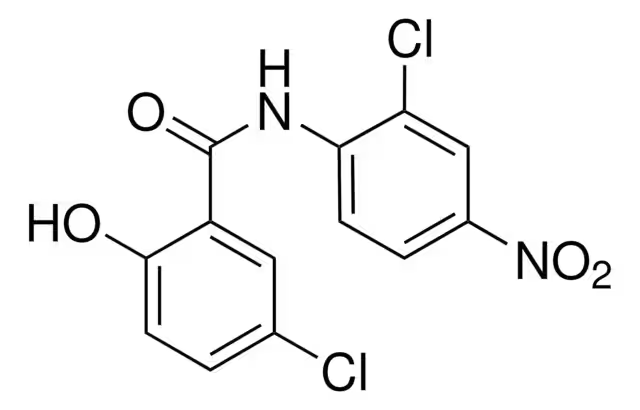
CAS Number50-65-7
Synonyms2',5-Dichloro-4'-nitrosalicylanilide; 2',5-dichloro-4'-nitrosalicylanilide; iomesan; nasemo; NICLOCIDE; hl2447; Niclosamide; clonitralid; EINECS 200-056-8; iomezan; bay2353; lintex; MFCD00057597; sulqui; 5-Chloro-N-(2-chloro-4-nitrophenyl)-2-hydroxybenzamide; mato; fenasal; 5-Chlor-N-(2-chlor-4-nitrophenyl)-2-hydroxybenzolcarboxamid; b2353
Molecular FormulaC13H8Cl2N2O4
Molecular Weight327.12
Purity97%
Density1.6±0.1 g/cm3
Boiling Point424.5±45.0 °C at 760 mmHg
Melting Point225-230ºC
Appearancepowder
EINECS200-056-8
Symbol
Signal WordWarning
| Chemical & Physical Properties | |
|---|---|
| CAS Number | 50-65-7 |
| Catalog No. | 2A-9011635 |
| Chinese Name | 氯硝柳胺 |
| Synonyms | 2',5-Dichloro-4'-nitrosalicylanilide; 2',5-dichloro-4'-nitrosalicylanilide; iomesan; nasemo; NICLOCIDE; hl2447; Niclosamide; clonitralid; EINECS 200-056-8; iomezan; bay2353; lintex; MFCD00057597; sulqui; 5-Chloro-N-(2-chloro-4-nitrophenyl)-2-hydroxybenzamide; mato; fenasal; 5-Chlor-N-(2-chlor-4-nitrophenyl)-2-hydroxybenzolcarboxamid; b2353 |
| Molecular Formula | C13H8Cl2N2O4 |
| Molecular Weight | 327.12 |
| Purity | 97 |
| Density | 1.6±0.1 g/cm3 |
| Boiling Point | 424.5±45.0 °C at 760 mmHg |
| Melting Point | 225-230ºC |
| Appearance | powder |
| Storage Condition | The warehouse is ventilated and dried at low tempe |
| Application | Niclosamide is a STAT3 inhibitor that inhibits DNA replication in HeLa cells with an IC50 value of 0.25 μM. |
| EINECS | 200-056-8 |
| HTC | 2924299090 |
| UN(IATA) | UN 无资料 |
| PubChem ID | 24278585 |
| MDL Number | MFCD00057597 |
| SMILES | Oc1ccc(Cl)cc1C(=O)Nc2ccc(cc2Cl)[N+]([O-])=O |
| InChI | 1S/C13H8Cl2N2O4/c14-7-1-4-12(18)9(5-7)13(19)16-11-3-2-8(17(20)21)6-10(11)15/h1-6,18H,(H,16,19) |
| InChI Key | RJMUSRYZPJIFPJ-UHFFFAOYSA-N |
| Beilstein/REAXYS | 2820605 |
| NACRES Code | NA.85 |
| UNSPSC | 51102829 |
| Hazard Symbols | 9.0 |
| MSDS | msds/11635_1_50_65_7.pdf |
| Bioactivity | Niclosamide is an inhibitor of STAT3 with IC50 of 0.25 μM in HeLa cells and inhibits DNA replication in a cell-free assay. Related Catalog Signaling Pathways >> JAK/STAT Signaling >> STAT Signaling Pathways >> Stem Cell/Wnt >> STAT Research Areas >> Infection Target STAT3:0.25 μM (IC50, in HeLa cells) In Vitro Niclosamide is an inhibitor of STAT3, inhibiting STAT3-mediated luciferase reporter activity with an IC50 of 0.25 μM in HeLa cells. Niclosamide (1 μM) inhibits the EGF-induced nuclear translocation of STAT3 in Du145 cells. Niclosamide (< 2 μM) dose dependently inhibits the transcription of STAT3 downstream genes in Du145 cells. Niclosamide (< 10 μM) induces G0/G1 arrest and apoptosis of Du145 cancer cells in a dose dependent manner[1]. Niclosamide can block SARS-CoV replication at a micromolar concentration in Vero E6 cells infected with SARS-CoV[2]. Niclosamide (< 7.5 μM) promotes Frizzled1 endocytosis, downregulates Dishevelled-2 protein, and inhibits Wnt3A-stimulated beta-catenin stabilization and LEF/TCF reporter activity in U2OS cells[3]. Niclosamide inhibits the TNF-induced NF-κB reporter activity in a dose- and time-dependent manner in U2OS cells. Niclosamide (125 nM) inhibits NF-κB activation induced by p65, IKKα, IKKβ, IKKγ, and TAK1 in U2OS cells. Niclosamide (< 500 nM) completely block the time- and dose-dependent TNFα-induced alteration of the NF-κB-DNA complex in HL-60 cells. Niclosamide (< 10 nM) inhibits constitutive NF-κB activation in U266 cells. Niclosamide inhibits TNF-induced degradation of IκBα and relocation of p65 in a dose- and time-dependent manner in HL-60, Molm13, or AML primary cells. Niclosamide (500 nM) causes decrease in TNF-induced NF-κB-dependent gene products involved in cell survival in HL-60 cells. Niclosamide also inhibits the growth and induces robust apoptosis of AML cells associated with decreased Mcl-1 and XIAP levels and increased intracellular ROS levels[4]. In Vivo Niclosamide (40 mg/kg/d, i.p.) suppresses the growth of xenografted AML cells in nude mice bearing HL-60 xenograft tumors[4]. Kinase Assay All of the protein kinases are expressed either in Sf9 insect cells or in E.coli as recombinant GST-fusion proteins or His-tagged proteins. A radiometric protein kinase assay is used for measuring the kinase activity of the 22 protein kinases. Briefly, for each protein kinase, 50 μL reaction cocktail containing 60 mM HEPES-NaOH, 3 mM MgCl2, 3 mM MnCl2, 3 μM Na-orthovanadate, 1.2 mM DTT, 50 μg/mL PEG20000, 1 μM [γ-33P]-ATP, Niclosamide, adequate amount of enzyme and its substrate. The PKC-alpha assay additionally contain 1 mM Ca2, 4 mM EDTA, 5 μg/mL phosphatidylserine and 1 μg/mL 1, 2-Dioleyl-glycerol. The reaction cocktails are incubated at 37°C for 60 minutes and stop with 50 μL 2% (v/v) H3PO4. Incorporation of 33Pi is determined with a microplate scintillation counter. The activities and the IC50 values are calculated using Quattro Workflow V2.28. Cell Assay Cells are plated in 96-well culture plates with cell density of 3-4 ×10³ cells/well and treat with Niclosamide by adding 100 μL medium containing Niclosamide of various concentrations on the second day. After 72-hour's treatment, MTT is added to each well and incubated for additional 4-5 hours, and the absorbance is measured on a microplate reader at 570 nm. Cell growth inhibition is evaluated as the ratio of the absorbance of the sample to that of the control. The results are representative of at least 3 independent experiments. Animal Admin Male nu/nu BALB/c mice are used in the assay. HL-60 cells are inoculated s.c. on the flanks of 4- to 6-wk-old mice. Tumors are measured every other day with use of calipers. Mice bearing HL-60 xenografts are randomized to receive treatment with normal saline (control) or p-niclosamide for 15 days (n=7 animals each). Tumor volumes are calculated by the following formula: a2×b×0.4, where a is the smallest diameter and b is the diameter perpendicular to a. After mice are euthanized, xenografts are dissected, weighed, or preserved. References [1]. Ren, X., et al., Identification of niclosamide as a new small-molecule inhibitor of the STAT3 signaling pathway. ACS Medicinal Chemistry Letters, 2010. 1(9): p. 454-459. [2]. Wu CJ, et al. Inhibition of severe acute respiratory syndrome coronavirus replication by niclosamide. Antimicrob Agents Chemother. 2004 Jul;48(7):2693-6. [3]. Chen, M., et al., The anti-helminthic niclosamide inhibits Wnt/Frizzled1 signaling. Biochemistry, 2009. 48(43): p. 10267-74. [4]. Jin, Y., et al. Antineoplastic mechanisms of niclosamide in acute myelogenous leukemia stem cells: inactivation of the NF-kappaB pathway and generation of reactive oxygen species. Cancer Res, 2010. 70(6): p. 2516-27. Chemical & Physical Properties Density 1.6±0.1 g/cm3 Boiling Point 424.5±45.0 °C at 760 mmHg Melting Point 225-230ºC Molecular Formula C13H8Cl2N2O4 Molecular Weight 327.120 Flash Point 210.5±28.7 °C Exact Mass 325.986115 PSA 95.15000 LogP 5.41 Vapour Pressure 0.0±1.0 mmHg at 25°C Index of Refraction 1.709 InChIKey RJMUSRYZPJIFPJ-UHFFFAOYSA-N SMILES O=C(Nc1ccc([N+](=O)[O-])cc1Cl)c1cc(Cl)ccc1O |
| Use of | Niclosamide is an inhibitor of STAT3 with IC50 of 0.25 μM in HeLa cells and inhibits DNA replication in a cell-free assay. Properties Articles51 Name niclosamide Synonym More Synonyms Niclosamide Biological Activity Description Niclosamide is an inhibitor of STAT3 with IC50 of 0.25 μM in HeLa cells and inhibits DNA replication in a cell-free assay. Related Catalog Signaling Pathways >> JAK/STAT Signaling >> STAT Signaling Pathways >> Stem Cell/Wnt >> STAT Research Areas >> Infection STAT3:0.25 μM (IC50, in HeLa cells) References [1]. Ren, X., et al., Identification of niclosamide as a new small-molecule inhibitor of the STAT3 signaling pathway. ACS Medicinal Chemistry Letters, 2010. 1(9): p. 454-459. [2]. Wu CJ, et al. Inhibition of severe acute respiratory syndrome coronavirus replication by niclosamide. Antimicrob Agents Chemother. 2004 Jul;48(7):2693-6. [3]. Chen, M., et al., The anti-helminthic niclosamide inhibits Wnt/Frizzled1 signaling. Biochemistry, 2009. 48(43): p. 10267-74. [4]. Jin, Y., et al. Antineoplastic mechanisms of niclosamide in acute myelogenous leukemia stem cells: inactivation of the NF-kappaB pathway and generation of reactive oxygen species. Cancer Res, 2010. 70(6): p. 2516-27. Chemical & Physical Properties Exact Mass 325.986115 PSA 95.15000 Index of Refraction 1.709 InChIKey RJMUSRYZPJIFPJ-UHFFFAOYSA-N |
| Tax Rebate | 13.0% |
| Supervision | None. MFN tariff: 6.5%. Ordinary tariff: 30.0% |
| Transport Info | Product name: Chemical name |
| Related Products in Specialty Chemicals | ||
|---|---|---|
| Nicardipine | 55985-32-5 | 2A-9011630 |
| Nicardipine Hydrochloride | 54527-84-3 | 2A-0201798 |
| Nicergoline | 27848-84-6 | 2A-9011632 |
| Niceritrol | 5868-05-3 | 2A-9011633 |
| Niclofolan | 10331-57-4 | 2A-9011634 |
| Nicoclonate | 10571-59-2 | 2A-9011638 |
| Nicodicodine | 808-24-2 | 2A-9011639 |
| Nicofurate | 4397-91-5 | 2A-9011641 |
| Nicomol | 27959-26-8 | 2A-9011642 |
| Nicoracetam | 128326-80-7 | 2A-9011643 |
| Browse all Specialty Chemicals products » | ||
Phone:
630-322-8886
630-322-8887
Email:
Office Locations:
Chicago, IL, USA
San Francisco, CA, USA


 EN
EN


 SDS
SDS