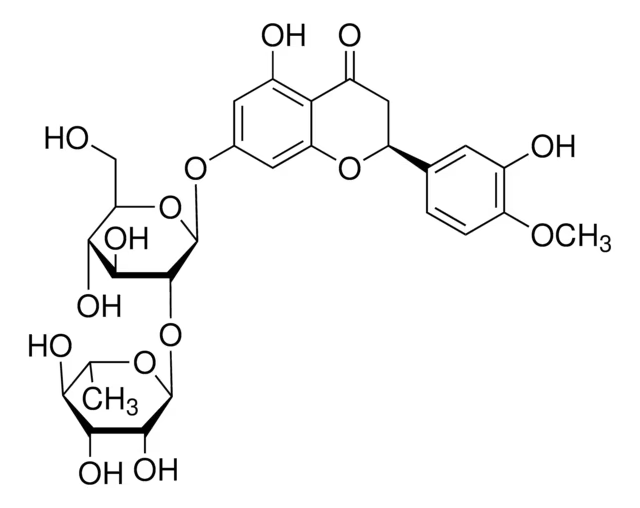
CAS Number13241-33-3
SynonymsHESPERETIN-7-NEOHESPERIDOSIDE; Hesperetin7-neohesperidoside; hesperetin 7-O-neohesperoside; Neohesperidin; Neohesperdin; MFCD00017357; Hesperetin-7-O-neohesperidoside; EINECS 236-216-9; (S)-4'-Methoxy-3',5,7-trihydroxyflavanone-7-[2-O-(α-L-rhamnopyranosyl)-β-D-glucopyranoside]; Hesperetin 7-O-neohesperidoside
Molecular FormulaC28H34O15
Molecular Weight610.56
Purity≥90 (HPLC)%
Density1.7±0.1 g/cm3
Boiling Point933.7±65.0 °C at 760 mmHg
Melting Point245.3 °C ((473.5 °F ) at 1,011 hPa - OECD Test)
Appearancepowder
EINECS236-216-9
Symbol
Signal WordWarning
| Chemical & Physical Properties | |
|---|---|
| CAS Number | 13241-33-3 |
| Catalog No. | 2A-9011609 |
| Chinese Name | 新橙皮苷 |
| Synonyms | HESPERETIN-7-NEOHESPERIDOSIDE; Hesperetin7-neohesperidoside; hesperetin 7-O-neohesperoside; Neohesperidin; Neohesperdin; MFCD00017357; Hesperetin-7-O-neohesperidoside; EINECS 236-216-9; (S)-4'-Methoxy-3',5,7-trihydroxyflavanone-7-[2-O-(α-L-rhamnopyranosyl)-β-D-glucopyranoside]; Hesperetin 7-O-neohesperidoside |
| Molecular Formula | C28H34O15 |
| Molecular Weight | 610.56 |
| Purity | ≥90 (HPLC) |
| Density | 1.7±0.1 g/cm3 |
| Boiling Point | 933.7±65.0 °C at 760 mmHg |
| Melting Point | 245.3 °C ((473.5 °F ) at 1,011 hPa - OECD Test) |
| Appearance | powder |
| Storage Condition | 2-8°C |
| Application | Neohesperidin is a flavonoid compound abundantly found in Cucurbitaceae plants and has antioxidant and anti-inflammatory effects. |
| EINECS | 236-216-9 |
| PubChem ID | 24897534 |
| MDL Number | MFCD16661259 |
| SMILES | COc1ccc(cc1O)[C@@H]2CC(=O)c3c(O)cc(O[C@@H]4O[C@H](CO)[C@@H](O)[C@H](O)[C@H]4O[C@@H]5O[C@@H](C)[C@H](O)[C@@H](O)[C@H]5O)cc3O2 |
| InChI | 1S/C28H34O15/c1-10-21(33)23(35)25(37)27(39-10)43-26-24(36)22(34)19(9-29)42-28(26)40-12-6-14(31)20-15(32)8-17(41-18(20)7-12)11-3-4-16(38-2)13(30)5-11/h3-7,10,17,19,21-31,33-37H,8-9H2,1-2H3/t10-,17-,19+,21-,22+,23+,24-,25+,26+,27-,28+/m0/s1 |
| InChI Key | ARGKVCXINMKCAZ-UZRWAPQLSA-N |
| Beilstein/REAXYS | 74945 |
| NACRES Code | NA.25 |
| UNSPSC | 12352201 |
| Hazard Symbols | Transport |
| MSDS | msds/11609_1_13241_33_3.pdf |
| Bioactivity | Neohesperidin is a flavonoid compound found in high amounts in Poncirus trifoliata with anti-oxidant and anti-inflammatory effects. Related Catalog Signaling Pathways >> Others >> Others Research Areas >> Inflammation/Immunology Natural Products >> Flavonoids In Vitro Neohesperidin induces cell apoptosis in human breast adenocarcinoma MDA-MB-231 cells. The IC50 values of neohesperidin at 24 and 48 h are 47.4±2.6 μM and 32.5±1.8 μM, respectively. The expressions of P53 and Bax in the neohesperidin-treated cells are significantly up-regulated, while that of Bcl-2 is down-regulated[1]. Neohesperidin exhibits antioxidant activity (IC50=22.31 μg/mL) in the DPPH radical-scavenging assay[2]. In Vivo Neohesperidin (50 mg/kg) significantly inhibits 55.0% of HCl/ethanol-induced gastric lesions. In pylorus ligated rats, neohesperidin (50 mg/kg) significantly decreases the volume of gastric secretion and gastric acid output, and increases the pH[1]. Treatment of neohesperidin significantly decreases fasting glucose, serum glucose, and glycosylated serum protein (GSP) in mice. It significantly elevates oral glucose tolerance and insulin sensitivity and decreases insulin resistance in the diabetic mice. Neohesperidin significantly decreases serum triglycerides, total cholesterol, leptin level, and liver index in the mice[3]. Animal Admin Mice: All the mice are fasted 6 h before the test and then fed with water or neohesperidin by gavage. The mice are intraperitoneally injected with either 2 g/kg BW glucose or 1 IU/kg BW insulin for OGTT and ITT, respectively. Blood samples are collected from the tail vein for the measurement of basal blood glucose levels (0 min) before the injection of glucose or insulin. Additional blood glucose levels are measured at 30, 60, 90 and 120 min[3]. References [1]. Lee JH, et al. Protective effects of neohesperidin and poncirin isolated from the fruits of Poncirus trifoliata on potential gastric disease. Phytother Res. 2009 Dec;23(12):1748-53. [2]. Xu F, et al. Neohesperidin induces cellular apoptosis in human breast adenocarcinoma MDA-MB-231 cells via activating the Bcl-2/Bax-mediated signaling pathway. Nat Prod Commun. 2012 Nov;7(11):1475-8. [3]. Jia S, et al. Hypoglycemic and hypolipidemic effects of neohesperidin derived from Citrus aurantium L. in diabetic KK-A(y) mice. Food Funct. 2015 Mar;6(3):878-86. Chemical & Physical Properties Density 1.7±0.1 g/cm3 Boiling Point 933.7±65.0 °C at 760 mmHg Melting Point 239-243ºC Molecular Formula C28H34O15 Molecular Weight 610.561 Flash Point 306.7±27.8 °C Exact Mass 610.189758 PSA 234.29000 LogP 2.44 Vapour Pressure 0.0±0.3 mmHg at 25°C Index of Refraction 1.695 InChIKey ARGKVCXINMKCAZ-QJBIFVCTSA-N SMILES COc1ccc(C2CC(=O)c3c(O)cc(OC4OC(CO)C(O)C(O)C4OC4OC(C)C(O)C(O)C4O)cc3O2)cc1O Storage condition 2-8°C |
| Use of | Neohesperidin is a flavonoid compound found in high amounts in Poncirus trifoliata with anti-oxidant and anti-inflammatory effects. Properties Articles11 Name neohesperidin Synonym More Synonyms Neohesperidin Biological Activity Description Neohesperidin is a flavonoid compound found in high amounts in Poncirus trifoliata with anti-oxidant and anti-inflammatory effects. Related Catalog Signaling Pathways >> Others >> Others Research Areas >> Inflammation/Immunology Natural Products >> Flavonoids References [1]. Lee JH, et al. Protective effects of neohesperidin and poncirin isolated from the fruits of Poncirus trifoliata on potential gastric disease. Phytother Res. 2009 Dec;23(12):1748-53. [3]. Jia S, et al. Hypoglycemic and hypolipidemic effects of neohesperidin derived from Citrus aurantium L. in diabetic KK-A(y) mice. Food Funct. 2015 Mar;6(3):878-86. Chemical & Physical Properties Molecular Formula C28H34O15 Exact Mass 610.189758 PSA 234.29000 Index of Refraction 1.695 InChIKey ARGKVCXINMKCAZ-QJBIFVCTSA-N |
| Transport Info | Product name: Purity: 98.0% |
| MSDS Transport Info | Module 14. Shipping information 14.1 UN dangerous goods number European Land Transport Dangerous Regulations: -International Maritime Dangerous Regulations: -International Air Transport Dangerous Regulations: - 14.2 Names specified by the United Nations (UN) European Land Transport Dangerous Regulations: Non-dangerous goods IMDG Code: Non-dangerous goods International air transport dangerous goods regulations: non-dangerous goods 14.3 Transport hazard categories European Land Transport Dangerous Regulations: -International Maritime Dangerous Regulations: -International Air Transport Dangerous Regulations: - 14.4 Package group European Land Transport Dangerous Regulations: -International Maritime Dangerous Regulations: -International Air Transport Dangerous Regulations: - 14.5 Environmental hazards European Land Transport Dangerous Regulations: No International Maritime Transport Dangerous Regulations Maritime Pollutants: No International Air Transport Risk Regulations: No 14.6 Special reminder to users No data available |
| Related Products in Specialty Chemicals | ||
|---|---|---|
| Nefopam | 13669-70-0 | 2A-9011601 |
| Nefopam hydrochloride | 23327-57-3 | 2A-9011602 |
| Neldazosin | 109713-79-3 | 2A-9011603 |
| Nemazoline | 130759-56-7 | 2A-9011606 |
| Neoarsphenamine | 457-60-3 | 2A-9011607 |
| Neomycin sulfate | 1405-10-3 | 2A-9011610 |
| Neoruscogenin | 17676-33-4 | 2A-9011612 |
| Neostigmine methyl sulfate | 51-60-5 | 2A-9011613 |
| Nepicastat | 173997-05-2 | 2A-9011615 |
| Nequinate | 13997-19-8 | 2A-9011616 |
| Browse all Specialty Chemicals products » | ||
Phone:
630-322-8886
630-322-8887
Email:
Office Locations:
Chicago, IL, USA
San Francisco, CA, USA


 EN
EN


 SDS
SDS