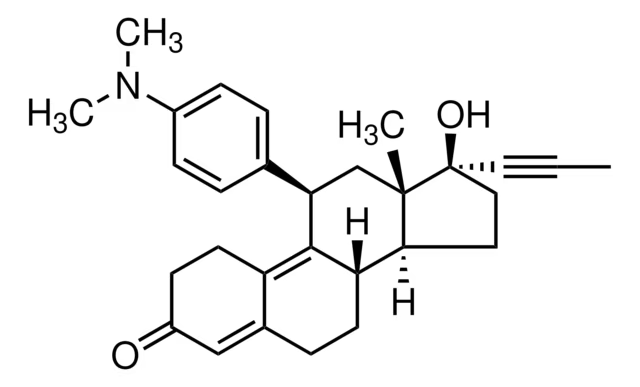
CAS Number84371-65-3
Synonyms11b-[4-(N,N-Dimethylamino)phenyl]-17a-(prop-1-ynyl)-D4,9-estradiene-17b-ol-3-one; (11β,17β)-11-[4-(Dimethylamino)phenyl]-17-hydroxy-17-(prop-1-yn-1-yl)estra-4,9-dien-3-one; (11β,17β)-11-[4-(dimethylamino)phenyl]-17-hydroxy-17-prop-1-yn-1-ylestra-4,9-dien-3-one; RU486; (11b,17b)-11-[4-(Dimethylamino)phenyl]-17-hydroxy-17-(1-propynyl)estra-4,9-dien-3-one; MFCD00867226; RU-486; Mifepristone; Mifestone; 17-β-Hydroxy-11-β-(4-dimethylaminophenyl)-17-α-(1- propynyl)-estra-4,9-dien-3-one
Molecular FormulaC29H35NO2
Molecular Weight429.59
Purity≥98%
Density1.2±0.1 g/cm3
Boiling Point628.6±55.0 °C at 760 mmHg
Melting Point195-198°C
Appearancepowder
| Chemical & Physical Properties | |
|---|---|
| CAS Number | 84371-65-3 |
| Catalog No. | 2A-9011443 |
| Chinese Name | 米非司酮 |
| Synonyms | 11b-[4-(N,N-Dimethylamino)phenyl]-17a-(prop-1-ynyl)-D4,9-estradiene-17b-ol-3-one; (11β,17β)-11-[4-(Dimethylamino)phenyl]-17-hydroxy-17-(prop-1-yn-1-yl)estra-4,9-dien-3-one; (11β,17β)-11-[4-(dimethylamino)phenyl]-17-hydroxy-17-prop-1-yn-1-ylestra-4,9-dien-3-one; RU486; (11b,17b)-11-[4-(Dimethylamino)phenyl]-17-hydroxy-17-(1-propynyl)estra-4,9-dien-3-one; MFCD00867226; RU-486; Mifepristone; Mifestone; 17-β-Hydroxy-11-β-(4-dimethylaminophenyl)-17-α-(1- propynyl)-estra-4,9-dien-3-one |
| Molecular Formula | C29H35NO2 |
| Molecular Weight | 429.59 |
| Purity | ≥98 |
| Density | 1.2±0.1 g/cm3 |
| Boiling Point | 628.6±55.0 °C at 760 mmHg |
| Melting Point | 195-198°C |
| Appearance | powder |
| Water Solubility | Soluble in: chloroform |
| Storage Condition | Refrigerated, airtight, dry place at 2-8°C |
| Application | Mifepristone is a progesterone receptor (PR) and glucocorticoid receptor (GR) antagonist with IC50 values of 0.2 nM and 2.6 nM respectively in in vitro experiments. |
| PubChem ID | 24278572 |
| MDL Number | MFCD00867226 |
| SMILES | [H][C@@]12CCC3=CC(=O)CCC3=C1[C@H](C[C@@]4(C)[C@@]2([H])CC[C@@]4(O)C#CC)c5ccc(cc5)N(C)C |
| InChI | 1S/C29H35NO2/c1-5-15-29(32)16-14-26-24-12-8-20-17-22(31)11-13-23(20)27(24)25(18-28(26,29)2)19-6-9-21(10-7-19)30(3)4/h6-7,9-10,17,24-26,32H,8,11-14,16,18H2,1-4H3/t24-,25+,26-,28-,29-/m0/s1 |
| InChI Key | VKHAHZOOUSRJNA-GCNJZUOMSA-N |
| NACRES Code | NA.77 |
| UNSPSC | 51111800 |
| MSDS | msds/11443_1_84371_65_3.pdf |
| Bioactivity | Mifepristone is a progesterone receptor (PR) and glucocorticoid receptor (GR) antagonist with IC50s of 0.2 nM and 2.6 nM in in vitro assay. Related Catalog Signaling Pathways >> Autophagy >> Autophagy Signaling Pathways >> GPCR/G Protein >> Glucocorticoid Receptor Signaling Pathways >> Others >> Progesterone Receptor Research Areas >> Endocrinology Target IC50: 0.2 nM (progesterone receptor, in T47D cells), 2.6 nM (glucocorticoid receptor, in A549 cells)[1] In Vitro The discovery of the first competitive progesterone antagonist, Mifepristone, has stimulated an intense search for more potent and more selective antiprogestins[1]. Cell growth is evaluated after 4 days of exposure to Mifepristone at 10 μM, a concentration close to the plasma concentration achievable in humans. The antiproliferative effect of Cisplatin is potentiated when administered in combination with Mifepristone in HeLa cells. The IC50 of Cisplatin in combination with Mifepristone is lower (14.2 μM) than that of Cisplatin alone (34.2 μM) in HeLa cells with an approximately 2.5-fold difference. After treatment with Mifepristone, the accumulation of intracellular Cisplatin in HeLa cells is 2-fold greater, representing a significant difference (p=0.009), compare with Cisplatin alone from 0.79 to 1.52 μg/mg of protein[2]. In Vivo The cervix tumor xenograft models are treated with Cisplatin alone, there is a tumor growth inhibition compare with control group. However, the tumor weight loss is even more significant (p<0.05) with the combination of Cisplatin and Mifepristone at the doses used, showing a decrease of ~50% compared with the treatments alone by the end of the study[2]. Adult male Sprague-Dawley rats are subjected to a 4-day binge-like EtOH administration regimen (3 to 5 g/kg/i.g. every 8 hours designed to produce peak blood EtOH levels (BELs) of <300 mg/dL). Subgroups of animals receive s.c. injection of Mifepristone (20 or 40 mg/kg in peanut oil). Although Mifepristone produces no significant changes in behavior of EtOH-naïve animals, pretreatment with Mifepristone (40 mg/kg) significantly reducesthe severity of EtOH withdrawal. Asignificant interaction between diet and drug, F(5,55)=3.92, p<0.05, such that EtOH-treated animals receiving vehicle or 20 mg/kg of Mifepristone displayssignificantly more signs of EtOH withdrawal than does EtOH-naïve animals receiving the same drug treatment. Importantly, treatment with 40 mg/kg of Mifepristone significantly reduces the severity of EtOH withdrawal, in a dose-dependent manner[3]. Kinase Assay T47D human breast cancer cells are plated in 96-well tissue culture plates at 10,000 cells per well in assay medium [RPMI medium without phenol red containing 5% (v/v) charcoal-treated FBS and 1% (v/v) penicillin-streptomycin]. Two days later, the medium is decanted and Mifepristone or control is added at a final concentration of 0.1% (v/v) dimethylsulfoxide in fresh assay medium. Twenty-four hours later, an alkaline phosphatase assay is performed using a SEAP kit. Briefly, the medium is decanted and the cells are fixed for 30 min at room temperature with 5% (v/v) formalin. The cells are washed once at room temperature with Hanks' buffered saline solution. Equal volumes (0.05 mL) of 1× dilution buffer, assay buffer, and 1:20 substrate/enhancer mixture are then added. After a 1-h incubation at room temperature in the dark, the lysate is transferred to a white 96-well plate and luminescence is read using a LuminoSkan Ascent[1]. Cell Assay The HeLa and CaSki human cervical cancer cell lines are used. The effect of Mifepristone on proliferation of cells exposed to Cisplatin is evaluated using the XTT assay. The assay is based on the cleavage of the yellow tetrazolium salt XTT to form an orange formazan dye by metabolically active cells. The procedure is as follows. Cells are seeded into 96-well plates; Costar at a density of 6×10³ viable cells per well in 100 μL culture medium. At the end of treatment with Cisplatin alone or the combination of Cisplatin plus Mifepristone, 50 μL XTT is added to each well (final concentration 0.3 mg/mL), follow by incubation for 4 h in a humidified atmosphere containing 5% CO2 at 37˚C. The absorbance of the samples is measured spectrophotometrically at 492 nm using a microtiter plate ELISA reader[2]. Animal Admin Mice[2] Female Nude mice between 6-8 weeks of age are implanted subcutaneously with 6×10⁶ HeLa cells in a flank. Once tumors are ~5×5 mm, the animals are pair-matched into treatment and control groups. Each group consist of 8 tumor-bearing mice. The intraperitoneal administration of drugs or vehicle begin on day 0. Cisplatin, as a single agent, is administered intraperitoneally at a dose of 3 mg/kg daily on days 1 through 3; the dose of Mifepristone, as a single agent, is 2 mg/kg/day subcutaneously for 3 days; in the combination study, the mice concurrently receive Cisplatin on the same schedule, and Mifepristone at the same dose 3 days previous to the administration of Cisplatin. The control animals receive only the vehicle. After administration of the drugs, mice are weighed and the tumors are measured with a caliper twice weekly. The tumor weight is calculated. Experiment is conducted for 74 days, after which time all animals are weighed and humanely euthanized. Rats[3] Adult male Sprague-Dawley rats, weighing between 224 and 245 g upon arrival, are used. Mifepristone (20 or 40 mg/kg) or vehicle (peanut oil) are administered subcutaneously (s.c.) once daily following the 0800 administration of EtOH or control diet. Mifepristone is suspended in peanut oil and sonicated for 30 minutes at least 24 hours prior to injection, it is then stored at 4°C until needed. Suspension is vortexed for 10 to 15 minutes prior to and as needed throughout dosing. References [1]. Jiang W, et al. New progesterone receptor antagonists: phosphorus-containing 11beta-aryl-substituted steroids. Bioorg Med Chem. 2006 Oct 1;14(19):6726-32. [2]. Jurado R, et al. Cisplatin cytotoxicity is increased by mifepristone in cervical carcinoma: an in vitro and in vivo study. Oncol Rep. 2009 Nov;22(5):1237-45. [3]. Sharrett-Field L, et al. Mifepristone Pretreatment Reduces Ethanol Withdrawal Severity In Vivo. Alcohol Clin Exp Res. 2013 Aug;37(8):1417-23. Chemical & Physical Properties Density 1.2±0.1 g/cm3 Boiling Point 628.6±55.0 °C at 760 mmHg Melting Point 195-198°C Molecular Formula C29H35NO2 Molecular Weight 429.594 Flash Point 334.0±31.5 °C Exact Mass 429.266785 PSA 40.54000 LogP 4.95 Vapour Pressure 0.0±1.9 mmHg at 25°C Index of Refraction 1.623 InChIKey VKHAHZOOUSRJNA-GCNJZUOMSA-N SMILES CC#CC1(O)CCC2C3CCC4=CC(=O)CCC4=C3C(c3ccc(N(C)C)cc3)CC21C Storage condition 2-8°C |
| Use of | Mifepristone is a progesterone receptor (PR) and glucocorticoid receptor (GR) antagonist with IC50s of 0.2 nM and 2.6 nM in in vitro assay. Properties Articles191 Name mifepristone Synonym More Synonyms Mifepristone Biological Activity Description Mifepristone is a progesterone receptor (PR) and glucocorticoid receptor (GR) antagonist with IC50s of 0.2 nM and 2.6 nM in in vitro assay. Related Catalog Signaling Pathways >> Autophagy >> Autophagy Signaling Pathways >> GPCR/G Protein >> Glucocorticoid Receptor Signaling Pathways >> Others >> Progesterone Receptor Research Areas >> Endocrinology In Vitro The discovery of the first competitive progesterone antagonist, Mifepristone, has stimulated an intense search for more potent and more selective antiprogestins[1]. Cell growth is evaluated after 4 days of exposure to Mifepristone at 10 μM, a concentration close to the plasma concentration achievable in humans. The antiproliferative effect of Cisplatin is potentiated when administered in combination with Mifepristone in HeLa cells. The IC50 of Cisplatin in combination with Mifepristone is lower (14.2 μM) than that of Cisplatin alone (34.2 μM) in HeLa cells with an approximately 2.5-fold difference. After treatment with Mifepristone, the accumulation of intracellular Cisplatin in HeLa cells is 2-fold greater, representing a significant difference (p=0.009), compare with Cisplatin alone from 0.79 to 1.52 μg/mg of protein[2]. References [1]. Jiang W, et al. New progesterone receptor antagonists: phosphorus-containing 11beta-aryl-substituted steroids. Bioorg Med Chem. 2006 Oct 1;14(19):6726-32. [2]. Jurado R, et al. Cisplatin cytotoxicity is increased by mifepristone in cervical carcinoma: an in vitro and in vivo study. Oncol Rep. 2009 Nov;22(5):1237-45. [3]. Sharrett-Field L, et al. Mifepristone Pretreatment Reduces Ethanol Withdrawal Severity In Vivo. Alcohol Clin Exp Res. 2013 Aug;37(8):1417-23. Chemical & Physical Properties Molecular Formula C29H35NO2 Exact Mass 429.266785 PSA 40.54000 Index of Refraction 1.623 InChIKey VKHAHZOOUSRJNA-GCNJZUOMSA-N |
| Transport Info | Product name: Purity: 98.0% |
| MSDS Transport Info | Module 14. Shipping information United Nations classification: inconsistent with United Nations classification standards UN number: not specified |
| Related Products in Specialty Chemicals | ||
|---|---|---|
| Micinicate | 39537-99-0 | 2A-9011435 |
| Micronomicin sulfate | 66803-19-8 | 2A-9011437 |
| Midecamycin | 35457-80-8 | 2A-9011439 |
| Midesteine | 94149-41-4 | 2A-9011440 |
| Midodrine hydrochloride | 3092-17-9 | 2A-9011442 |
| Mifobate | 76541-72-5 | 2A-9011444 |
| milacainide | 141725-10-2 | 2A-9011446 |
| Mildonate | 76144-81-5 | 2A-9011447 |
| Milfasartan | 148564-47-0 | 2A-9011448 |
| Milnacipran | 92623-85-3 | 2A-9011449 |
| Browse all Specialty Chemicals products » | ||
Phone:
630-322-8886
630-322-8887
Email:
Office Locations:
Chicago, IL, USA
San Francisco, CA, USA


 EN
EN


 SDS
SDS