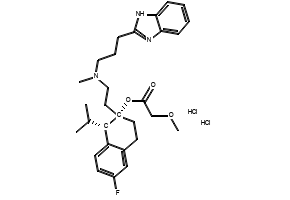
| Chemical & Physical Properties | |
|---|---|
| CAS Number | 116666-63-8 |
| Catalog No. | 2A-9011434 |
| Chinese Name | 米贝拉地尔 |
| Synonyms | Mibefradil hydrochloride; Mibefradil (dihydrochloride) |
| Molecular Formula | C29H40O3N3Cl2F1 |
| Molecular Weight | 568.56 |
| Purity | 98 |
| Boiling Point | 647.6ºC at 760mmHg |
| Storage Condition | 2-8℃ |
| Application | Mibefradil dihydrochloride is a calcium channel inhibitor that selectively acts on T-type Ca2+ channels, acting on T-type and L-type channels, with IC50 of 2.7 μM and 18.6 μM respectively. |
| MDL Number | MFCD00881804 |
| SMILES | COCC(=O)OC1(CCN(C)CCCc2nc3ccccc3[nH]2)CCc2cc(F)ccc2C1C(C)C.Cl.Cl |
| InChI | InChI=1S/C29H38FN3O3.2ClH/c1-20(2)28-23-12-11-22(30)18-21(23)13-14-29(28,36-27(34)19-35-4)15-17-33(3)16-7-10-26-31-24-8-5-6-9-25(24)32-26;;/h5-6,8-9,11-12,18,20,28H,7,10,13-17,19H2,1-4H3,(H,31,32);2*1H/t28-,29-;;/m0../s1 |
| InChI Key | MTJLQTFHJIHXIX-GDUXWEAWSA-N |
| Hazard Symbols | Transport |
| MSDS | msds/11434_1_116666_63_8.pdf |
| Bioactivity | Mibefradil dihydrochloride is a calcium channel blocker with moderate selectivity for T-type Ca2+ channels displaying IC50s of 2.7 μM and 18.6 μM for T-type and L-type currents, respectively. Related Catalog Signaling Pathways >> Membrane Transporter/Ion Channel >> Calcium Channel Research Areas >> Cardiovascular Disease Target IC50: 2.7 μM (T-type calcium channel), 18.6 μM (L-type calcium channel)[1] In Vitro Mibefradil dihydrochloride inhibits reversibly the T- and L-type currents with IC50 values of 2.7 and 18.6 μM, respectively. The inhibition of the L-type current is voltage-dependent, whereas that of the T-type current is not. Ro 40-5967 blocks T-type current already at a holding potential of -100 mV[1] At a higher concentration (20 µM), Mibefradil reduces the amplitude of excitatory junction potentials (by 37±10 %), slows the rate of repolarisation (by 44±16 %) and causes a significant membrane potential depolarisation (from −83±1 mV to −71±5 mV). At a higher Mibefradil concentration (20 µM) there is significant membrane potential depolarisation and a slowing of repolarisation. These actions of Mibefradil are consistent with K+ channel inhibition, which has been shown to occur in human myoblasts and other cells[2]. In Vivo The hearing thresholds of the 24-26 week old C57BL/6J mice differ following the 4-week treatment period. The hearing threshold at 24 kHz is significantly decreased in the Mibefradil-treated and benidipine-treated groups compared with the saline-treated group (P<0.05)[3]. Compared with the saline-treated group, rats receiving Mibefradil or Ethosuximide show significant lower CaV3.2 expression in the spinal cord and DRG[4]. Animal Admin Mice[3] A total of 30 male C57BL/6J mice (age, 6-8 weeks) are randomized into three groups for the detection of three calcium channel receptor subunits α1G, α1H and α1I, using reverse transcription-quantitative polymerase chain reaction (RT-qPCR). In addition, a further 30 C57BL/6J male mice (age, 24-26 weeks) are allocated at random into three treatment groups: Saline, Mibefradil and benidipine. Each group is subjected to auditory brainstem recording (ABR) and distortion product otoacoustic emission (DPOAE) tests following treatment. Mibefradil and benidipine are dissolved in physiological saline solution. A preliminary experiment led to the selection of dosages of 30 mg/kg/day Mibefradil and 10 mg/kg/day Benidipine. The drugs are administered to the mice by gavage for four consecutive weeks. Rats[4] Male Sprague-Dawley rats (200-250 g) are used for right L5/6 SNL to induce neuropathic pain. Intrathecal infusion of saline or TCC blockers [Mibefradil (0.7 μg/h) or Ethosuximide (60 μg/h)] is started after surgery for 7 days. Fluorescent immunohistochemistry and Western blotting are used to determine the expression pattern and protein level of CaV3.2. Hematoxylin-eosin and toluidine blue staining are used to evaluate the neurotoxicity of tested agents. References [1]. Mehrke G, et al. The Ca(++)-channel blocker Ro 40-5967 blocks differently T-type and L-type Ca++ channels. J Pharmacol Exp Ther. 1994 Dec;271(3):1483-8. [2]. Brain KL, et al. The sources and sequestration of Ca(2+) contributing to neuroeffector Ca(2+) transients in the mouse vas deferens. J Physiol. 2003 Dec 1;553(Pt 2):627-35. [3]. Yu YF, et al. Protection of the cochlear hair cells in adult C57BL/6J mice by T-type calcium channel blockers. Exp Ther Med. 2016 Mar;11(3):1039-1044. [4]. Shiue SJ, et al. Chronic intrathecal infusion of T-type calcium channel blockers attenuates CaV3.2 upregulation in nerve-ligated rats. Acta Anaesthesiol Taiwan. 2016 Oct 17. pii: S1875-4597(16)30071-6. Chemical & Physical Properties Boiling Point 647.6ºC at 760mmHg Molecular Formula C29H40Cl2FN3O3 Molecular Weight 568.551 Flash Point 345.5ºC Exact Mass 567.243103 PSA 67.45000 LogP 6.87490 Vapour Pressure 1.17E-16mmHg at 25°C InChIKey MTJLQTFHJIHXIX-GDUXWEAWSA-N SMILES COCC(=O)OC1(CCN(C)CCCc2nc3ccccc3[nH]2)CCc2cc(F)ccc2C1C(C)C.Cl.Cl Storage condition 2-8℃ |
| Use of | Mibefradil dihydrochloride is a calcium channel blocker with moderate selectivity for T-type Ca2+ channels displaying IC50s of 2.7 μM and 18.6 μM for T-type and L-type currents, respectively. Properties Name Mibefradil dihydrochloride hydrate Synonym More Synonyms Mibefradil dihydrochloride Biological Activity Description Mibefradil dihydrochloride is a calcium channel blocker with moderate selectivity for T-type Ca2+ channels displaying IC50s of 2.7 μM and 18.6 μM for T-type and L-type currents, respectively. Related Catalog Signaling Pathways >> Membrane Transporter/Ion Channel >> Calcium Channel Research Areas >> Cardiovascular Disease IC50: 2.7 μM (T-type calcium channel), 18.6 μM (L-type calcium channel)[1] In Vivo The hearing thresholds of the 24-26 week old C57BL/6J mice differ following the 4-week treatment period. The hearing threshold at 24 kHz is significantly decreased in the Mibefradil-treated and benidipine-treated groups compared with the saline-treated group (P<0.05)[3]. Compared with the saline-treated group, rats receiving Mibefradil or Ethosuximide show significant lower CaV3.2 expression in the spinal cord and DRG[4]. References [1]. Mehrke G, et al. The Ca(++)-channel blocker Ro 40-5967 blocks differently T-type and L-type Ca++ channels. J Pharmacol Exp Ther. 1994 Dec;271(3):1483-8. [2]. Brain KL, et al. The sources and sequestration of Ca(2+) contributing to neuroeffector Ca(2+) transients in the mouse vas deferens. J Physiol. 2003 Dec 1;553(Pt 2):627-35. [3]. Yu YF, et al. Protection of the cochlear hair cells in adult C57BL/6J mice by T-type calcium channel blockers. Exp Ther Med. 2016 Mar;11(3):1039-1044. [4]. Shiue SJ, et al. Chronic intrathecal infusion of T-type calcium channel blockers attenuates CaV3.2 upregulation in nerve-ligated rats. Acta Anaesthesiol Taiwan. 2016 Oct 17. pii: S1875-4597(16)30071-6. Chemical & Physical Properties Exact Mass 567.243103 PSA 67.45000 LogP 6.87490 InChIKey MTJLQTFHJIHXIX-GDUXWEAWSA-N Storage condition 2-8℃ |
| Transport Info | Product name: Purity: 98.0% |
| MSDS Transport Info | Module 14. Shipping information 14.1 UN number European Land Transport Dangerous Regulations: -International Maritime Dangerous Regulations: -International Air Transport Dangerous Regulations: - 14.2 Names specified by the United Nations (UN) European Land Transport Dangerous Regulations: No dangerous goods IMDG Code: No dangerous goods International Air Transport Dangerous Regulations: No dangerous goods 14.3 Transport hazard categories European Land Transport Dangerous Regulations: -International Maritime Dangerous Regulations: -International Air Transport Dangerous Regulations: - 14.4 Package group European Land Transport Dangerous Regulations: -International Maritime Dangerous Regulations: -International Air Transport Dangerous Regulations: - 14.5 Environmental hazards European Land Transport Dangerous Regulations: No International Maritime Transport Dangerous Regulations Maritime Pollutants: No International Air Transport Risk Regulations: No 14.6 Special precautions for users No data available |
| Related Products in Specialty Chemicals | ||
|---|---|---|
| Mexiletine | 31828-71-4 | 2A-9011429 |
| Mexrenoate potassium | 43169-54-6 | 2A-9011430 |
| Mezlocillin acid | 51481-65-3 | 2A-9011431 |
| Mezlocillin sodium | 59798-30-0 | 2A-9011432 |
| Mianserine hydrochloride | 21535-47-7 | 2A-9011433 |
| Micinicate | 39537-99-0 | 2A-9011435 |
| Micronomicin sulfate | 66803-19-8 | 2A-9011437 |
| Midecamycin | 35457-80-8 | 2A-9011439 |
| Midesteine | 94149-41-4 | 2A-9011440 |
| Midodrine hydrochloride | 3092-17-9 | 2A-9011442 |
| Browse all Specialty Chemicals products » | ||
Phone:
630-322-8886
630-322-8887
Email:
Office Locations:
Chicago, IL, USA
San Francisco, CA, USA


 EN
EN


 SDS
SDS