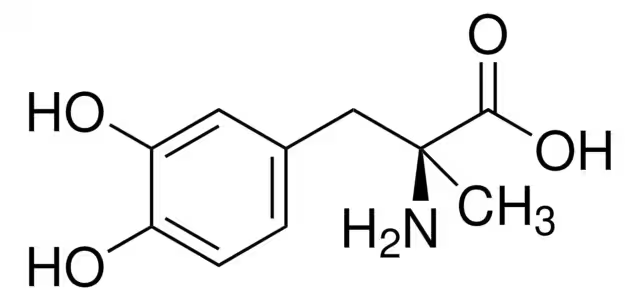
CAS Number555-30-6
Synonymsa-Methyl-L-dopa; α-Methyl-L-dopa; Methyldopa Sesquihydrate; Dopegyt; L-(-)-b-(3,4-Dihydroxyphenyl)-a-methylalanine; L-(-)-α-Methyl-β-(3,4-dihydroxyphenyl)alanine; L-(-)-a-Methyl-b-(3,4-dihydroxyphenyl)alanine; a-Methyl Dopa; L-α-Methyl-DOPA; alpha-methyl-L-dopa; MFCD00004186; α-Methyl dopa; EINECS 209-089-2; L-Tyrosine, 3-hydroxy-α-methyl-, hydrate (2:3); Tyrosine, 3-hydroxy-α-methyl-, hydrate (1:1); L-(a-Md); L-α-Methyldopa; α-Methyldopa sesquihydrate; (-)-α-Methyldopa; 3-Hydroxy-α-methyl-L-tyrosine; Dopamet; (−)-3-(3,4-Dihydroxyphenyl)-2-methyl-L-alanine sesquihydrate; 3-(3,4-Dihydroxyphenyl)-2-methyl-L-alanine,MK-351,Methyl-L-DOPA; (S)-(-)-a-Methyldopa; a-Methyl-b-(3,4-dihydroxyphenyl)-L-alanine; Methyl dopa; Aldomet; (-)-3-(3,4-Dihydroxyphenyl)-2-Methyl-L-Alanine Sesquihydrate; l-a-Met
Molecular FormulaC10H13NO4
Molecular Weight238.24
Purity98%
Density1.4±0.1 g/cm3
Boiling Point441.6±45.0 °C at 760 mmHg
Melting Point≥300 °C
AppearanceColorless or nearly colorless crystals or white to light yellow-white fine powder, almost odorless i
| Chemical & Physical Properties | |
|---|---|
| CAS Number | 555-30-6 |
| Catalog No. | 2A-9011398 |
| Chinese Name | 甲基多巴 |
| Synonyms | a-Methyl-L-dopa; α-Methyl-L-dopa; Methyldopa Sesquihydrate; Dopegyt; L-(-)-b-(3,4-Dihydroxyphenyl)-a-methylalanine; L-(-)-α-Methyl-β-(3,4-dihydroxyphenyl)alanine; L-(-)-a-Methyl-b-(3,4-dihydroxyphenyl)alanine; a-Methyl Dopa; L-α-Methyl-DOPA; alpha-methyl-L-dopa; MFCD00004186; α-Methyl dopa; EINECS 209-089-2; L-Tyrosine, 3-hydroxy-α-methyl-, hydrate (2:3); Tyrosine, 3-hydroxy-α-methyl-, hydrate (1:1); L-(a-Md); L-α-Methyldopa; α-Methyldopa sesquihydrate; (-)-α-Methyldopa; 3-Hydroxy-α-methyl-L-tyrosine; Dopamet; (−)-3-(3,4-Dihydroxyphenyl)-2-methyl-L-alanine sesquihydrate; 3-(3,4-Dihydroxyphenyl)-2-methyl-L-alanine,MK-351,Methyl-L-DOPA; (S)-(-)-a-Methyldopa; a-Methyl-b-(3,4-dihydroxyphenyl)-L-alanine; Methyl dopa; Aldomet; (-)-3-(3,4-Dihydroxyphenyl)-2-Methyl-L-Alanine Sesquihydrate; l-a-Met |
| Molecular Formula | C10H13NO4 |
| Molecular Weight | 238.24 |
| Purity | 98 |
| Density | 1.4±0.1 g/cm3 |
| Boiling Point | 441.6±45.0 °C at 760 mmHg |
| Melting Point | ≥300 °C |
| Appearance | Colorless or nearly colorless crystals or white to light yellow-white fine powder, almost odorless i |
| Storage Condition | Store at RT |
| Application | Methyldopa is a selective agonist of α2-adrenergic receptors. |
| HTC | 2918199090 |
| PubChem ID | 329750434 |
| MDL Number | MFCD00004186 |
| SMILES | C[C@](N)(Cc1ccc(O)c(O)c1)C(O)=O |
| InChI | 1S/C10H13NO4/c1-10(11,9(14)15)5-6-2-3-7(12)8(13)4-6/h2-4,12-13H,5,11H2,1H3,(H,14,15)/t10-/m0/s1 |
| InChI Key | CJCSPKMFHVPWAR-JTQLQIEISA-N |
| Beilstein/REAXYS | 2417244 |
| NACRES Code | NA.24 |
| UNSPSC | 41116107 |
| MSDS | msds/11398_1_555_30_6.pdf |
| Bioactivity | Methyldopa is an alpha-adrenergic agonist (selective for α2-adrenergic receptors) psychoactive drug used as a sympatholytic or antihypertensive.Target: alpha-adrenergic agonistMethyldopa is an alpha-adrenergic agonist (selective for α2-adrenergic receptors) psychoactive drug used as a sympatholytic or antihypertensive. Its use is now mostly deprecated following the introduction of alternative safer classes of agents. However, it continues to have a role in otherwise difficult to treat hypertension and gestational hypertension (also known as pregnancy-induced hypertension (PIH)).Methyldopa has a dual mechanism of action. It is a competitive inhibitor of the enzyme DOPA decarboxylase, also known as aromatic L-amino acid decarboxylase, which converts L-DOPA into dopamine. Dopamine is a precursor for norepinephrine (noradrenaline) and subsequently epinephrine (adrenaline). This inhibition results in reduced dopaminergic and adrenergic neurotransmission in the peripheral nervous system. This effect may lower blood pressure and cause central nervous system effects such as depression, anxiety, apathy, anhedonia, and parkinsonism. It is converted to α-methylnorepinephrine by dopamine beta-hydroxylase (DBH). α-methylnorepinephrine is an agonist of presynaptic central nervous system α2-adrenergic receptors. Activation of these receptors in the brainstem appears to inhibit sympathetic nervous system output and lower blood pressure. This is also the mechanism of action of clonidine. Related Catalog Signaling Pathways >> GPCR/G Protein >> Adrenergic Receptor Research Areas >> Cardiovascular Disease Natural Products >> Others References [1]. BAILA MR, et al. The use of the combination of L-alpha-methyldopa and dichlorothiazide in the treatment of arterial hypertension. Dia Med. 1962 Dec 6;34:2422-4. Chemical & Physical Properties Density 1.4±0.1 g/cm3 Boiling Point 441.6±45.0 °C at 760 mmHg Melting Point ≥300 °C Molecular Formula C10H13NO4 Molecular Weight 211.214 Flash Point 220.9±28.7 °C Exact Mass 211.084457 PSA 103.78000 LogP 0.13 Vapour Pressure 0.0±1.1 mmHg at 25°C Index of Refraction 1.635 InChIKey CJCSPKMFHVPWAR-JTQLQIEISA-N SMILES CC(N)(Cc1ccc(O)c(O)c1)C(=O)O Storage condition Store at RT |
| Use of | Methyldopa is an alpha-adrenergic agonist (selective for α2-adrenergic receptors) psychoactive drug used as a sympatholytic or antihypertensive.Target: alpha-adrenergic agonistMethyldopa is an alpha-adrenergic agonist (selective for α2-adrenergic receptors) psychoactive drug used as a sympatholytic or antihypertensive. Its use is now mostly deprecated following the introduction of alternative safer classes of agents. However, it continues to have a role in otherwise difficult to treat hypertension and gestational hypertension (also known as pregnancy-induced hypertension (PIH)).Methyldopa has a dual mechanism of action. It is a competitive inhibitor of the enzyme DOPA decarboxylase, also known as aromatic L-amino acid decarboxylase, which converts L-DOPA into dopamine. Dopamine is a precursor for norepinephrine (noradrenaline) and subsequently epinephrine (adrenaline). This inhibition results in reduced dopaminergic and adrenergic neurotransmission in the peripheral nervous system. This effect may lower blood pressure and cause central nervous system effects such as depression, anxiety, apathy, anhedonia, and parkinsonism. It is converted to α-methylnorepinephrine by dopamine beta-hydroxylase (DBH). α-methylnorepinephrine is an agonist of presynaptic central nervous system α2-adrenergic receptors. Activation of these receptors in the brainstem appears to inhibit sympathetic nervous system output and lower blood pressure. This is also the mechanism of action of clonidine. Properties Name α-methyl-L-dopa Synonym More Synonyms Methyldopa Biological Activity Description Methyldopa is an alpha-adrenergic agonist (selective for α2-adrenergic receptors) psychoactive drug used as a sympatholytic or antihypertensive.Target: alpha-adrenergic agonistMethyldopa is an alpha-adrenergic agonist (selective for α2-adrenergic receptors) psychoactive drug used as a sympatholytic or antihypertensive. Its use is now mostly deprecated following the introduction of alternative safer classes of agents. However, it continues to have a role in otherwise difficult to treat hypertension and gestational hypertension (also known as pregnancy-induced hypertension (PIH)).Methyldopa has a dual mechanism of action. It is a competitive inhibitor of the enzyme DOPA decarboxylase, also known as aromatic L-amino acid decarboxylase, which converts L-DOPA into dopamine. Dopamine is a precursor for norepinephrine (noradrenaline) and subsequently epinephrine (adrenaline). This inhibition results in reduced dopaminergic and adrenergic neurotransmission in the peripheral nervous system. This effect may lower blood pressure and cause central nervous system effects such as depression, anxiety, apathy, anhedonia, and parkinsonism. It is converted to α-methylnorepinephrine by dopamine beta-hydroxylase (DBH). α-methylnorepinephrine is an agonist of presynaptic central nervous system α2-adrenergic receptors. Activation of these receptors in the brainstem appears to inhibit sympathetic nervous system output and lower blood pressure. This is also the mechanism of action of clonidine. Related Catalog Signaling Pathways >> GPCR/G Protein >> Adrenergic Receptor Research Areas >> Cardiovascular Disease Natural Products >> Others References [1]. BAILA MR, et al. The use of the combination of L-alpha-methyldopa and dichlorothiazide in the treatment of arterial hypertension. Dia Med. 1962 Dec 6;34:2422-4. Chemical & Physical Properties Molecular Formula C10H13NO4 Exact Mass 211.084457 PSA 103.78000 Index of Refraction 1.635 InChIKey CJCSPKMFHVPWAR-JTQLQIEISA-N Storage condition Store at RT |
| Tax Rebate | 9.0% |
| Supervision | None. MFN tariff: 6.5%. Ordinary tariff: 30.0% |
| Transport Info | Product name: Purity: 98.0% |
| MSDS Transport Info | Module 14. Shipping information United Nations classification: inconsistent with United Nations classification standards UN number: not specified |
| Related Products in Plastic & Specialty Additives | ||
|---|---|---|
| Gadopenamide | 117827-80-2 | 2A-9010673 |
| Gadopentetic acid | 80529-93-7 | 2A-9010674 |
| Glycerol tripalmitate | 555-44-2 | 2A-9010767 |
| Indoprofen | 31842-01-0 | 2A-9010947 |
| Methamidophos | 10265-92-6 | 2A-9011371 |
| Podophyllotoxin | 4354-76-1 | 2A-9012065 |
| Podophyllotoxin | 518-28-5 | 2A-9012066 |
| Prolyl endopeptidase inhibitor II | 86925-97-5 | 2A-9012144 |
| Rizatriptan | 144034-80-0 | 2A-9012324 |
| Rizatriptan benzoate | 145202-66-0 | 2A-9012325 |
| Browse all Plastic & Specialty Additives products » | ||
Phone:
630-322-8886
630-322-8887
Email:
Office Locations:
Chicago, IL, USA
San Francisco, CA, USA


 EN
EN


 SDS
SDS