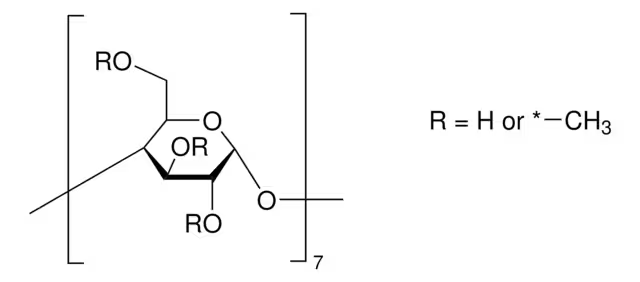
CAS Number128446-36-6
Synonymsβ-Cyclodextrin methyl ethers; Methyl-Beta-Cyclodextrin; Methyl-β-cyclodextrin; MFCD00074980; Randomly methylated-β-Cyclodextrin; Methyl-beta-cyclodextrin,average Mn ~1310
Molecular FormulaC54H94O35
Molecular Weight1303.303
Purity98%
Density1.4±0.1 g/cm3
Boiling Point1206.9±65.0 °C at 760 mmHg
Melting Point180-182 °C (lit.)
Appearancepowder
Symbol
Signal WordWarning
| Chemical & Physical Properties | |
|---|---|
| CAS Number | 128446-36-6 |
| Catalog No. | 2A-9011392 |
| Chinese Name | 甲基-β-环糊精 |
| Synonyms | β-Cyclodextrin methyl ethers; Methyl-Beta-Cyclodextrin; Methyl-β-cyclodextrin; MFCD00074980; Randomly methylated-β-Cyclodextrin; Methyl-beta-cyclodextrin,average Mn ~1310 |
| Molecular Formula | C54H94O35 |
| Molecular Weight | 1303.303 |
| Purity | 98 |
| Density | 1.4±0.1 g/cm3 |
| Boiling Point | 1206.9±65.0 °C at 760 mmHg |
| Melting Point | 180-182 °C (lit.) |
| Appearance | powder |
| Water Solubility | H2O: soluble50mg/mL | Soluble in water |
| Storage Condition | Keep the receptacle sealed, stored in a cool, dry |
| Application | Methyl-β-cyclodextrin is a cyclic heptasaccharide that can effectively eliminate cholesterol in cells; the IC50 value for inhibiting PEL cell growth is 3.33-4.23 mM. |
| MDL Number | MFCD00066764 |
| SMILES | O1C2OC(C(OC3OC(C(OC4OC(C(OC5OC(C(OC6OC(C(OC7OC(C(OC8OC(C1C(C8OC)O)COC)C(C7OC)O)COC)C(C6OC)O)COC)C(C5OC)O)COC)C(C4OC)O)COC)C(C3OC)O)COC)C(C2OC)O)COC |
| InChI | 1S/C56H98O35/c1-64-15-22-36-29(57)43(71-8)50(78-22)86-37-23(16-65-2)80-52(45(73-10)30(37)58)88-39-25(18-67-4)82-54(47(75-12)32(39)60)90-41-27(20-69-6)84-56(49(77-14)34(41)62)91-42-28(21-70-7)83-55(48(76-13)35(42)63)89-40-26(19-68-5)81-53(46(74-11)33(40)61)87-38-24(17-66-3)79-51(85-36)44(72-9)31(38)59/h22-63H,15-21H2,1-14H3 |
| InChI Key | QGKBSGBYSPTPKJ-UHFFFAOYSA-N |
| NACRES Code | NA.77 |
| UNSPSC | 12352201 |
| Hazard Symbols | Transport |
| MSDS | msds/11392_1_128446_36_6.pdf |
| Bioactivity | Methyl-β-cyclodextrin, a cyclic heptasaccharide, is an effective agent for the depletion of cholesterol from cells; also inhibits PEL cell growth with an IC50 of 3.33-4.23 mM. Related Catalog Signaling Pathways >> Others >> Others Research Areas >> Cancer Biochemical Assay Reagents Target IC50: 3.33-4.23 mM (PEL cell growth)[1] In Vitro Cyclodextrins are a family of cyclic oligosaccharides with a hydrophilic outer surface and a lipophilic central cavity. Cyclodextrins molecules are relatively large with a number of hydrogen donors and acceptors and, thus in general, they do not permeate lipophilic membranes. In the pharmaceutical industry, cyclodextrins have mainly been used as complexing agents to increase aqueous solubility of poorly soluble drugs and to increase their bioavailability and stability. Cyclodextrins are used in pharmaceutical applications for numerous purposes, including improving the bioavailability of drugs[2]. Methyl-β-cyclodextrin quickly induces caspase-dependent apoptosis in PEL cells via cholesterol depletion from the plasma membrane. Methyl-β-cyclodextrin inhibits the growth of all PEL cell lines in a dose-dependent manner. The IC50 is 3.33-4.23 mM in each cell line[1]. Methyl-b-cyclodextrin is a highly water soluble cyclic heptasaccharide consisting of a β-glucopyranose unit, has been reported as the most effective agent for the depletion of cholesterol from cells among the various cholesterol-depleting agents[1]. In Vivo In a PEL xenograft mouse model, methyl-b-cyclodextrin significantly inhibits the growth and invasion of PEL cells without apparent adverse effects. Methyl-b-cyclodextrin-treated mice appears to be healthy, whereas non-treated mice has a distended abdominal region. The body weights of control are significantly higher than those of M-b-CyD treated mice. Methyl-b-cyclodextrin-treated mice has a significantly lower volume of ascites than that of non-treated mice[1]. Studies in both humans and animals have shown that cyclodextrins can be used to improve drug delivery from almost any type of drug formulation. Currently, there are approximately 30 different pharmaceutical products worldwide containing drug/cyclodextrins complexes in the market[2]. Cell Assay PEL cells are incubated in triplicate in a 96-well microculture plate in the presence of different concentrations of methyl-β-cyclodextrin (0-10 mM) in a final volume of 0.1 mL for 24 h at 37°C. Subsequently, MTT (0.5 mg/mL final concentration) is added to each well. After 3 h of additional incubation, 100 μL of a 0.04 N HCl is added to dissolve the crystals. Absorption values at 570 nm are determined[1]. Animal Admin Mice: Female NRJ mice are intraperitoneally inoculated with BCBL-1 cells suspended in PBS. The mice are then treated with intraperitoneal injections of PBS or methyl-β-cyclodextrin (500 mg/kg per day). Tumor burdens are evaluated by measuring body weights and ascites[1]. References [1]. Gotoh K, et al. The antitumor effects of methyl-β-cyclodextrin against primary effusion lymphoma via the depletion of cholesterol from lipid rafts. Biochem Biophys Res Commun. 2014 Dec 12;455(3-4):285-9. [2]. Tiwari G, et al. Cyclodextrins in delivery systems: Applications. J Pharm Bioallied Sci. 2010 Apr;2(2):72-9. Chemical & Physical Properties Density 1.4±0.1 g/cm3 Boiling Point 1206.9±65.0 °C at 760 mmHg Melting Point 180-182ºC Molecular Formula C54H94O35 Molecular Weight 1303.303 Flash Point 683.7±34.3 °C Exact Mass 1302.557617 PSA 422.05000 LogP 6.95 Vapour Pressure 0.0±0.6 mmHg at 25°C Index of Refraction 1.567 InChIKey YZOUYRAONFXZSI-SBHWVFSVSA-N SMILES COC1C2OC(CO)C(OC3OC(CO)C(OC4OC(CO)C(OC5OC(CO)C(OC6OC(CO)C(OC7OC(CO)C(OC8OC(CO)C(O2)C(OC)C8OC)C(OC)C7OC)C(OC)C6OC)C(OC)C5OC)C(OC)C4OC)C(O)C3OC)C1O Storage condition 2~8°C Water Solubility H2O: soluble50mg/mL | Soluble in water |
| Use of | Properties Articles17 Name beta-Cyclodextrin methyl ethers Synonym More Synonyms Methyl-β-cyclodextrin Biological Activity Related Catalog Signaling Pathways >> Others >> Others Research Areas >> Cancer Biochemical Assay Reagents In Vivo In a PEL xenograft mouse model, methyl-b-cyclodextrin significantly inhibits the growth and invasion of PEL cells without apparent adverse effects. Methyl-b-cyclodextrin-treated mice appears to be healthy, whereas non-treated mice has a distended abdominal region. The body weights of control are significantly higher than those of M-b-CyD treated mice. Methyl-b-cyclodextrin-treated mice has a significantly lower volume of ascites than that of non-treated mice[1]. Studies in both humans and animals have shown that cyclodextrins can be used to improve drug delivery from almost any type of drug formulation. Currently, there are approximately 30 different pharmaceutical products worldwide containing drug/cyclodextrins complexes in the market[2]. References [1]. Gotoh K, et al. The antitumor effects of methyl-β-cyclodextrin against primary effusion lymphoma via the depletion of cholesterol from lipid rafts. Biochem Biophys Res Commun. 2014 Dec 12;455(3-4):285-9. [2]. Tiwari G, et al. Cyclodextrins in delivery systems: Applications. J Pharm Bioallied Sci. 2010 Apr;2(2):72-9. Chemical & Physical Properties Molecular Formula C54H94O35 Exact Mass 1302.557617 PSA 422.05000 Index of Refraction 1.567 InChIKey YZOUYRAONFXZSI-SBHWVFSVSA-N |
| Transport Info | Shipping Name: UN |
| MSDS Transport Info | Module 14. Shipping information 14.1 UN dangerous goods number European Land Transport Dangerous Regulations: -International Maritime Dangerous Regulations: -International Air Transport Dangerous Regulations: - 14.2 United Nations shipping name European Land Transport Dangerous Regulations: Non-dangerous goods IMDG Code: Non-dangerous goods International air transport dangerous goods regulations: non-dangerous goods 14.3 Transport hazard categories European Land Transport Dangerous Regulations: -International Maritime Dangerous Regulations: -International Air Transport Dangerous Regulations: - 14.4 Package group European Land Transport Dangerous Regulations: -International Maritime Dangerous Regulations: -International Air Transport Dangerous Regulations: - 14.5 Environmental hazards European Land Transport Danger Regulations: No International Maritime Danger Regulations International Air Transport Danger Regulations: No Marine pollutants (yes/no): No 14.6 Special reminder to users No data available |
| Related Products in Specialty Chemicals | ||
|---|---|---|
| Methothrin | 34388-29-9 | 2A-9011383 |
| Methoxamine | 390-28-3 | 2A-9011387 |
| Methoxamine hydrochloride | 61-16-5 | 2A-9011388 |
| Methoxatin | 72909-34-3 | 2A-9011389 |
| Methoxsalen | 298-81-7 | 2A-9011390 |
| Methyl clofenapate | 21340-68-1 | 2A-9011393 |
| Methyl sulphanilylcarbamate | 3337-71-1 | 2A-9011395 |
| Methyldymron | 42609-73-4 | 2A-9011399 |
| Methyloleanolate | 1724-17-0 | 2A-9011400 |
| Methyltrienolone | 965-93-5 | 2A-9011404 |
| Browse all Specialty Chemicals products » | ||
Phone:
630-322-8886
630-322-8887
Email:
Office Locations:
Chicago, IL, USA
San Francisco, CA, USA


 EN
EN


 SDS
SDS