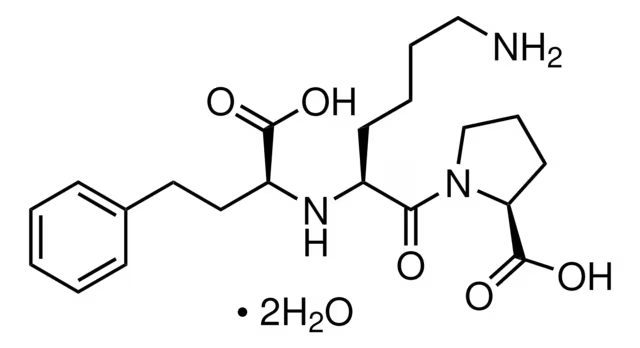
CAS Number83915-83-7
SynonymsL-Proline, N-[(1S)-1-carboxy-3-phenylpropyl]-L-lysyl-, hydrate (1:2); (S)-1-[N2-(1-carboxy-3-phenylpropyl)-L-lysyl]-L-proline dihydrate; N-[(1S)-1-Carboxy-3-phenylpropyl]-L-lysyl-L-proline dihydrate; MFCD08064198; Lisinopril Dihydrate; EINECS 278-488-1; Lisinopril diydrate; Lisinopril (dihydrate)
Molecular FormulaC21H35N3O7
Molecular Weight441.52
Purity≥98 (HPLC)%
Density1.251 g/cm3
Boiling Point666.4ºC at 760 mmHg
Melting Point160ºC (Decomposes)
Appearancesolid
Symbol
Signal WordWarning
| Chemical & Physical Properties | |
|---|---|
| CAS Number | 83915-83-7 |
| Catalog No. | 2A-9011203 |
| Chinese Name | 赖诺普利二水合物 |
| Synonyms | L-Proline, N-[(1S)-1-carboxy-3-phenylpropyl]-L-lysyl-, hydrate (1:2); (S)-1-[N2-(1-carboxy-3-phenylpropyl)-L-lysyl]-L-proline dihydrate; N-[(1S)-1-Carboxy-3-phenylpropyl]-L-lysyl-L-proline dihydrate; MFCD08064198; Lisinopril Dihydrate; EINECS 278-488-1; Lisinopril diydrate; Lisinopril (dihydrate) |
| Molecular Formula | C21H35N3O7 |
| Molecular Weight | 441.52 |
| Purity | ≥98 (HPLC) |
| Density | 1.251 g/cm3 |
| Boiling Point | 666.4ºC at 760 mmHg |
| Melting Point | 160ºC (Decomposes) |
| Appearance | solid |
| Water Solubility | H2O: ≥10 mg/mL |
| Storage Condition | 2-8°C |
| Application | Lisinopril dihydrate is an angiotensin-converting enzyme inhibitor that can act on hypertension, congestive heart failure and heart disease. |
| HTC | 2933990090 |
| PubChem ID | 329817636 |
| MDL Number | MFCD01698825 |
| SMILES | [H]O[H].[H]O[H].NCCCC[C@H](N[C@@H](CCc1ccccc1)C(O)=O)C(=O)N2CCC[C@H]2C(O)=O |
| InChI | 1S/C21H31N3O5.2H2O/c22-13-5-4-9-16(19(25)24-14-6-10-18(24)21(28)29)23-17(20(26)27)12-11-15-7-2-1-3-8-15;;/h1-3,7-8,16-18,23H,4-6,9-14,22H2,(H,26,27)(H,28,29);2*1H2/t16-,17-,18-;;/m0../s1 |
| InChI Key | CZRQXSDBMCMPNJ-ZUIPZQNBSA-N |
| NACRES Code | NA.32 |
| UNSPSC | 12352200 |
| Hazard Symbols | Transport |
| MSDS | msds/11203_1_83915_83_7.pdf |
| Bioactivity | Lisinopril Dihydrate is angiotensin-converting enzyme inhibitor, used in treatment of hypertension, congestive heart failure, and heart attacks.Target: ACELisinopril is a potent, competitive inhibitor of angiotensin-converting enzyme (ACE), the enzyme responsible for the conversion of angiotensin I (ATI) to angiotensin II (ATII). ATII regulates blood pressure and is a key component of the renin-angiotensin-aldosterone system (RAAS). Lisinopril may be used to treat hypertension and symptomatic congestive heart failure, to improve survival in certain individuals following myocardial infarction, and to prevent progression of renal disease in hypertensive patients with diabetes mellitus and microalbuminuria or overt nephropathy [1, 2]. Related Catalog Signaling Pathways >> Metabolic Enzyme/Protease >> Angiotensin-converting Enzyme (ACE) Research Areas >> Cardiovascular Disease References [1]. Andujar-Sanchez, M., V. Jara-Perez, and A. Camara-Artigas, Thermodynamic determination of the binding constants of angiotensin-converting enzyme inhibitors by a displacement method. FEBS Lett, 2007. 581(18): p. 3449-54. [2]. Song, J.C. and C.M. White, Clinical pharmacokinetics and selective pharmacodynamics of new angiotensin converting enzyme inhibitors: an update. Clin Pharmacokinet, 2002. 41(3): p. 207-24. Chemical & Physical Properties Density 1.251 g/cm3 Boiling Point 666.4ºC at 760 mmHg Melting Point 160ºC (Decomposes) Molecular Formula C21H35N3O7 Molecular Weight 441.52 Flash Point 356.9ºC PSA 132.96000 LogP 2.26430 Index of Refraction -45 ° (C=1, 0.25mol/L Zinc Acetate Buffer) InChIKey CZRQXSDBMCMPNJ-ZUIPZQNBSA-N SMILES NCCCCC(NC(CCc1ccccc1)C(=O)O)C(=O)N1CCCC1C(=O)O.O.O Storage condition 2-8°C Stability Hygroscopic Water Solubility H2O: ≥10 mg/mL |
| Use of | Lisinopril Dihydrate is angiotensin-converting enzyme inhibitor, used in treatment of hypertension, congestive heart failure, and heart attacks.Target: ACELisinopril is a potent, competitive inhibitor of angiotensin-converting enzyme (ACE), the enzyme responsible for the conversion of angiotensin I (ATI) to angiotensin II (ATII). ATII regulates blood pressure and is a key component of the renin-angiotensin-aldosterone system (RAAS). Lisinopril may be used to treat hypertension and symptomatic congestive heart failure, to improve survival in certain individuals following myocardial infarction, and to prevent progression of renal disease in hypertensive patients with diabetes mellitus and microalbuminuria or overt nephropathy [1, 2]. Properties Articles80 Name lisinopril dihydrate Synonym More Synonyms Lisinopril diydrate Biological Activity Description Lisinopril Dihydrate is angiotensin-converting enzyme inhibitor, used in treatment of hypertension, congestive heart failure, and heart attacks.Target: ACELisinopril is a potent, competitive inhibitor of angiotensin-converting enzyme (ACE), the enzyme responsible for the conversion of angiotensin I (ATI) to angiotensin II (ATII). ATII regulates blood pressure and is a key component of the renin-angiotensin-aldosterone system (RAAS). Lisinopril may be used to treat hypertension and symptomatic congestive heart failure, to improve survival in certain individuals following myocardial infarction, and to prevent progression of renal disease in hypertensive patients with diabetes mellitus and microalbuminuria or overt nephropathy [1, 2]. Related Catalog Signaling Pathways >> Metabolic Enzyme/Protease >> Angiotensin-converting Enzyme (ACE) Research Areas >> Cardiovascular Disease References [1]. Andujar-Sanchez, M., V. Jara-Perez, and A. Camara-Artigas, Thermodynamic determination of the binding constants of angiotensin-converting enzyme inhibitors by a displacement method. FEBS Lett, 2007. 581(18): p. 3449-54. [2]. Song, J.C. and C.M. White, Clinical pharmacokinetics and selective pharmacodynamics of new angiotensin converting enzyme inhibitors: an update. Clin Pharmacokinet, 2002. 41(3): p. 207-24. Chemical & Physical Properties Molecular Formula C21H35N3O7 PSA 132.96000 LogP 2.26430 InChIKey CZRQXSDBMCMPNJ-ZUIPZQNBSA-N Stability Hygroscopic |
| Tax Rebate | 13.0% |
| Supervision | None. MFN tariff: 6.5%. Ordinary tariff: 20.0% |
| Transport Info | Product name: Purity: 98.0% |
| MSDS Transport Info | Module 14. Shipping information 14.1 UN dangerous goods number European Land Transport Dangerous Regulations: -International Maritime Dangerous Regulations: -International Air Transport Dangerous Regulations: - 14.2 Names specified by the United Nations (UN) European Land Transport Dangerous Regulations: Non-dangerous goods IMDG Code: Non-dangerous goods International air transport dangerous goods regulations: non-dangerous goods 14.3 Transport hazard categories European Land Transport Dangerous Regulations: -International Maritime Dangerous Regulations: -International Air Transport Dangerous Regulations: - 14.4 Package group European Land Transport Dangerous Regulations: -International Maritime Dangerous Regulations: -International Air Transport Dangerous Regulations: - 14.5 Environmental hazards European Land Transport Dangerous Regulations: No International Maritime Transport Dangerous Regulations Maritime Pollutants: No International Air Transport Risk Regulations: No 14.6 Special reminder to users No data available |
| Related Products in API & Advanced Intermediates | ||
|---|---|---|
| Levodopa | 59-92-7 | 2A-9011171 |
| Levofloxacin | 100986-85-4 | 2A-9011173 |
| levofloxacin Mesylate | 226578-51-4 | 2A-9011174 |
| Lincomycin hydrochloride | 7179-49-9 | 2A-9011191 |
| Linezolid | 165800-03-3 | 2A-9011192 |
| Lopinavir | 192725-17-0 | 2A-9011228 |
| Losartan | 114798-26-4 | 2A-9011236 |
| Losartan Potassium | 124750-99-8 | 2A-0200254 |
| Marbofloxacin | 115550-35-1 | 2A-9011292 |
| Mefloquine | 53230-10-7 | 2A-9011319 |
| Browse all API & Advanced Intermediates products » | ||
Phone:
630-322-8886
630-322-8887
Email:
Office Locations:
Chicago, IL, USA
San Francisco, CA, USA


 EN
EN


 SDS
SDS