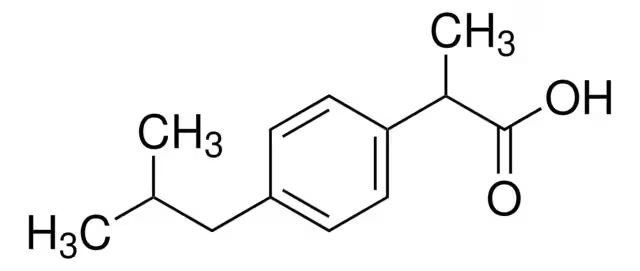
CAS Number15687-27-1
SynonymsInoven; Lebrufen; (RS)-ibuprofen; IP-82; Dolgit; Ibumetin; Femadon; 2-(4-Isobutylphenyl)propionic acid; QVY1&R D1Y1&1; Para-Isobutylhydratropic Acid; rufen; EINECS 239-784-6; Dolgin; rufin; Ibuprofen; (±)-ibuprofen; Novogent N; Ibutid; fenbid; 2-(4-Isobutylphenyl)propanoic acid; MOTRIN; Andran; Bluton; Dolgirid; 4-Isobutyl-α-methylphenylacetic Acid; Amibufen; MFCD00010393; Nurofen; Racemic ibuprofen; Advil
Molecular FormulaC13H18O2
Molecular Weight206.28
Purity≥98 (GC)%
Density1.0±0.1 g/cm3
Boiling Point319.6±11.0 °C at 760 mmHg
Melting Point77-78 °C
Appearancepowder
EINECS239-784-6
Symbol
Signal WordWarning
| Chemical & Physical Properties | |
|---|---|
| CAS Number | 15687-27-1 |
| Catalog No. | 2A-0202344 |
| Chinese Name | 布洛芬 |
| Synonyms | Inoven; Lebrufen; (RS)-ibuprofen; IP-82; Dolgit; Ibumetin; Femadon; 2-(4-Isobutylphenyl)propionic acid; QVY1&R D1Y1&1; Para-Isobutylhydratropic Acid; rufen; EINECS 239-784-6; Dolgin; rufin; Ibuprofen; (±)-ibuprofen; Novogent N; Ibutid; fenbid; 2-(4-Isobutylphenyl)propanoic acid; MOTRIN; Andran; Bluton; Dolgirid; 4-Isobutyl-α-methylphenylacetic Acid; Amibufen; MFCD00010393; Nurofen; Racemic ibuprofen; Advil |
| Molecular Formula | C13H18O2 |
| Molecular Weight | 206.28 |
| Purity | ≥98 (GC) |
| Density | 1.0±0.1 g/cm3 |
| Boiling Point | 319.6±11.0 °C at 760 mmHg |
| Melting Point | 77-78 °C |
| Appearance | powder |
| Water Solubility | insoluble |
| Storage Condition | Closed at room temperature, protected from light, |
| Packaging | III |
| Application | Ibuprofen is an inhibitor of COX-1 and COX-2, with IC50 values of 13 μM and 370 μM respectively, and has anti-inflammatory activity. |
| EINECS | 239-784-6 |
| HTC | 2924299090 |
| PubChem ID | 24277715 |
| MDL Number | MFCD00010393 |
| SMILES | CC(C)Cc1ccc(cc1)C(C)C(O)=O |
| InChI | 1S/C13H18O2/c1-9(2)8-11-4-6-12(7-5-11)10(3)13(14)15/h4-7,9-10H,8H2,1-3H3,(H,14,15) |
| InChI Key | HEFNNWSXXWATRW-UHFFFAOYSA-N |
| NACRES Code | NA.77 |
| UNSPSC | 12352200 |
| Hazard Symbols | 6.1(b) |
| MSDS | msds/10883_1_15687_27_1.pdf |
| Bioactivity | Ibuprofen is an anti-inflammatory inhibitor targeting COX-1 and COX-2 with IC50 of 13 μM and 370 μM, respectively. Related Catalog Signaling Pathways >> Immunology/Inflammation >> COX Research Areas >> Infection Target COX-1:13 μM (IC50) COX-2:370 μM (IC50) In Vitro Ibuprofen inhibits the enzyme cyclooxygenase COX-1 and COX-2, which convert arachidonic acid to prostaglandin H2 (PGH2). Its action is similar to aspirin, indomethacin and all other NSAIDs in intact cells, broken cells, and purified enzyme preparations[1]. Ibuprofen inhibits the constitutive activation of NF-κB and IKKα in the androgen-independent prostate tumor cells PC-3 and DU-145. It sensitizes prostate cells to ionizing radiation and blocks stimulated activation of NF-κB following exposure to TNFα or ionizing radiation in the androgen-sensitive prostate tumor cell line LNCaP. Both of these cannot be attributed directly to inhibition of IκB-α kinase but to inhibition of an upstream regulator of IKKα[2]. Ibuprofen exerts an anticancer effect by reducing survival of cancer cells. Ibuprofen is more efficacious than aspirin and acetaminophen, and comparable with (R)-flurbiprofen and indomethacin in induction of p75NTR protein expression in cell lines from bladder and other organs[3]. In Vivo Ibuprofen reacts with the heme group of cyclooxygenase to prevent arachidonic acid conversion. Prior exposure to Ibuprofen in vivo protects cyclooxygenase completely from the irreversible effects of aspirin in platelets[4]. Ibuprofen treatment is effective in attenuating joint inflammation and early articular cartilage degeneration in the adult female Sprague-Dawley rat model induced by high-repetition and high-force (HRHF) task. It dose this by blocking the increases in serum C1 and 2C (a biomarker of collagen I and II degradation) as well as the ratio of collagen degradation to synthesis (C1, 2C/CPII, the latter a biomarker of collage type II synthesis) induced by HRHF[5]. Cell Assay The number of cells in each well after treatment (48 hours) with NSAIDs is estimated using the 3-(4,5-dimethylthiazol-2-yl)-2,5-diphenyltetrazolium bromide (MTT) assay. MTT labeling reagent (final concentration, 0.5 mg/mL) is added to each of the NSAID-treated T24 cells, ponasterone A alone-treated cells, ΔDDp75NTR-transfected cells plus ponasterone A, and ΔICDp75NTR-transfected cells plus ponasterone A (2×10³ cells/well) in 96-well culture plates (final volume, 100 μL culture medium/well) and incubated for 4 hours at 37°C in a humidified atmosphere of 10% CO2. Subsequently, cells are incubated overnight with 100 μL of solubilization solution per well, and the samples are quantified at 570 nm using a microtiter plate reader. Animal Admin At the end of the 4th week of task performance, subcohorts of the above animals are administered ibuprofen in drinking water daily (45 mg/kg body weight): NC+IBU (n=10), TR + IBU (n=11) and HRHF + IBU (n=15). HRHF+IBU animals continue to perform the HRHF task regimen with ibuprofen treatment for the remainder of the 12-week task period (i.e., an 8-week course of ibuprofen treatment). The dose used is lower than the maximum limit for gastrointestinal toxicity in rats, yet has been shown to be effective in reducing chronic inflammation. The amount of medicated water consumed/day is tracked for each animal by measuring the difference between the initial and final volume of suspended solution daily. Based on these assessments, the average weekly ibuprofen dose is similar in all groups (48.8±6.3 mg/kg body weight), with no significant differences in ibuprofen dose administered or serum levels of ibuprofen between the treated groups. References [1]. Noreen Y, et al. Development of a radiochemical cyclooxygenase-1 and -2 in vitro assay for identification of natural products as inhibitors of prostaglandin biosynthesis. J Nat Prod. 1998 Jan;61(1):2-7. [2]. Palayoor ST, et al. Constitutive activation of IkappaB kinase alpha and NF-kappaB in prostate cancer cells is inhibited by ibuprofen. Oncogene. 1999 Dec 2;18(51):7389-94. [3]. Khwaja F, et al. Ibuprofen inhibits survival of bladder cancer cells by induced expression of the p75NTR tumor suppressor protein. Cancer Res. 2004 Sep 1;64(17):6207-13. [4]. Rao GH, et al. Ibuprofen protects platelet cyclooxygenase from irreversible inhibition by aspirin. Arteriosclerosis. 1983 Jul-Aug;3(4):383-8. [5]. Driban JB, et al. Joint inflammation and early degeneration induced by high-force reaching are attenuated by ibuprofen in an animal model of work-related musculoskeletal disorder. J Biomed Biotechnol. 2011;2011:691412 Chemical & Physical Properties Density 1.0±0.1 g/cm3 Boiling Point 319.6±11.0 °C at 760 mmHg Melting Point 77-78 °C(lit.) Molecular Formula C13H18O2 Molecular Weight 206.281 Flash Point 216.7±14.4 °C Exact Mass 206.130676 PSA 37.30000 LogP 3.72 Vapour Pressure 0.0±0.7 mmHg at 25°C Index of Refraction 1.519 InChIKey HEFNNWSXXWATRW-UHFFFAOYSA-N SMILES CC(C)Cc1ccc(C(C)C(=O)O)cc1 Storage condition -20?C Freezer Stability Stable. Combustible. Incompatible with strong oxidizing agents. Water Solubility insoluble |
| Use of | Ibuprofen is an anti-inflammatory inhibitor targeting COX-1 and COX-2 with IC50 of 13 μM and 370 μM, respectively. Properties Articles403 Name ibuprofen Synonym More Synonyms Ibuprofen Biological Activity Description Ibuprofen is an anti-inflammatory inhibitor targeting COX-1 and COX-2 with IC50 of 13 μM and 370 μM, respectively. Related Catalog Signaling Pathways >> Immunology/Inflammation >> COX Research Areas >> Infection COX-1:13 μM (IC50) COX-2:370 μM (IC50) In Vitro Ibuprofen inhibits the enzyme cyclooxygenase COX-1 and COX-2, which convert arachidonic acid to prostaglandin H2 (PGH2). Its action is similar to aspirin, indomethacin and all other NSAIDs in intact cells, broken cells, and purified enzyme preparations[1]. Ibuprofen inhibits the constitutive activation of NF-κB and IKKα in the androgen-independent prostate tumor cells PC-3 and DU-145. It sensitizes prostate cells to ionizing radiation and blocks stimulated activation of NF-κB following exposure to TNFα or ionizing radiation in the androgen-sensitive prostate tumor cell line LNCaP. Both of these cannot be attributed directly to inhibition of IκB-α kinase but to inhibition of an upstream regulator of IKKα[2]. Ibuprofen exerts an anticancer effect by reducing survival of cancer cells. Ibuprofen is more efficacious than aspirin and acetaminophen, and comparable with (R)-flurbiprofen and indomethacin in induction of p75NTR protein expression in cell lines from bladder and other organs[3]. References [1]. Noreen Y, et al. Development of a radiochemical cyclooxygenase-1 and -2 in vitro assay for identification of natural products as inhibitors of prostaglandin biosynthesis. J Nat Prod. 1998 Jan;61(1):2-7. [2]. Palayoor ST, et al. Constitutive activation of IkappaB kinase alpha and NF-kappaB in prostate cancer cells is inhibited by ibuprofen. Oncogene. 1999 Dec 2;18(51):7389-94. [3]. Khwaja F, et al. Ibuprofen inhibits survival of bladder cancer cells by induced expression of the p75NTR tumor suppressor protein. Cancer Res. 2004 Sep 1;64(17):6207-13. [4]. Rao GH, et al. Ibuprofen protects platelet cyclooxygenase from irreversible inhibition by aspirin. Arteriosclerosis. 1983 Jul-Aug;3(4):383-8. [5]. Driban JB, et al. Joint inflammation and early degeneration induced by high-force reaching are attenuated by ibuprofen in an animal model of work-related musculoskeletal disorder. J Biomed Biotechnol. 2011;2011:691412 Chemical & Physical Properties Molecular Formula C13H18O2 Exact Mass 206.130676 PSA 37.30000 Index of Refraction 1.519 InChIKey HEFNNWSXXWATRW-UHFFFAOYSA-N Storage condition -20?C Freezer Stability Stable. Combustible. Incompatible with strong oxidizing agents. Water Solubility insoluble |
| Tax Rebate | 9.0% |
| Supervision | none |
| Transport Info | Product name: Purity: 98.0% |
| MSDS Transport Info | Module 14. Shipping information United Nations classification: inconsistent with United Nations classification standards UN number: not specified |
| Related Products in API & Advanced Intermediates | ||
|---|---|---|
| Hydrocortisone | 50-23-7 | 2A-9010867 |
| Hydroxychloroquine sulfate | 747-36-4 | 2A-9010870 |
| Hydroxyprogesterone acetate | 302-23-8 | 2A-9010871 |
| Hydroxyprogesterone caproate | 630-56-8 | 2A-9010872 |
| Ibandronate sodium | 138926-19-9 | 2A-9010881 |
| Idarubicin | 58957-92-9 | 2A-9010888 |
| Idarubicin Hydrochloride | 57852-57-0 | 2A-9010889 |
| Idarubicinol | 86189-66-4 | 2A-9010890 |
| Ifosfamide | 3778-73-2 | 2A-9010901 |
| Imatinib mesylate | 220127-57-1 | 2A-9010911 |
| Browse all API & Advanced Intermediates products » | ||
Phone:
630-322-8886
630-322-8887
Email:
Office Locations:
Chicago, IL, USA
San Francisco, CA, USA


 EN
EN


 SDS
SDS