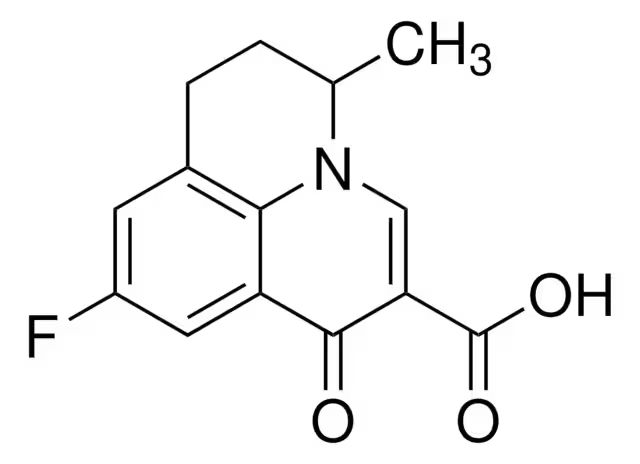
CAS Number42835-25-6
SynonymsApurone; UNII:UVG8VSP2SJ; Quinolone; 9-Fluoro-5-methyl-1-oxo-1,5,6,7-tetrahydropyrido[3,2,1-ij]quinoline-2-carboxylic acid; FLUMEQUIN; Flumeguine; EINECS 255-962-6; 9-Fluoro-5-methyl-1-oxo-6,7-dihydro-1H,5H-pyrido[3,2,1-ij]quinoline-2-carboxylic acid; MFCD00079298; Imequyl; 9-Fluoro-1,5,6,7-tetrahydro-5-methyl-1-oxopyrido[3,2,1-ij]quinoline-2-carboxylic Acid; Flumural; Flumequine; Aoyribe; Fantacin; R 802
Molecular FormulaC14H12FNO3
Molecular Weight261.25
Purity98%
Density1.5±0.1 g/cm3
Boiling Point439.7±45.0 °C at 760 mmHg
Melting Point253-255°C
AppearanceWhite to off-white powder
EINECS255-962-6
Symbol
Signal WordWarning
| Chemical & Physical Properties | |
|---|---|
| CAS Number | 42835-25-6 |
| Catalog No. | 2A-9010556 |
| Chinese Name | 氟甲喹 |
| Synonyms | Apurone; UNII:UVG8VSP2SJ; Quinolone; 9-Fluoro-5-methyl-1-oxo-1,5,6,7-tetrahydropyrido[3,2,1-ij]quinoline-2-carboxylic acid; FLUMEQUIN; Flumeguine; EINECS 255-962-6; 9-Fluoro-5-methyl-1-oxo-6,7-dihydro-1H,5H-pyrido[3,2,1-ij]quinoline-2-carboxylic acid; MFCD00079298; Imequyl; 9-Fluoro-1,5,6,7-tetrahydro-5-methyl-1-oxopyrido[3,2,1-ij]quinoline-2-carboxylic Acid; Flumural; Flumequine; Aoyribe; Fantacin; R 802 |
| Molecular Formula | C14H12FNO3 |
| Molecular Weight | 261.25 |
| Purity | 98 |
| Density | 1.5±0.1 g/cm3 |
| Boiling Point | 439.7±45.0 °C at 760 mmHg |
| Melting Point | 253-255°C |
| Appearance | White to off-white powder |
| Storage Condition | Sealed, cool, dry storage |
| Application | Flumequine is a quinolone antibiotic and a topoisomerase II (Topoisomerase II) inhibitor with an IC50 value of 15 μM (3.92 μg/mL). |
| EINECS | 255-962-6 |
| HTC | 2933990090 |
| PubChem ID | 329756930 |
| MDL Number | MFCD00079298 |
| SMILES | CC1CCc2cc(F)cc3C(=O)C(=CN1c23)C(O)=O |
| InChI | 1S/C14H12FNO3/c1-7-2-3-8-4-9(15)5-10-12(8)16(7)6-11(13(10)17)14(18)19/h4-7H,2-3H2,1H3,(H,18,19) |
| InChI Key | DPSPPJIUMHPXMA-UHFFFAOYSA-N |
| Beilstein/REAXYS | 490724 |
| NACRES Code | NA.24 |
| UNSPSC | 41116107 |
| Hazard Symbols | 6.1 |
| MSDS | msds/10556_1_42835_25_6.pdf |
| Bioactivity | Flumequine is a quinolone antibiotic, and acts as a topoisomerase II inhibitor, with an IC50 of 15 μM (3.92 μg/mL). Related Catalog Signaling Pathways >> Anti-infection >> Bacterial Research Areas >> Infection Target Topoisomerase II:15 μM (IC50) In Vitro Flumequine is a topoisomerase II inhibitor, with an IC50 of 3.92 μg/mL, and less potently inhibits Gyrase, with an IC50 of 1764 μg/mL. Flumequine (0-625 μg/mL) increases migration of nuclear DNA from CHL cells[1]. Flumequine inhibits Spanish field isolates of B. hyodysenteriae with MIC50 and MIC90 of 50 and 100 μg/mL, and MBC50 and MBC90 of 50, 200 μg/mL, respectively[2]. Flumequine suppresses A. salmonicida isolates with MIC ranging from 0.06 to 32 μg/mL[3]. In Vivo Flumequine (0-500 mg/kg, p.o.) causes dose-related DNA damage in the stomach, colon, and urinary bladder of mice, 1 and 3 h but not 24 h after its administration[1]. Kinase Assay Twenty μL of reaction mixture containing 0.4 μg of kinetoplast DNA with 1 U of topoisomerase II and serial dilutions of each antibacterial agent (including Flumequine) are incubated for 5 min at 37°C in buffer containing 20 mM Tris-HCl (pH 7.5), 120 mM KCl, 10 mM MgCl2, 1 mM ATP, 0.5 mM dithiothreitol, and 30 μg/mL of bovine serum albumin. After stopping the reaction by adding sarcosyl with gel-loading buffer, catenated and decatenated kDNAs are separated by agarose gel electrophoresis. The gels are stained with ethidium bromide and photographed using UV light (302 nm) with a Gel Print 200i/VGA, and the brightness of bands is traced with an Image Analyzer. Each band is quantified and the amount of DNA treated with each concentration of quinolone is measured to determine the 50% inhibitory concentration against DNA gyrase and topoisomerase II[1]. Cell Assay The Chinese hamster lung cell line CHL/IU is routinely maintained in monolayer culture in Dulbecco's modified MEM medium supplemented with 10% fetal bovine serum at 37°C under a 5% CO2 atmosphere. Exponentially growing cells are treated with Flumequine dissolved in DMSO for 1 h. The dose range is chosen in order to obtain both damaged and highly damaged cells. Following Flumequine treatment, cells are embedded in GP42 agarose dissolved in saline at 1%. Cell number and cell viability are determined for each dose[1]. Animal Admin Infant and young-adult male ddY mice at 4 and 7 weeks of age, respectively, are used after 1 week of acclimatization. Groups are treated once orally with Flumequine at <500 mg/kg. Adult mice are sacrificed at 3 and 24 h after treatment, and 8 organs, the stomach, colon, liver, kidney, urinary bladder, lung, brain, and bone marrow, are removed. Infant mice are sacrificed 3 and 24 h after treatment, and the livers are excised. In another study, the genotoxicity of Flumequine is studied in the regenerating liver of adult mice. For this purpose, male mice at 8 weeks-of-age are anesthetized with ether and 3 major lobes of the liver, left lateral lobe, left medial lobe, and right lateral lobe, are removed. Four days after the hepatectomy, mice are subjected to oral administration of Flumequine once. They are sacrificed 3 h after FL-treatment and regenerated livers are sampled. Slides for the comet assay are prepared at each set time[1]. References [1]. Kashida Y, et al. Mechanistic study on flumequine hepatocarcinogenicity focusing on DNA damage in mice. Toxicol Sci. 2002 Oct;69(2):317-21. [2]. Aller-Morán LM, et al. Evaluation of the in vitro activity of flumequine against field isolates of Brachyspira hyodysenteriae. Res Vet Sci. 2015 Dec;103:51-3. [3]. Giraud E, et al. Mechanisms of quinolone resistance and clonal relationship among Aeromonas salmonicida strains isolated from reared fish with furunculosis. J Med Microbiol. 2004 Sep;53(Pt 9):895-901. Chemical & Physical Properties Density 1.5±0.1 g/cm3 Boiling Point 439.7±45.0 °C at 760 mmHg Melting Point 253-255°C Molecular Formula C14H12FNO3 Molecular Weight 261.248 Flash Point 219.7±28.7 °C Exact Mass 261.080109 PSA 59.30000 LogP 2.41 Vapour Pressure 0.0±1.1 mmHg at 25°C Index of Refraction 1.646 InChIKey DPSPPJIUMHPXMA-UHFFFAOYSA-N SMILES CC1CCc2cc(F)cc3c(=O)c(C(=O)O)cn1c23 Storage condition 0-6°C Stability Stable. Incompatible with strong oxidizing agents. |
| Use of | Flumequine is a quinolone antibiotic, and acts as a topoisomerase II inhibitor, with an IC50 of 15 μM (3.92 μg/mL). Properties Name Flumequine Synonym More Synonyms Flumequine Biological Activity Description Flumequine is a quinolone antibiotic, and acts as a topoisomerase II inhibitor, with an IC50 of 15 μM (3.92 μg/mL). Related Catalog Signaling Pathways >> Anti-infection >> Bacterial Research Areas >> Infection Topoisomerase II:15 μM (IC50) In Vitro Flumequine is a topoisomerase II inhibitor, with an IC50 of 3.92 μg/mL, and less potently inhibits Gyrase, with an IC50 of 1764 μg/mL. Flumequine (0-625 μg/mL) increases migration of nuclear DNA from CHL cells[1]. Flumequine inhibits Spanish field isolates of B. hyodysenteriae with MIC50 and MIC90 of 50 and 100 μg/mL, and MBC50 and MBC90 of 50, 200 μg/mL, respectively[2]. Flumequine suppresses A. salmonicida isolates with MIC ranging from 0.06 to 32 μg/mL[3]. References [1]. Kashida Y, et al. Mechanistic study on flumequine hepatocarcinogenicity focusing on DNA damage in mice. Toxicol Sci. 2002 Oct;69(2):317-21. [2]. Aller-Morán LM, et al. Evaluation of the in vitro activity of flumequine against field isolates of Brachyspira hyodysenteriae. Res Vet Sci. 2015 Dec;103:51-3. [3]. Giraud E, et al. Mechanisms of quinolone resistance and clonal relationship among Aeromonas salmonicida strains isolated from reared fish with furunculosis. J Med Microbiol. 2004 Sep;53(Pt 9):895-901. Chemical & Physical Properties Molecular Formula C14H12FNO3 Exact Mass 261.080109 PSA 59.30000 Index of Refraction 1.646 InChIKey DPSPPJIUMHPXMA-UHFFFAOYSA-N Stability Stable. Incompatible with strong oxidizing agents. |
| Tax Rebate | 13.0% |
| Supervision | None. MFN tariff: 6.5%. Ordinary tariff: 20.0% |
| Transport Info | Product name: Purity: 98.0% |
| MSDS Transport Info | Module 14. Shipping information United Nations classification: inconsistent with United Nations classification standards UN number: not specified |
| Related Products in Specialty Chemicals | ||
|---|---|---|
| Flufenamic acid | 530-78-9 | 2A-9010551 |
| Flufenoxuron | 101463-69-8 | 2A-9010552 |
| Fluindarol | 6723-40-6 | 2A-9010553 |
| Flumazenil | 78755-81-4 | 2A-9010554 |
| Flumecinol | 56430-99-0 | 2A-9010555 |
| Flumetalin | 62924-70-3 | 2A-9010557 |
| Flumethrin | 69770-45-2 | 2A-9010558 |
| Flumiclorac-pentyl | 87546-18-7 | 2A-9010559 |
| Flunarizine | 52468-60-7 | 2A-9010561 |
| Flunarizine Hydrochloride | 30484-77-6 | 2A-9010562 |
| Browse all Specialty Chemicals products » | ||
Phone:
630-322-8886
630-322-8887
Email:
Office Locations:
Chicago, IL, USA
San Francisco, CA, USA


 EN
EN


 SDS
SDS