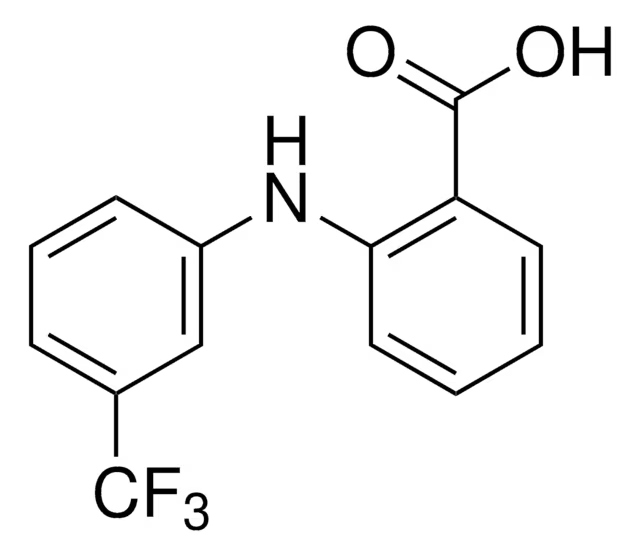
CAS Number530-78-9
Synonyms2-(3-Trifluoromethylanilino)benzoic Acid; N-(3-Trifluoromethylphenyl)anthranilic Acid; 2-{[3-(Trifluoromethyl)phenyl]amino}benzoic acid; Meralen; N-(a,a,a-Trifluoro-m-tolyl)anthranilic Acid; Paraflu; 2-[(3-Trifluoromethylphenyl)amino]benzoic Acid; Alfenamin; Flufenamic Acid; EINECS 208-494-1; Surika; Sastridex; 2-[3-(trifluoromethyl)anilino]benzoic acid; Opyrin; Achless; Tecramine; 2-[[3-(Trifluoromethyl)phenyl]amino]benzoic acid; Arlef; MFCD00002422; Ristogen; Parlef; 2-((3-(Trifluoromethyl)phenyl)amino)benzoic acid
Molecular Formula2-(CF3C6H4NH)C6H4CO2H
Molecular Weight281.23
Purity98%
Density1.4±0.1 g/cm3
Boiling Point373.9±42.0 °C at 760 mmHg
Melting Point132-135 °C (lit.)
AppearanceWhite to light yellow crystalline powder
EINECS208-494-1
Symbol
Signal WordWarning
| Chemical & Physical Properties | |
|---|---|
| CAS Number | 530-78-9 |
| Catalog No. | 2A-9010551 |
| Chinese Name | 氟芬那酸 |
| Synonyms | 2-(3-Trifluoromethylanilino)benzoic Acid; N-(3-Trifluoromethylphenyl)anthranilic Acid; 2-{[3-(Trifluoromethyl)phenyl]amino}benzoic acid; Meralen; N-(a,a,a-Trifluoro-m-tolyl)anthranilic Acid; Paraflu; 2-[(3-Trifluoromethylphenyl)amino]benzoic Acid; Alfenamin; Flufenamic Acid; EINECS 208-494-1; Surika; Sastridex; 2-[3-(trifluoromethyl)anilino]benzoic acid; Opyrin; Achless; Tecramine; 2-[[3-(Trifluoromethyl)phenyl]amino]benzoic acid; Arlef; MFCD00002422; Ristogen; Parlef; 2-((3-(Trifluoromethyl)phenyl)amino)benzoic acid |
| Molecular Formula | 2-(CF3C6H4NH)C6H4CO2H |
| Molecular Weight | 281.23 |
| Purity | 98 |
| Density | 1.4±0.1 g/cm3 |
| Boiling Point | 373.9±42.0 °C at 760 mmHg |
| Melting Point | 132-135 °C (lit.) |
| Appearance | White to light yellow crystalline powder |
| Water Solubility | 0.0265 g/L (37 ºC) |
| Storage Condition | Store in a cool, dry, well-ventilated warehouse. K |
| Packaging | III |
| Application | Flufenamic acid is a nonsteroidal anti-inflammatory agent that can inhibit the activity of COX, activate the activity of AMPK, regulate ion channels, block chloride channel (chloride channel) and L-ty |
| EINECS | 208-494-1 |
| HTC | 2922499990 |
| PubChem ID | 329799777 |
| MDL Number | MFCD00002422 |
| SMILES | OC(=O)c1ccccc1Nc2cccc(c2)C(F)(F)F |
| InChI | 1S/C14H10F3NO2/c15-14(16,17)9-4-3-5-10(8-9)18-12-7-2-1-6-11(12)13(19)20/h1-8,18H,(H,19,20) |
| InChI Key | LPEPZBJOKDYZAD-UHFFFAOYSA-N |
| NACRES Code | NA.24 |
| UNSPSC | 41116107 |
| Hazard Symbols | 6.1(b) |
| MSDS | msds/10551_1_530_78_9.pdf |
| Bioactivity | Flufenamic acid is a non-steroidal anti-inflammatory agent, inhibits cyclooxygenase (COX), activates AMPK, and also modulates ion channels, blocking chloride channels and L-type Ca2+ channels, modulating non-selective cation channels (NSC), activating K+ channels. Related Catalog Signaling Pathways >> Epigenetics >> AMPK Signaling Pathways >> PI3K/Akt/mTOR >> AMPK Signaling Pathways >> Membrane Transporter/Ion Channel >> Calcium Channel Signaling Pathways >> Membrane Transporter/Ion Channel >> Chloride Channel Signaling Pathways >> Immunology/Inflammation >> COX Signaling Pathways >> Membrane Transporter/Ion Channel >> Potassium Channel Research Areas >> Inflammation/Immunology Target COX, Chloride Channel, Calcium Channel, Potassium Channel[1], AMPK[2] In Vitro Flufenamic acid is a non-steroidal anti-inflammatory agent, inhibits cyclooxygenase (COX), and also modulates ion channels, blocking chloride channels and L-type Ca2+ channels, modulating non-selective cation channels (NSC), activating K+ channels. Flufenamic acid inhibits a wide spectrum of TRP channels, including: C3, C7, M2, M3, M4, M5, M7, M8, V1, V3, and V4 but activates at least two TRP channels (C6 and A1)[1]. Flufenamic acid induces AMPK activation in T84 cells, and such an effect is via a direct stimulation of calcium/calmodulin-dependent protein kinase kinase beta (CaMKKβ) activity[2]. Moreover, Flufenamic acid (FFA; 5-50 μM) dose-dependently inhibits cAMP-dependent Cl- secretion in intact T84 cells, suppresses CFTR-mediated apical ICl-, and blocks the Ca2+-dependent Cl- secretion in a dose-dependent manner with IC50 of appr 10 μM and near complete inhibition at 100 μM in T84 cell monolayers, but shows no effect on Na+-K+ ATPase or NKCC in T84 cells[3]. In Vivo Flufenamic acid (50 mg/kg, i.p.) has anti-inflammatory effect in a mouse model of Vibrio cholerae El Tor variant (EL)-induced diarrhea and significantly abrogates EL-induced intestinal fluid secretion and barrier disruption at 20 mg/kg. Furthermore, Flufenamic acid suppresses NF-κB nuclear translocation and expression of proinflammatory mediators and promotes AMPK phosphorylation in the EL-infected mouse intestine[2]. Cell Assay In brief, apical and basolateral chambers are filled symmetrically with Kreb's solutions. Thereafter, DMSO or Flufenamic acid is added into the basolateral chamber followed by apical membrane permealization by amphotericin B. After the amphotericin B-elicited Isc is stabilized, ouabain is added into the basolateral chamber. The ouabain sensitive Isc is used as an indicator of Na+-K+ ATPase activity[3]. Animal Admin Rats[2] Six-week-old male ICR outbred mice (weight 30-35 g) are fasted for 24 h before anesthesia using an intraperitoneal injection of nembutal (60 mg/kg). Following abdominal incision, the ileum is ligated (appr 3-4 cm long) and inoculated with 100 µL of PBS or PBS containing V. cholerae (105 CFU/loop) with or without a concomitant intraperitoneal injection of Flufenamic acid or metformin. Twelve hours post-inoculation, ileal loops are removed for weight/length ratio measurement, biochemical analysis and ultrastructural evaluation[2]. References [1]. Guinamard R, et al. Flufenamic acid as an ion channel modulator. Pharmacol Ther. 2013 May;138(2):272-84. [2]. Pongkorpsakol P, et al. Flufenamic acid protects against intestinal fluid secretion and barrier leakage in a mouse model of Vibrio cholerae infection through NF-κB inhibition and AMPK activation. Eur J Pharmacol. 2017 Mar 5;798:94-104. [3]. Pongkorpsakol P, et al. Cellular mechanisms underlying the inhibitory effect of flufenamic acid on chloride secretion in human intestinal epithelial cells. J Pharmacol Sci. 2017 Jun;134(2):93-100. Chemical & Physical Properties Density 1.4±0.1 g/cm3 Boiling Point 373.9±42.0 °C at 760 mmHg Melting Point 132-135 °C(lit.) Molecular Formula C14H10F3NO2 Molecular Weight 281.230 Flash Point 179.9±27.9 °C Exact Mass 281.066376 PSA 49.33000 LogP 5.62 Vapour Pressure 0.0±0.9 mmHg at 25°C Index of Refraction 1.585 InChIKey LPEPZBJOKDYZAD-UHFFFAOYSA-N SMILES O=C(O)c1ccccc1Nc1cccc(C(F)(F)F)c1 Storage condition Refrigerator Water Solubility 0.0265 g/L (37 ºC) |
| Use of | Flufenamic acid is a non-steroidal anti-inflammatory agent, inhibits cyclooxygenase (COX), activates AMPK, and also modulates ion channels, blocking chloride channels and L-type Ca2+ channels, modulating non-selective cation channels (NSC), activating K+ channels. Properties Articles64 Name flufenamic acid Synonym More Synonyms Flufenamic Acid Biological Activity Description Flufenamic acid is a non-steroidal anti-inflammatory agent, inhibits cyclooxygenase (COX), activates AMPK, and also modulates ion channels, blocking chloride channels and L-type Ca2+ channels, modulating non-selective cation channels (NSC), activating K+ channels. Related Catalog Signaling Pathways >> Epigenetics >> AMPK Signaling Pathways >> PI3K/Akt/mTOR >> AMPK Signaling Pathways >> Membrane Transporter/Ion Channel >> Calcium Channel Signaling Pathways >> Membrane Transporter/Ion Channel >> Chloride Channel Signaling Pathways >> Immunology/Inflammation >> COX Signaling Pathways >> Membrane Transporter/Ion Channel >> Potassium Channel Research Areas >> Inflammation/Immunology COX, Chloride Channel, Calcium Channel, Potassium Channel[1], AMPK[2] Cell Assay In brief, apical and basolateral chambers are filled symmetrically with Kreb's solutions. Thereafter, DMSO or Flufenamic acid is added into the basolateral chamber followed by apical membrane permealization by amphotericin B. After the amphotericin B-elicited Isc is stabilized, ouabain is added into the basolateral chamber. The ouabain sensitive Isc is used as an indicator of Na+-K+ ATPase activity[3]. References [1]. Guinamard R, et al. Flufenamic acid as an ion channel modulator. Pharmacol Ther. 2013 May;138(2):272-84. [2]. Pongkorpsakol P, et al. Flufenamic acid protects against intestinal fluid secretion and barrier leakage in a mouse model of Vibrio cholerae infection through NF-κB inhibition and AMPK activation. Eur J Pharmacol. 2017 Mar 5;798:94-104. [3]. Pongkorpsakol P, et al. Cellular mechanisms underlying the inhibitory effect of flufenamic acid on chloride secretion in human intestinal epithelial cells. J Pharmacol Sci. 2017 Jun;134(2):93-100. Chemical & Physical Properties Molecular Formula C14H10F3NO2 Exact Mass 281.066376 PSA 49.33000 Index of Refraction 1.585 InChIKey LPEPZBJOKDYZAD-UHFFFAOYSA-N Storage condition Refrigerator |
| Tax Rebate | 9.0% |
| Supervision | A. Customs clearance form for inbound goods B. Customs clearance form for outbound goods |
| Inspection | P. Quarantine of entry animals, plants, and animal and plant products Q. Quarantine of exit animals, plants, and animal and plant products R. Hygiene supervision and inspection of imported food S. Hyg |
| Transport Info | Product name: Purity: 99.0% |
| MSDS Transport Info | Module 14. Shipping information 14.1 UN dangerous goods number European Dangerous Regulations for land transport: 2811 International Dangerous Regulations for sea transport: 2811 International Dangerous Regulations for air transport: 2811 14.2 Names specified by the United Nations (UN) European Land Transport Dangerous Regulations: TOXIC SOLID, ORGANIC, N.O.S. (Flufenamic acid) IMDG Code: TOXIC SOLID, ORGANIC, N.O.S. (Flufenamic acid) International air transport hazard regulations: Toxic solid, organic, n.o.s. (Flufenamic acid) 14.3 Transport hazard categories European Land Transport Danger Regulations: 6.1 International Maritime Transport Danger Regulations: 6.1 International Air Transport Danger Regulations: 6.1 14.4 Package group European Land Transport Danger Regulations: III International Maritime Transport Danger Regulations: III International Air Transport Danger Regulations: III 14.5 Environmental hazards European Land Transport Dangerous Regulations: No International Maritime Transport Dangerous Regulations Maritime Pollutants: No International Air Transport Risk Regulations: No 14.6 Special reminder to users No data available |
| Related Products in Specialty Chemicals | ||
|---|---|---|
| Flucloxacillin sodium | 1847-24-1 | 2A-9010543 |
| Flucrilate | 23023-91-8 | 2A-9010545 |
| Fludarabine | 21679-14-1 | 2A-9010547 |
| Fludarabine phosphate | 75607-67-9 | 2A-9010548 |
| Fludoxopone | 71923-29-0 | 2A-9010550 |
| Flufenoxuron | 101463-69-8 | 2A-9010552 |
| Fluindarol | 6723-40-6 | 2A-9010553 |
| Flumazenil | 78755-81-4 | 2A-9010554 |
| Flumecinol | 56430-99-0 | 2A-9010555 |
| Flumequine | 42835-25-6 | 2A-9010556 |
| Browse all Specialty Chemicals products » | ||
Phone:
630-322-8886
630-322-8887
Email:
Office Locations:
Chicago, IL, USA
San Francisco, CA, USA


 EN
EN


 SDS
SDS