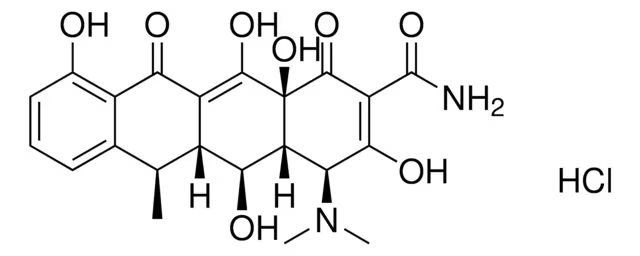
CAS Number10592-13-9
SynonymsDoxylin; samecin; liomycin; EINECS 234-198-7; Doxycycline (hydrochloride); Doxycycline HCl; tecacin; DOXYCYCLINE; doxycycline hyclate; doxycycline hydrochloride; ecodox; MFCD03427564; 6-deoxy-5-oxytetracycline hydrochloride; novadox; retens; DOXYCYCLINEHCL; HYDRAMYCIN; doxy-ii; a-6-Deoxy-5-hydroxytetracycline Hydrochloride; mespafin; midoxin
Molecular FormulaC22H25ClN2O8
Molecular Weight480.90
Purity≥95.0 (HPLC)%
Density1.63 g/cm3
Boiling Point762.6ºC at 760 mmHg
Melting Point195-201℃
Appearanceliquid


Please Login or Create an Account to: See VlP prices and availability
US Stock: ship in 0-1 business day
Global Stock: ship in 5-7 days
| Chemical & Physical Properties | |
|---|---|
| CAS Number | 10592-13-9 |
| Catalog No. | 2A-9010248 |
| Chinese Name | 盐酸多西环素 |
| Synonyms | Doxylin; samecin; liomycin; EINECS 234-198-7; Doxycycline (hydrochloride); Doxycycline HCl; tecacin; DOXYCYCLINE; doxycycline hyclate; doxycycline hydrochloride; ecodox; MFCD03427564; 6-deoxy-5-oxytetracycline hydrochloride; novadox; retens; DOXYCYCLINEHCL; HYDRAMYCIN; doxy-ii; a-6-Deoxy-5-hydroxytetracycline Hydrochloride; mespafin; midoxin |
| Molecular Formula | C22H25ClN2O8 |
| Molecular Weight | 480.90 |
| Purity | ≥95.0 (HPLC) |
| Density | 1.63 g/cm3 |
| Boiling Point | 762.6ºC at 760 mmHg |
| Melting Point | 195-201℃ |
| Appearance | liquid |
| Water Solubility | H2O: 50 mg/mL, clear, yellow-green |
| Storage Condition | Sealed in a cool, dry place at 0-6ºC. |
| Application | Doxycycline hydrochloride is a synthetic tetracycline derivative with antibacterial activity. |
| HTC | 29413000 |
| MDL Number | MFCD03427564 |
| SMILES | CC1c2cccc(O)c2C(O)=C2C(=O)C3(O)C(O)=C(C(N)=O)C(=O)C(N(C)C)C3C(O)C21.Cl |
| InChI | 1S/C22H24N2O8.ClH/c1-7-8-5-4-6-9(25)11(8)16(26)12-10(7)17(27)14-15(24(2)3)18(28)13(21(23)31)20(30)22(14,32)19(12)29;/h4-7,10,14-15,17,25-27,31-32H,23H2,1-3H3;1H/b21-13-;/t7-,10+,14+,15-,17-,22-;/m0./s1 |
| InChI Key | VLUQVUWDECWBTL-UQVCFKGQSA-N |
| NACRES Code | NA.85 |
| UNSPSC | 51284028 |
| MSDS | msds/10248_1_10592_13_9.pdf |
| Bioactivity | Doxycycline hydrochloride is a tetracycline antibiotic and broad-spectrum metalloproteinase (MMP) inhibitor. Related Catalog Research Areas >> Infection Target MMP In Vitro Doxycycline shows excellent effectiveness and time-dependent characteristics against M. gallisepticum strain S6 in vitro[2]. Osteoblasts exposed to the composite containing 25 μg/mL doxycycline (DOX)/β-cyclodextrin (βCD) has increased cell proliferation (p < 0.05) compared to control osteoblast cultures at all experimental time points, reaching a maximum in the second week. Alkaline phosphatase (AP) activity and collagen secretion levels are also elevated in osteoblasts exposed to the DOX/βCD composite (p < 0.05 vs. controls) and reach a maximum after 14 days[3]. Doxycycline (20 nM) inhibits ECM (extracellular matrix) production and remodeling in both SMC (smooth muscle cell) types of cultures, and synthesis of collagens and isoprenylated proteins in SMC-Ch (a cholesterol-rich diet) is a higher than in SMC-C (a standard diet)[4]. In Vivo In heterozygous (HT) Col3a1 knockout mice, after 3 months of treatment with doxycycline or placebo, 9-month-old HT or wild-type (WT) mice are subjected to surgical stressing of the aorta. A 3-fold increase in stress-induced aortic lesions found in untreated HT mice 1 week after intervention (cumulative score 4.5±0.87 versus 1.3±0.34 in WT, p<0.001) is fully prevented in the doxycycline (25 or 100 mg/kg, p.o.)-treated group (1.1±0.56)[1]. Kinase Assay Gelatin (0.1% (w/v) is added to standard LaemmLi acrylamide polymerization mixture. Tissue extract is mixed 1:2 with sample buffer [250 mM Tris-Cl pH 6.8, 10% (w/v) SDS, 20% (v/v) glycerol, 0.005% (w/v) bromphenol blue]. Serum is diluted 1:10 with electrophoresis buffer (2.5 mM Tris, 20 mM glycine, 0.005% SDS) and mixed 1:2 with sample buffer. Twenty μLs are loaded after 10-min incubation at room temperature without boiling. After electrophoresis at 90 V, the gels are soaked in 2.5% (w/v) Triton X-100, incubated 2 to 3 days at 37°C in gelatin digestion buffer [50 mM Tris-Cl, pH 8.0, 8 mM CaCl2, 10 mM ZnSO2, 0.02% (w/v) NaN3], stained in 0.05% Coomassie blue R-250 in acetic acid/methanol/water (1:4.5:4.5 by volume), destained in 10% acetic acid and 5% methanol, and scanned for lysis band intensity. The lysis band intensity is proportional to gelatinase activity and is quantified densitometrically by using One-Dimensional Scan software. The result, a number between 0.07 and 3.75, is normalized to the protein content by dividing the densitometry result with the relative optical density from the BCA protein assay kit result. The result is used for the analysis as the arbitrary unit. For the total MMP activity results of lysis bands of pro-MMP-9, active MMP-9, pro-MMP-2, and active MMP-2 are added. A protein size marker is used to determine the correct size. Cell Assay All in vitro treatments are performed in SMC cultures at 90% confluence, when ECM synthesis in SMC starts to be evident. Doxycycline (20 nM) is diluted in culture medium at a concentration of 10 μg/mL (20 nM), at which no toxicity or variation in primary cultured SMC proliferation has been reported, as well as in other cell lines and the incubation time is 48 h. SMC-C and SMC-Ch are seeded at equal cell density in 6-well plates and, when confluence reaches 90%, 1 mL culture medium is added to each well containing 3.7×10⁴ Bq L-[5-H3]-proline (9.62×10¹¹ Bq/mmol). After 48 h incubation, cells are lysed with 0.5 mL 0.5 mol/L NaOH for 1 h. The resulting solution is neutralized with an equal amount of 0.5 mol/L HCl, and 50 μL are used to measure total proteins with the Bradford method. One volume of 10% TCA is added to the remaining 250 μL and centrifuged at 13,000 g for 15 min at 4°C. The resulting precipitate is dissolved in 100 μL 0.2 mol/L NaOH, and then neutralized with 1 mol/L HCl. The solution is incubated with collagenase buffer (Tris-HCl, pH 7.6 20 mM, and CaCl2 250 mM final concentration) and 10 units of collagenase at 37°C overnight. Then, 150 μL 10% TCA are added and centrifuged at 13000 g for 15 min at 4°C. The resulting supernatant is added to 4 mL of scintillation fluid and the radioactivity is measured in a liquid scintillation counter LS 600 TA. Animal Admin Two groups of 6-month-old female heterozygous (HT) Col3a1 knockout mice are treated for 3 months with doxycycline. Treatment is provided with food containing 200 or 800 mg/kg of doxycycline. Because preliminary measured food intake of these mice is averaged at 3.5 g/day and the average body weight of animals is 25 g, the average drug dose for low- and high-dose groups is 25 (Doxy25) or 100 (Doxy100) mg/kg per day, respectively. Untreated (wild type) WT and HT mice are maintained on a regular diet (NIH-07 mouse/rat diet) and served as controls. After 3 months, under general inhalation anesthesia (2% of isoflurane in oxygen) and aseptic conditions, the abdominal aortas are surgically exposed and stressed by the following technique: the blood flow is stopped by occluding the abdominal aorta against the spinal column with a sterile cotton-tip applicator pressed at the level of the renal arteries. After 30 s a second applicator is pressed at the level of iliac bifurcation and the first applicator is abruptly released, followed by release of the second applicator. The abdominal incision is sutured closed, and mice are returned to home cages. The treatment is continued after the intervention. One week after intervention mice are euthanized by an overdose of isoflurane. Blood is collected, and aortas and segments of colon and skin are harvested. References [1]. Wilfried Briest, et al. Doxycycline ameliorates the susceptibility to aortic lesions in a mouse model for the vascular type of Ehlers-Danlos syndrome. J Pharmacol Exp Ther. 2011 Jun;337(3):621-7. [2]. Zhang N, et al. The PK/PD Interactions of Doxycycline against Mycoplasma gallisepticum. Front Microbiol. 2016 May 4;7:653. [3]. Trajano VC, et al. Osteogenic activity of cyclodextrin-encapsulated doxycycline in a calcium phosphate PCL and PLGA composite. Mater Sci Eng C Mater Biol Appl. 2016 Jul 1;64:370-5. [4]. Palomino-Morales R, et al. Inhibition of extracellular matrix production and remodeling by doxycycline in smooth muscle cells. J Pharmacol Sci. 2016 Mar 25. Epub ahead of print Chemical & Physical Properties Density 1.63 g/cm3 Boiling Point 762.6ºC at 760 mmHg Melting Point 195-201℃ Molecular Formula C22H25ClN2O8 Molecular Weight 480.896 Flash Point 415ºC Exact Mass 480.129944 PSA 181.62000 LogP 1.15470 InChIKey PTNZGHXUZDHMIQ-CVHRZJFOSA-N SMILES CC1c2cccc(O)c2C(O)=C2C(=O)C3(O)C(O)=C(C(N)=O)C(=O)C(N(C)C)C3C(O)C21.Cl Storage condition 0-6°C Water Solubility H2O: 50 mg/mL, clear, yellow-green |
| Use of | Doxycycline hydrochloride is a tetracycline antibiotic and broad-spectrum metalloproteinase (MMP) inhibitor. Properties Name doxycycline HCl Synonym More Synonyms doxycycline hydrochloride Biological Activity Description Doxycycline hydrochloride is a tetracycline antibiotic and broad-spectrum metalloproteinase (MMP) inhibitor. Related Catalog Research Areas >> Infection In Vitro Doxycycline shows excellent effectiveness and time-dependent characteristics against M. gallisepticum strain S6 in vitro[2]. Osteoblasts exposed to the composite containing 25 μg/mL doxycycline (DOX)/β-cyclodextrin (βCD) has increased cell proliferation (p < 0.05) compared to control osteoblast cultures at all experimental time points, reaching a maximum in the second week. Alkaline phosphatase (AP) activity and collagen secretion levels are also elevated in osteoblasts exposed to the DOX/βCD composite (p < 0.05 vs. controls) and reach a maximum after 14 days[3]. Doxycycline (20 nM) inhibits ECM (extracellular matrix) production and remodeling in both SMC (smooth muscle cell) types of cultures, and synthesis of collagens and isoprenylated proteins in SMC-Ch (a cholesterol-rich diet) is a higher than in SMC-C (a standard diet)[4]. References [1]. Wilfried Briest, et al. Doxycycline ameliorates the susceptibility to aortic lesions in a mouse model for the vascular type of Ehlers-Danlos syndrome. J Pharmacol Exp Ther. 2011 Jun;337(3):621-7. [2]. Zhang N, et al. The PK/PD Interactions of Doxycycline against Mycoplasma gallisepticum. Front Microbiol. 2016 May 4;7:653. [3]. Trajano VC, et al. Osteogenic activity of cyclodextrin-encapsulated doxycycline in a calcium phosphate PCL and PLGA composite. Mater Sci Eng C Mater Biol Appl. 2016 Jul 1;64:370-5. [4]. Palomino-Morales R, et al. Inhibition of extracellular matrix production and remodeling by doxycycline in smooth muscle cells. J Pharmacol Sci. 2016 Mar 25. Epub ahead of print Chemical & Physical Properties Exact Mass 480.129944 PSA 181.62000 LogP 1.15470 InChIKey PTNZGHXUZDHMIQ-CVHRZJFOSA-N |
| Transport Info | Product Name: Doxycycline Hydrochloride |
| Related Products in API & Advanced Intermediates | ||
|---|---|---|
| Donepezil hydrochloride | 120014-06-4 | 2A-9010227 |
| Donepezil Hydrochloride | 120011-70-3 | 2A-9010228 |
| Doripenem | 148016-81-3 | 2A-9010234 |
| Doxycycline hyclate | 24390-14-5 | 2A-9010246 |
| Doxycycline hydrate | 564-25-0 | 2A-9010247 |
| Dutasteride | 164656-23-9 | 2A-0200630 |
| Ecenofloxacin | 162301-05-5 | 2A-9010274 |
| Efavirenz | 154598-52-4 | 2A-9010286 |
| Emtricitabine | 143491-57-0 | 2A-9010311 |
| Enalapril | 75847-73-3 | 2A-9010312 |
| Browse all API & Advanced Intermediates products » | ||
Phone:
630-322-8886
630-322-8887
Email:
Office Locations:
Chicago, IL, USA
San Francisco, CA, USA


 EN
EN

 SDS
SDS