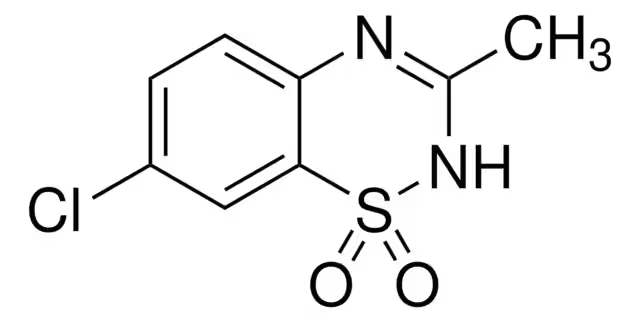
CAS Number364-98-7
Synonymsdiazoxidum [INN_la]; 7-chloro-3-methyl-4H-1λ<sup>6</sup>,2,4-benzothiadiazine 1,1-dioxide; Hypertonalum; Diazoxido; 7-chloro-3-methyl-4H-1,2,4-benzothiadiazine 1,1-dioxide; Sodium dodecyl sulphate solution; EINECS 206-668-1; Mutabase; Proglycem; Dizoxide; Diazossido; MFCD00078578; diazoxide; Eudemine; Proglicem; 2H-1,2,4-Benzothiadiazine, 7-chloro-3-methyl-, 1,1-dioxide; 7-chloro-3-methyl-1,2,4-benzothiadiazine-1,1-dioxide; Hyperstat; 7-Chloro-3-methyl-2H-1,2,4-benzothiadiazine 1,1-dioxide; 7-chloro-3-méthyl-2H-1,2,4-benzothiadiazine-1,1-dioxyde; 3-Methyl-7-chloro-1,2,4-benzothiadiazine 1,1-dioxide
Molecular FormulaC8H7ClN2O2S
Molecular Weight230.67
Purity98%
Density1.6±0.1 g/cm3
Boiling Point414.8±47.0 °C at 760 mmHg
Melting Point>310°C
Appearancepowder
EINECS206-668-1
Symbol
Signal WordWarning
| Chemical & Physical Properties | |
|---|---|
| CAS Number | 364-98-7 |
| Catalog No. | 2A-9010102 |
| Chinese Name | 氯甲苯噻嗪 |
| Synonyms | diazoxidum [INN_la]; 7-chloro-3-methyl-4H-1λ<sup>6</sup>,2,4-benzothiadiazine 1,1-dioxide; Hypertonalum; Diazoxido; 7-chloro-3-methyl-4H-1,2,4-benzothiadiazine 1,1-dioxide; Sodium dodecyl sulphate solution; EINECS 206-668-1; Mutabase; Proglycem; Dizoxide; Diazossido; MFCD00078578; diazoxide; Eudemine; Proglicem; 2H-1,2,4-Benzothiadiazine, 7-chloro-3-methyl-, 1,1-dioxide; 7-chloro-3-methyl-1,2,4-benzothiadiazine-1,1-dioxide; Hyperstat; 7-Chloro-3-methyl-2H-1,2,4-benzothiadiazine 1,1-dioxide; 7-chloro-3-méthyl-2H-1,2,4-benzothiadiazine-1,1-dioxyde; 3-Methyl-7-chloro-1,2,4-benzothiadiazine 1,1-dioxide |
| Molecular Formula | C8H7ClN2O2S |
| Molecular Weight | 230.67 |
| Purity | 98 |
| Density | 1.6±0.1 g/cm3 |
| Boiling Point | 414.8±47.0 °C at 760 mmHg |
| Melting Point | >310°C |
| Appearance | powder |
| Water Solubility | 0.1 M NaOH: soluble |
| Storage Condition | Store at RT |
| Application | Diazoxide is an ATP-sensitive potassium channel activator; useful in the treatment of hyperinsulinemia. |
| EINECS | 206-668-1 |
| HTC | 2933990090 |
| PubChem ID | 24277831 |
| MDL Number | MFCD00078578 |
| SMILES | CC1=Nc2ccc(Cl)cc2S(=O)(=O)N1 |
| InChI | 1S/C8H7ClN2O2S/c1-5-10-7-3-2-6(9)4-8(7)14(12,13)11-5/h2-4H,1H3,(H,10,11) |
| InChI Key | GDLBFKVLRPITMI-UHFFFAOYSA-N |
| NACRES Code | NA.77 |
| UNSPSC | 12352119 |
| Hazard Symbols | Transport |
| MSDS | msds/10102_1_364_98_7.pdf |
| Bioactivity | Diazoxide is an ATP-sensitive potassium channel activator ; can be used to treat hyperinsulinism. Related Catalog Signaling Pathways >> Autophagy >> Autophagy Signaling Pathways >> Membrane Transporter/Ion Channel >> Potassium Channel Research Areas >> Cardiovascular Disease In Vitro Diazoxide has a number of physiological effects, including lowering the blood pressure and rectifying hypoglycemia. Diazoxide has powerful protective properties against cardiac ischemia[1].Diazoxide could protect NSC-34 neurons against the main sources of neurodegenerative damage. Diazoxide increases Nrf2 nuclear translocation in NSC-34 motoneurons and prevents endogenous oxidative damage[2]. In Vivo Diazoxide attenuates postresuscitation brain injury, protects mitochondrial function, inhibits brain cell apoptosis, and activates the PKC pathway by opening mitoKATP channels[3]. Treatment with diazoxide in wild-type mice decreases intraocular pressure (IOP) by 21.5±3.2% with an absolute IOP reduction of 3.9 ± 0.6 mm Hg[4]. Cell Assay Diazoxide is dissolved in DMSO to prepare 50 mM stock solution. NSC-34 cells are allowed to differentiate for 8 weeks under reduced serum conditions and then seeded in 24-well plates. Glutamate is dissolved in culture medium and added to cultures at concentration of 10 μM for 24 h. Cell treatment with 100 µM diazoxide starts 2 h before glutamate exposure. Cell viability is measured by the MTT assay[2]. Animal Admin Rats: Adult male Sprague-Dawley rats with induced cerebral ischemia (n=10 per group) receive an intraperitoneal injection of 0.1% DMSO (1 mL; vehicle group), diazoxide (10 mg/kg; DZ group), or diazoxide (10 mg/kg) plus 5-hydroxydecanoate (5 mg/kg; DZ + 5-HD group) 30 min after CPR. The control group (sham group, n=5) undergoes sham operation, without cardiac arrest. Mitochondrial respiratory control rate (RCR) is determined. Brain cell apoptosis is assessed using TUNEL staining. Expression of Bcl-2, Bax, and protein kinase C epsilon (PKCε) in the cerebral cortex is determined by Western blotting and immunohistochemistry[3]. Mouse: Diazoxide is prepared by diluting a 100 mM stock solution in 10% polyethoxylated castor oil in PBS. In C57BL/6 wild-type and Kir6.2(−/−) mice, a 5 μL drop of 5 mM diazoxide is topically administered to one eye of each mouse while the fellow control eye received vehicle (DMSO and 10% polyethoxylated castor oil in the same proportion as the treated eye). IOP is measured daily at 1 hour, 4 hours, and 23 hours following treatment. Treatment with diazoxide and vehicle is continued daily for 14 consecutive days[4]. References [1]. Coetzee WA, et al. Multiplicity of effectors of the cardioprotective agent, diazoxide. Pharmacol Ther. 2013 Nov;140(2):167-75. [2]. Virgili N, et al. K(ATP) channel opener diazoxide prevents neurodegeneration: a new mechanism of action viaantioxidative pathway activation. PLoS One. 2013 Sep 11;8(9):e75189. [3]. Wu H, et al. Diazoxide Attenuates Postresuscitation Brain Injury in a Rat Model of Asphyxial Cardiac Arrest by Opening Mitochondrial ATP-Sensitive Potassium Channels. Biomed Res Int. 2016;2016:1253842. [4]. Chowdhury UR, et al. ATP-sensitive potassium (K(ATP)) channel openers diazoxide and nicorandil lower intraocular pressure in vivo. Invest Ophthalmol Vis Sci. 2013 Jul 22;54(7):4892-9. Chemical & Physical Properties Density 1.6±0.1 g/cm3 Boiling Point 414.8±47.0 °C at 760 mmHg Melting Point >310°C Molecular Formula C8H7ClN2O2S Molecular Weight 230.671 Flash Point 204.6±29.3 °C Exact Mass 229.991669 PSA 66.91000 LogP 1.08 Vapour Pressure 0.0±1.0 mmHg at 25°C Index of Refraction 1.692 InChIKey GDLBFKVLRPITMI-UHFFFAOYSA-N SMILES CC1=NS(=O)(=O)c2cc(Cl)ccc2N1 Storage condition Store at RT Water Solubility 0.1 M NaOH: soluble |
| Use of | Diazoxide is an ATP-sensitive potassium channel activator ; can be used to treat hyperinsulinism. Properties Articles63 Name diazoxide Synonym More Synonyms diazoxide Biological Activity Description Diazoxide is an ATP-sensitive potassium channel activator ; can be used to treat hyperinsulinism. Related Catalog Signaling Pathways >> Autophagy >> Autophagy Signaling Pathways >> Membrane Transporter/Ion Channel >> Potassium Channel Research Areas >> Cardiovascular Disease References [1]. Coetzee WA, et al. Multiplicity of effectors of the cardioprotective agent, diazoxide. Pharmacol Ther. 2013 Nov;140(2):167-75. [2]. Virgili N, et al. K(ATP) channel opener diazoxide prevents neurodegeneration: a new mechanism of action viaantioxidative pathway activation. PLoS One. 2013 Sep 11;8(9):e75189. [3]. Wu H, et al. Diazoxide Attenuates Postresuscitation Brain Injury in a Rat Model of Asphyxial Cardiac Arrest by Opening Mitochondrial ATP-Sensitive Potassium Channels. Biomed Res Int. 2016;2016:1253842. [4]. Chowdhury UR, et al. ATP-sensitive potassium (K(ATP)) channel openers diazoxide and nicorandil lower intraocular pressure in vivo. Invest Ophthalmol Vis Sci. 2013 Jul 22;54(7):4892-9. Chemical & Physical Properties Exact Mass 229.991669 PSA 66.91000 Index of Refraction 1.692 InChIKey GDLBFKVLRPITMI-UHFFFAOYSA-N Storage condition Store at RT Water Solubility 0.1 M NaOH: soluble |
| Tax Rebate | 13.0% |
| Supervision | None. MFN tariff: 6.5%. Ordinary tariff: 20.0% |
| Transport Info | Shipping Name: UN |
| MSDS Transport Info | Module 14. Shipping information 14.1 UN dangerous goods number European Land Transport Dangerous Regulations: -International Maritime Dangerous Regulations: -International Air Transport Dangerous Regulations: - 14.2 United Nations shipping name European Land Transport Dangerous Regulations: Non-dangerous goods IMDG Code: Non-dangerous goods International air transport dangerous goods regulations: non-dangerous goods 14.3 Transport hazard categories European Land Transport Dangerous Regulations: -International Maritime Dangerous Regulations: -International Air Transport Dangerous Regulations: - 14.4 Package group European Land Transport Dangerous Regulations: -International Maritime Dangerous Regulations: -International Air Transport Dangerous Regulations: - 14.5 Environmental hazards European Land Transport Danger Regulations: No International Maritime Danger Regulations International Air Transport Danger Regulations: No Marine pollutants (yes/no): No 14.6 Special reminder to users No data available |
| Related Products in Specialty Chemicals | ||
|---|---|---|
| Diacetoxyscirpenol | 2270-40-8 | 2A-9010094 |
| Diallate | 2303-16-4 | 2A-9010097 |
| Dianisyl trichloroethane | 72-43-5 | 2A-9010098 |
| Diaveridine | 5355-16-8 | 2A-9010099 |
| Diaveridine hydrochloride | 2507-23-5 | 2A-9010100 |
| Dibekacin | 58580-55-5 | 2A-9010103 |
| Dibenzthione | 350-12-9 | 2A-9010104 |
| Dibrompropamidine | 496-00-4 | 2A-9010105 |
| Dibromsalan | 87-12-7 | 2A-9010106 |
| Cinchocaine base | 85-79-0 | 2A-9010107 |
| Browse all Specialty Chemicals products » | ||
Phone:
630-322-8886
630-322-8887
Email:
Office Locations:
Chicago, IL, USA
San Francisco, CA, USA


 EN
EN


 SDS
SDS