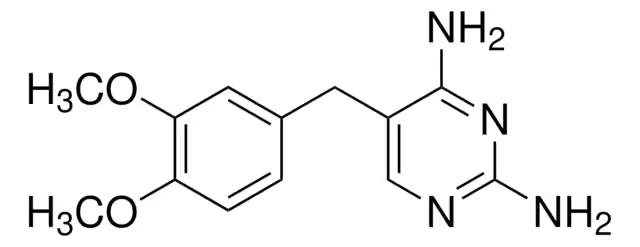
CAS Number5355-16-8
SynonymsDiaveridinum [INN-Latin]; Diaveridinum; DIAVERIDINE; 2,4-Diamino-5-veratrylpyrimidine; 5-(3,4-Dimethoxybenzyl)-2,4-pyrimidinediamine; 2,4-diamino-5-(3,4-dimethoxy-benzyl)-pyrimidine; MFCD00057349; 5-(3,4-dimethoxy-benzyl)-pyrimidine-2,4-diamine; 5-[(3,4-dimethoxyphenyl)methyl]pyrimidine-2,4-diamine; Diaveridin; BW 49-210; Diaveridina; 5-Veratryl-pyrimidin-2,4-diyldiamin; EINECS 226-333-3
Molecular FormulaC13H16N4O2
Molecular Weight260.29
Purity≥99.0 (TLC)%
Density1.3±0.1 g/cm3
Boiling Point506.1±60.0 °C at 760 mmHg
Melting Point232 - 236ºC
Appearancewhite solid
EINECS226-333-3
Symbol
Signal WordWarning
| Chemical & Physical Properties | |
|---|---|
| CAS Number | 5355-16-8 |
| Catalog No. | 2A-9010099 |
| Chinese Name | 敌菌净 |
| Synonyms | Diaveridinum [INN-Latin]; Diaveridinum; DIAVERIDINE; 2,4-Diamino-5-veratrylpyrimidine; 5-(3,4-Dimethoxybenzyl)-2,4-pyrimidinediamine; 2,4-diamino-5-(3,4-dimethoxy-benzyl)-pyrimidine; MFCD00057349; 5-(3,4-dimethoxy-benzyl)-pyrimidine-2,4-diamine; 5-[(3,4-dimethoxyphenyl)methyl]pyrimidine-2,4-diamine; Diaveridin; BW 49-210; Diaveridina; 5-Veratryl-pyrimidin-2,4-diyldiamin; EINECS 226-333-3 |
| Molecular Formula | C13H16N4O2 |
| Molecular Weight | 260.29 |
| Purity | ≥99.0 (TLC) |
| Density | 1.3±0.1 g/cm3 |
| Boiling Point | 506.1±60.0 °C at 760 mmHg |
| Melting Point | 232 - 236ºC |
| Appearance | white solid |
| Storage Condition | Lined with plastic bags and packed in woven bags o |
| Application | Diaveridine (EGIS-5645) is an inhibitor of dihydrofolate reductase (DHFR) with a Ki of 11.5 nM for wild-type DHFR. Diaveridine is also an antibacterial agent. |
| EINECS | 226-333-3 |
| HTC | 2933599090 |
| PubChem ID | 329798904 |
| MDL Number | MFCD00057349 |
| SMILES | COc1ccc(Cc2cnc(N)nc2N)cc1OC |
| InChI | 1S/C13H16N4O2/c1-18-10-4-3-8(6-11(10)19-2)5-9-7-16-13(15)17-12(9)14/h3-4,6-7H,5H2,1-2H3,(H4,14,15,16,17) |
| InChI Key | LDBTVAXGKYIFHO-UHFFFAOYSA-N |
| Beilstein/REAXYS | 258464 |
| NACRES Code | NA.24 |
| UNSPSC | 41116107 |
| Hazard Symbols | Transport |
| MSDS | msds/10099_1_5355_16_8.pdf |
| Bioactivity | Diaveridine (EGIS-5645) is a dihydrofolate reductase (DHFR) inhibitor with a Ki of 11.5 nM for the wild type DHFR and also an antibacterial agent. Related Catalog Signaling Pathways >> Cell Cycle/DNA Damage >> Antifolate Signaling Pathways >> Anti-infection >> Bacterial Research Areas >> Infection Target Ki: 11.5 nM (DHFR) [1] Bacterial[2] In Vitro Diaveridine is a dihydrofolate reductase (DHFR) inhibitor with a Ki of 11.5 nM for the wild type DHFR and also an antibacterial agent[1]. Treatments with Diaveridine for 90 min have a strong bactericidal effect on S. typhimurium TA1535, and no bacterial growth is observed at 10μg/mL or more. Without metabolic activation, treatment with Diaveridine for 48 h, but not 24 h, causes a dose-dependent, significant increase in the frequency of aberrant metaphases. At 100 μg/mL, 60% of the metaphases contain chromosome aberrations[2]. In Vivo The sperm abnormality of the Diaveridine (DVD) treatment groups at all dose levels (Diaveridine, 128 to 512 mg/kg) shows no significant differences compare with the negative control group. There are no significant differences of micronucleus between the negative control group and the Diaveridine treatment groups (Diaveridine, 128 to 512 mg/kg). The chromosome aberration of the Diaveridine treatment groups at all dose levels and the negative control group are significantly lower than those in the positive control group treated with cyclophosphamide (P<0.05), indicating that Diaveridine at the doses studied does not cause abnormal chromosome aberration. The results demonstrate that the Diaveridine administration does not produce significant changes in the ratio of organ-to-body weight, compare with the negative control group in the end period of the study[3]. Cell Assay Cells are cultured at 37°C in a humidified atmosphere of 5% CO2 in air. The growth medium is Eagle's MEM supplemented with 10% fetal bovine serum. In the experiment without metabolic activation, the cells are treated for 24 or 48 h continuously without a medium change. In the experiment with metabolic activation, the cells are pulse treated with test compounds (including Diaveridine) at varying doses for 6 h and incubated for 18 h in fresh culture medium. Breakage type chromatid aberrations, exchange type chromatid aberrations, breakage type chromosome aberrations, and exchange type chromosome aberrations are scored. Gaps are also counted. Mitotic index is determined from scoring 2000 cells[2]. Animal Admin 3]Fifty male ICR mice, weighing 25 to 35 g, are assigned to five groups randomly with 10 mice in each group. Mice in the experiment groups receive Diaveridine (DVD) via IG at ed 128 mg/kg (low doses), 256 mg/kg (medium doses), and 512 mg/kg (high doses) body weight for 5 consecutive days, respectively. Mice in negative and positive control groups receive IG 1% CMC-Na solvent and 40 mg/kg body weight of cyclophosphamide, respectively. The testing groups are administered 0.2 mL/10 g Diaveridine (mixed with 1% of CMC-Na, to obtain the concentration of 2 mg/mL.) body weight, once a day, for 5 days. The behavioral changes are recorded on the daily basis[3]. References [1]. Sirichaiwat C et al. Target guided synthesis of 5-benzyl-2,4-diamonopyrimidines: their antimalarial activities and binding affinities to wild type and mutant dihydrofolate reductases from Plasmodium falciparum. J Med Chem 47:345-54 (2004). [2]. Ono T, et al. The genotoxicity of diaveridine and trimethoprim. Environ Toxicol Pharmacol. 1997 Sep;3(4):297-306. [3]. Wang J, et al. Acute, mutagenicity, teratogenicity and subchronic oral toxicity studies of diaveridine in rodents. Environ Toxicol Pharmacol. 2015 Sep;40(2):660-70. Chemical & Physical Properties Density 1.3±0.1 g/cm3 Boiling Point 506.1±60.0 °C at 760 mmHg Melting Point 232 - 236ºC Molecular Formula C13H16N4O2 Molecular Weight 260.292 Flash Point 259.9±32.9 °C Exact Mass 260.127319 PSA 96.28000 LogP 1.09 Vapour Pressure 0.0±1.3 mmHg at 25°C Index of Refraction 1.626 InChIKey LDBTVAXGKYIFHO-UHFFFAOYSA-N SMILES COc1ccc(Cc2cnc(N)nc2N)cc1OC Storage condition 2-8°C |
| Use of | Diaveridine (EGIS-5645) is a dihydrofolate reductase (DHFR) inhibitor with a Ki of 11.5 nM for the wild type DHFR and also an antibacterial agent. Properties Name diaveridine Synonym More Synonyms Diaveridine Biological Activity Description Diaveridine (EGIS-5645) is a dihydrofolate reductase (DHFR) inhibitor with a Ki of 11.5 nM for the wild type DHFR and also an antibacterial agent. Related Catalog Signaling Pathways >> Cell Cycle/DNA Damage >> Antifolate Signaling Pathways >> Anti-infection >> Bacterial Research Areas >> Infection Ki: 11.5 nM (DHFR) [1] Bacterial[2] References [1]. Sirichaiwat C et al. Target guided synthesis of 5-benzyl-2,4-diamonopyrimidines: their antimalarial activities and binding affinities to wild type and mutant dihydrofolate reductases from Plasmodium falciparum. J Med Chem 47:345-54 (2004). [2]. Ono T, et al. The genotoxicity of diaveridine and trimethoprim. Environ Toxicol Pharmacol. 1997 Sep;3(4):297-306. [3]. Wang J, et al. Acute, mutagenicity, teratogenicity and subchronic oral toxicity studies of diaveridine in rodents. Environ Toxicol Pharmacol. 2015 Sep;40(2):660-70. Chemical & Physical Properties Molecular Formula C13H16N4O2 Exact Mass 260.127319 PSA 96.28000 Index of Refraction 1.626 InChIKey LDBTVAXGKYIFHO-UHFFFAOYSA-N |
| Tax Rebate | 13.0% |
| Supervision | None. MFN tariff: 6.5%. Ordinary tariff: 20.0% |
| Transport Info | Product name: Purity: 98.0% |
| MSDS Transport Info | Module 14. Shipping information 14.1 UN dangerous goods number European Land Transport Dangerous Regulations: -International Maritime Dangerous Regulations: -International Air Transport Dangerous Regulations: - 14.2 Names specified by the United Nations (UN) European Land Transport Dangerous Regulations: Non-dangerous goods IMDG Code: Non-dangerous goods International air transport dangerous goods regulations: non-dangerous goods 14.3 Transport hazard categories European Land Transport Dangerous Regulations: -International Maritime Dangerous Regulations: -International Air Transport Dangerous Regulations: - 14.4 Package group European Land Transport Dangerous Regulations: -International Maritime Dangerous Regulations: -International Air Transport Dangerous Regulations: - 14.5 Environmental hazards European Land Transport Dangerous Regulations: No International Maritime Transport Dangerous Regulations Maritime Pollutants: No International Air Transport Risk Regulations: No 14.6 Special reminder to users No data available |
| Related Products in Specialty Chemicals | ||
|---|---|---|
| Diacetazotol | 83-63-6 | 2A-9010092 |
| Diacetolol | 28197-69-5 | 2A-9010093 |
| Diacetoxyscirpenol | 2270-40-8 | 2A-9010094 |
| Diallate | 2303-16-4 | 2A-9010097 |
| Dianisyl trichloroethane | 72-43-5 | 2A-9010098 |
| Diaveridine hydrochloride | 2507-23-5 | 2A-9010100 |
| Diazoxide | 364-98-7 | 2A-9010102 |
| Dibekacin | 58580-55-5 | 2A-9010103 |
| Dibenzthione | 350-12-9 | 2A-9010104 |
| Dibrompropamidine | 496-00-4 | 2A-9010105 |
| Browse all Specialty Chemicals products » | ||
Phone:
630-322-8886
630-322-8887
Email:
Office Locations:
Chicago, IL, USA
San Francisco, CA, USA


 EN
EN


 SDS
SDS