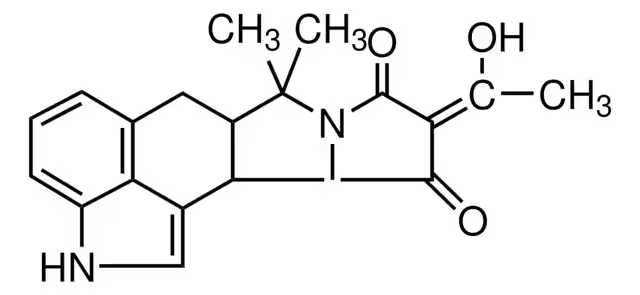
CAS Number18172-33-3
Synonymsγ-Linolenoyl-CoA; Cyclopiazonic acid from Penicillium cyclopium; 9-Phenanthrol; CYCLOPIAZONICACID,BIOTECHGRADE; CPA; PENICILLIUM CYCLOPIUM; MFCD00167445; Cyclopiazonsaeure
Molecular FormulaC20H20N2O3
Molecular Weight336.38
Purity≥98 (HPLC)%
Density1.5±0.1 g/cm3
Boiling Point598.6ºC at 760mmHg
Melting Point245-246ºC
Appearancepowder
Symbol
Signal WordWarning
| Chemical & Physical Properties | |
|---|---|
| CAS Number | 18172-33-3 |
| Catalog No. | 2A-9009953 |
| Chinese Name | 环匹阿尼酸 |
| Synonyms | γ-Linolenoyl-CoA; Cyclopiazonic acid from Penicillium cyclopium; 9-Phenanthrol; CYCLOPIAZONICACID,BIOTECHGRADE; CPA; PENICILLIUM CYCLOPIUM; MFCD00167445; Cyclopiazonsaeure |
| Molecular Formula | C20H20N2O3 |
| Molecular Weight | 336.38 |
| Purity | ≥98 (HPLC) |
| Density | 1.5±0.1 g/cm3 |
| Boiling Point | 598.6ºC at 760mmHg |
| Melting Point | 245-246ºC |
| Appearance | powder |
| Storage Condition | -20°C |
| Packaging | II |
| Application | Cyclopiazonic acid (CPA), a neurotoxic secondary metabolite (SM) derived from A. flavus, is a nanomolar endoplasmic reticulum calcium ATPase inhibitor (Ca2+ATPase; SERCA) and a potent inducer of plant |
| PubChem ID | 24892420 |
| MDL Number | MFCD00167445 |
| SMILES | CN1C(=O)C(=C(\C)O)\C(=O)C2C(Cc3cccc4[nH]cc2c34)C1(C)C |
| InChI | 1S/C20H22N2O3/c1-10(23)15-18(24)17-12-9-21-14-7-5-6-11(16(12)14)8-13(17)20(2,3)22(4)19(15)25/h5-7,9,13,17,21,23H,8H2,1-4H3/b15-10- |
| InChI Key | WJCPGKDPOYBOOJ-GDNBJRDFSA-N |
| NACRES Code | NA.77 |
| UNSPSC | 12352106 |
| Hazard Symbols | 6.1(a) |
| MSDS | msds/9953_1_18172_33_3.pdf |
| Bioactivity | Cyclopiazonic acid (CPA), a neurotoxic secondary metabolite (SM) made by A. flavus, is a nanomolar inhibitor of endoplasmic reticulum calcium ATPase (Ca2+ATPase; SERCA) and a potent inducer of cell death in plants[1]. Related Catalog Signaling Pathways >> Membrane Transporter/Ion Channel >> Calcium Channel Research Areas >> Others References [1]. Chalivendra SC, et al. Cyclopiazonic Acid Is a Pathogenicity Factor for Aspergillus flavus and a Promising Target for Screening Germplasm for Ear Rot Resistance. Mol Plant Microbe Interact. 2017 May;30(5):361-373. Chemical & Physical Properties Density 1.5±0.1 g/cm3 Boiling Point 598.6ºC at 760mmHg Melting Point 245-246ºC Molecular Formula C20H20N2O3 Molecular Weight 1027.948 Flash Point 315.8ºC Exact Mass 1027.329224 PSA 73.40000 LogP 2.96 Index of Refraction 1.626 Storage condition -20°C |
| Use of | Cyclopiazonic acid (CPA), a neurotoxic secondary metabolite (SM) made by A. flavus, is a nanomolar inhibitor of endoplasmic reticulum calcium ATPase (Ca2+ATPase; SERCA) and a potent inducer of cell death in plants[1]. Properties Articles66 Name (6aR,11aS,11bR)-10-acetyl-11-hydroxy-7,7-dimethyl-2,6,6a,7,11a,11b-hexahydro-9H-pyrrolo[1',2':2,3]isoindolo[4,5,6-cd]indol-9-one Synonym More Synonyms γ-Linolenoyl-CoA Biological Activity Description Cyclopiazonic acid (CPA), a neurotoxic secondary metabolite (SM) made by A. flavus, is a nanomolar inhibitor of endoplasmic reticulum calcium ATPase (Ca2+ATPase; SERCA) and a potent inducer of cell death in plants[1]. Related Catalog Signaling Pathways >> Membrane Transporter/Ion Channel >> Calcium Channel Research Areas >> Others References [1]. Chalivendra SC, et al. Cyclopiazonic Acid Is a Pathogenicity Factor for Aspergillus flavus and a Promising Target for Screening Germplasm for Ear Rot Resistance. Mol Plant Microbe Interact. 2017 May;30(5):361-373. Chemical & Physical Properties Molecular Formula C20H20N2O3 Exact Mass 1027.329224 PSA 73.40000 Index of Refraction 1.626 |
| Transport Info | Shipping Name: UN |
| MSDS Transport Info | Module 14. Shipping information 14.1 UN dangerous goods number European Dangerous Regulations for land transport: 2811 International Dangerous Regulations for sea transport: 2811 International Dangerous Regulations for air transport: 2811 14.2 United Nations shipping name European Land Transport Dangerous Regulations: TOXIC SOLID, ORGANIC, N.O.S. (Cyclopiazonic acid) IMDG Code: TOXIC SOLID, ORGANIC, N.O.S. (Cyclopiazonic acid) International air transport hazard regulations: Toxic solid, organic, n.o.s. (Cyclopiazonic acid) 14.3 Transport hazard categories European Land Transport Danger Regulations: 6.1 International Maritime Transport Danger Regulations: 6.1 International Air Transport Danger Regulations: 6.1 14.4 Package group European Dangerous Regulations for land transport: II International Dangerous Regulations for sea transport: II International Dangerous Regulations for air transport: II 14.5 Environmental hazards European Land Transport Danger Regulations: No International Maritime Danger Regulations International Air Transport Danger Regulations: No Marine pollutants (yes/no): No 14.6 Special reminder to users No data available The above information is believed to be correct, but is not all-inclusive and should be used as a guide only. The information in this document is based on our current knowledge and is Correct safety instructions apply to this product. This information does not represent a warranty as to the properties of this product. See reverse side of invoice or packing slip. |
| Related Products in Specialty Chemicals | ||
|---|---|---|
| Cyclopamine | 4449-51-8 | 2A-9009948 |
| Cyclopentadiene hexachkoride; Hexachlorocyclopentadiene | 77-47-4 | 2A-9009949 |
| Cyclopentamine | 102-45-4 | 2A-9009950 |
| Cyclopentolate | 512-15-2 | 2A-9009951 |
| Cyclopentolate hydrochloride | 5870-29-1 | 2A-9009952 |
| Cycloprate | 54460-46-7 | 2A-9009954 |
| Cycloprothrin | 63935-38-6 | 2A-9009955 |
| Cyclosporin B | 63775-95-1 | 2A-0202360 |
| Cyclosporin C | 59787-61-0 | 2A-9009957 |
| Cyclosporin D | 63775-96-2 | 2A-0202361 |
| Browse all Specialty Chemicals products » | ||
Phone:
630-322-8886
630-322-8887
Email:
Office Locations:
Chicago, IL, USA
San Francisco, CA, USA


 EN
EN


 SDS
SDS