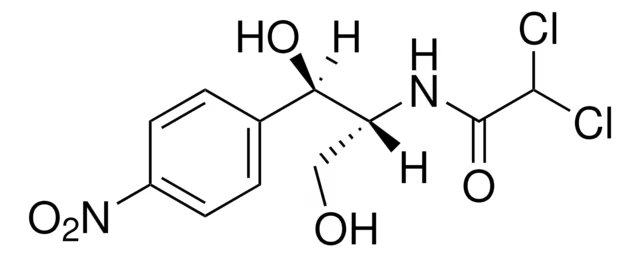
CAS Number56-75-7
SynonymsMychel; chloroamphenicol; CAF; Chloramphenicol; 2,2-dichloro-N-[(1R,2R)-2-hydroxy-1-(hydroxymethyl)-2-(4-nitrophenyl)ethyl]acetamide; i337a; u-6062; 2,2-dichloro-N-[(1R,2R)-1,3-dihydroxy-1-(4-nitrophenyl)propan-2-yl]acetamide; Chlomin; MFCD00078159; EINECS 200-287-4; Ambofen; D-()-threo-1-p-nitrophenyl-2-dichloracetamido-1,3-propanediol; Catilan; Enicol
Molecular FormulaCl2CHCONHCH(CH2OH)CH(OH)C6H4NO2
Molecular Weight323.13
Purity≥98 (HPLC)%
Density1.6±0.1 g/cm3
Boiling Point563.2±60.0 °C at 760 mmHg
Melting Point149-153 °C (lit.)
Appearancepowder or crystals
EINECS200-287-4
Symbol
Signal WordWarning
| Chemical & Physical Properties | |
|---|---|
| CAS Number | 56-75-7 |
| Catalog No. | 2A-9009722 |
| Chinese Name | 氯霉素 |
| Synonyms | Mychel; chloroamphenicol; CAF; Chloramphenicol; 2,2-dichloro-N-[(1R,2R)-2-hydroxy-1-(hydroxymethyl)-2-(4-nitrophenyl)ethyl]acetamide; i337a; u-6062; 2,2-dichloro-N-[(1R,2R)-1,3-dihydroxy-1-(4-nitrophenyl)propan-2-yl]acetamide; Chlomin; MFCD00078159; EINECS 200-287-4; Ambofen; D-()-threo-1-p-nitrophenyl-2-dichloracetamido-1,3-propanediol; Catilan; Enicol |
| Molecular Formula | Cl2CHCONHCH(CH2OH)CH(OH)C6H4NO2 |
| Molecular Weight | 323.13 |
| Purity | ≥98 (HPLC) |
| Density | 1.6±0.1 g/cm3 |
| Boiling Point | 563.2±60.0 °C at 760 mmHg |
| Melting Point | 149-153 °C (lit.) |
| Appearance | powder or crystals |
| Water Solubility | 2.5 g/L (25 º C) |
| Storage Condition | This product should be sealed and stored in a cool |
| Application | Chloramphenicol is a broad-spectrum antibacterial agent. |
| EINECS | 200-287-4 |
| HTC | 2941400000 |
| PubChem ID | 24892250 |
| MDL Number | MFCD00078159 |
| SMILES | OC[C@@H](NC(=O)C(Cl)Cl)[C@H](O)c1ccc(cc1)[N+]([O-])=O |
| InChI | 1S/C11H12Cl2N2O5/c12-10(13)11(18)14-8(5-16)9(17)6-1-3-7(4-2-6)15(19)20/h1-4,8-10,16-17H,5H2,(H,14,18)/t8-,9-/m1/s1 |
| InChI Key | WIIZWVCIJKGZOK-RKDXNWHRSA-N |
| Beilstein/REAXYS | 2225532 |
| NACRES Code | NA.76 |
| UNSPSC | 51102831 |
| Hazard Symbols | Transport |
| MSDS | msds/9722_1_56_75_7.pdf |
| Bioactivity | Chloramphenicol is a broad-spectrum antibiotic.Target: AntibacterialChloramphenicol is a bacteriostatic drug that stops bacterial growth by inhibiting protein synthesis. Chloramphenicol prevents protein chain elongation by inhibiting the peptidyl transferase activity of the bacterial ribosome. It specifically binds to A2451 and A2452 residues in the 23S rRNA of the 50S ribosomal subunit, preventing peptide bond formation. While chloramphenicol and the macrolide class of antibiotics both interact with ribosomes, chloramphenicol is not a macrolide. It directly interferes with substrate binding, whereas macrolides sterically block the progression of the growing peptide [1, 2]. Related Catalog Signaling Pathways >> Anti-infection >> Bacterial Research Areas >> Infection Natural Products >> Others References [1]. Jardetzky, O., Studies on the mechanism of action of chloramphenicol. I. The conformation of chlioramphenicol in solution. J Biol Chem, 1963. 238: p. 2498-508. [2]. Wolfe, A.D. and F.E. Hahn, Mode of Action of Chloramphenicol. Ix. Effects of Chloramphenicol Upon a Ribosomal Amino Acid Polymerization System and Its Binding to Bacterial Ribosome. Biochim Biophys Acta, 1965. 95: p. 146-55. Chemical & Physical Properties Density 1.6±0.1 g/cm3 Boiling Point 563.2±60.0 °C at 760 mmHg Melting Point 148-150 °C(lit.) Molecular Formula C11H12Cl2N2O5 Molecular Weight 323.129 Flash Point 294.4±32.9 °C Exact Mass 322.012329 PSA 115.38000 LogP 1.62 Vapour Pressure 0.0±1.6 mmHg at 25°C Index of Refraction 1.623 InChIKey WIIZWVCIJKGZOK-RKDXNWHRSA-N SMILES O=C(NC(CO)C(O)c1ccc([N+](=O)[O-])cc1)C(Cl)Cl Water Solubility 2.5 g/L (25 º C) |
| Use of | Chloramphenicol is a broad-spectrum antibiotic.Target: AntibacterialChloramphenicol is a bacteriostatic drug that stops bacterial growth by inhibiting protein synthesis. Chloramphenicol prevents protein chain elongation by inhibiting the peptidyl transferase activity of the bacterial ribosome. It specifically binds to A2451 and A2452 residues in the 23S rRNA of the 50S ribosomal subunit, preventing peptide bond formation. While chloramphenicol and the macrolide class of antibiotics both interact with ribosomes, chloramphenicol is not a macrolide. It directly interferes with substrate binding, whereas macrolides sterically block the progression of the growing peptide [1, 2]. Properties Articles475 Name chloramphenicol Synonym More Synonyms Chloramphenicol Biological Activity Description Chloramphenicol is a broad-spectrum antibiotic.Target: AntibacterialChloramphenicol is a bacteriostatic drug that stops bacterial growth by inhibiting protein synthesis. Chloramphenicol prevents protein chain elongation by inhibiting the peptidyl transferase activity of the bacterial ribosome. It specifically binds to A2451 and A2452 residues in the 23S rRNA of the 50S ribosomal subunit, preventing peptide bond formation. While chloramphenicol and the macrolide class of antibiotics both interact with ribosomes, chloramphenicol is not a macrolide. It directly interferes with substrate binding, whereas macrolides sterically block the progression of the growing peptide [1, 2]. Related Catalog Signaling Pathways >> Anti-infection >> Bacterial Research Areas >> Infection Natural Products >> Others References [1]. Jardetzky, O., Studies on the mechanism of action of chloramphenicol. I. The conformation of chlioramphenicol in solution. J Biol Chem, 1963. 238: p. 2498-508. [2]. Wolfe, A.D. and F.E. Hahn, Mode of Action of Chloramphenicol. Ix. Effects of Chloramphenicol Upon a Ribosomal Amino Acid Polymerization System and Its Binding to Bacterial Ribosome. Biochim Biophys Acta, 1965. 95: p. 146-55. Chemical & Physical Properties Exact Mass 322.012329 PSA 115.38000 Index of Refraction 1.623 InChIKey WIIZWVCIJKGZOK-RKDXNWHRSA-N |
| Transport Info | Shipping Name: UN |
| MSDS Transport Info | Module 14. Shipping information 14.1 UN dangerous goods number European Land Transport Dangerous Regulations: -International Maritime Dangerous Regulations: -International Air Transport Dangerous Regulations: - 14.2 United Nations shipping name European Land Transport Dangerous Regulations: Non-dangerous goods IMDG Code: Non-dangerous goods International air transport dangerous goods regulations: non-dangerous goods 14.3 Transport hazard categories European Land Transport Dangerous Regulations: -International Maritime Dangerous Regulations: -International Air Transport Dangerous Regulations: - 14.4 Package group European Land Transport Dangerous Regulations: -International Maritime Dangerous Regulations: -International Air Transport Dangerous Regulations: - 14.5 Environmental hazards European Land Transport Danger Regulations: No International Maritime Danger Regulations International Air Transport Danger Regulations: No Marine pollutants (yes/no): No 14.6 Special reminder to users No data available |
| Related Products in Specialty Chemicals | ||
|---|---|---|
| Chlomethocillin | 1926-49-4 | 2A-9009717 |
| Chlomethoxynil | 32861-85-1 | 2A-9009718 |
| Chlophedianol | 511-13-7 | 2A-9009719 |
| Chloracyzine | 800-22-6 | 2A-9009720 |
| Chloramben | 133-90-4 | 2A-9009721 |
| Chloramphenicol palmitate | 530-43-8 | 2A-9009723 |
| Chloramphenicol succinate sodium | 982-57-0 | 2A-9009724 |
| Chlordane | 57-74-9 | 2A-9009725 |
| Chlordene | 3734-48-3 | 2A-9009726 |
| Chlordiazepoxide hydrochloride | 438-41-5 | 2A-9009727 |
| Browse all Specialty Chemicals products » | ||
Phone:
630-322-8886
630-322-8887
Email:
Office Locations:
Chicago, IL, USA
San Francisco, CA, USA


 EN
EN


 SDS
SDS