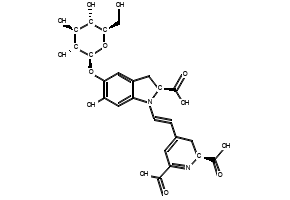
CAS Number7659-95-2
Synonyms(s-(r*,r*))--dihydro-6-hydroxy-1h-indol-1-yl)ethenyl)-3-dihydro; Phytolaccanin; Beetroot Red; EINECS 231-628-5
Molecular FormulaC24H26O13N2
Molecular Weight550.48
Purity98.00%
Density1.8±0.1 g/cm3
Boiling Point983.5±75.0 °C at 760 mmHg
AppearancePink to dark red liquid
Symbol
Signal WordWarning
| Chemical & Physical Properties | |
|---|---|
| CAS Number | 7659-95-2 |
| Catalog No. | 2A-9009385 |
| Chinese Name | 甜菜红 |
| Synonyms | (s-(r*,r*))--dihydro-6-hydroxy-1h-indol-1-yl)ethenyl)-3-dihydro; Phytolaccanin; Beetroot Red; EINECS 231-628-5 |
| Molecular Formula | C24H26O13N2 |
| Molecular Weight | 550.48 |
| Purity | 98.00 |
| Density | 1.8±0.1 g/cm3 |
| Boiling Point | 983.5±75.0 °C at 760 mmHg |
| Appearance | Pink to dark red liquid |
| Water Solubility | Water solubility: soluble |
| Storage Condition | Store in a cool, dry place and seal. |
| Application | Betanin has potent antioxidant and anti-inflammatory activities and is able to inhibit peroxynitrite (ONOO-) with an IC50 value of 19.2 μM. Betanin is a red glycoside extracted from sugar beets that i |
| HTC | 3203001990 |
| MDL Number | MFCD31729341 |
| SMILES | OC[C@H]1O[C@@H](Oc2cc3C[C@H](N(C=CC4=CC(=[NH+][C@@H](C4)C(O)=O)C(O)=O)c3cc2O)C([O-])=O)[C@H](O)[C@@H](O)[C@@H]1O |
| InChI | InChI=1S/C24H26N2O13/c27-8-17-18(29)19(30)20(31)24(39-17)38-16-6-10-5-14(23(36)37)26(13(10)7-15(16)28)2-1-9-3-11(21(32)33)25-12(4-9)22(34)35/h1-3,6-7,12,14,17-20,24,27-31H,4-5,8H2,(H,32,33)(H,34,35)(H,36,37)/t12-,14-,17+,18+,19-,20+,24+/m0/s1 |
| InChI Key | InChIKey=CTMLKIKAUFEMLE-FMOSSLLZSA-N |
| Hazard Symbols | 6.1 |
| MSDS | msds/9385_1_7659_95_2.pdf |
| Bioactivity | Betanin has potent antioxidant and anti-inflammatory effect, that could inhibit peroxynitrite (ONOO-), with an IC50 of 19.2 μM. Betanin is a red glycoside obtained from beets that can be used as colorant. Related Catalog Signaling Pathways >> Others >> Others Research Areas >> Metabolic Disease Natural Products >> Saccharides and Glycosides Target IC50: 19.2 μM (ONOO-)[1]. In Vitro Betanin is a representative constituent of red beetroot betacyanins, could inhibit peroxynitrite (ONOO-), with an IC50 of 19.2 μM[1]. Betanin also has anti-inflammatory, anti-proliferative effects, nephroprotective activity, cardioprotective activity, strong, antioxidant and angiotensin converting enzyme (ACE) inhibitory activity[2]. Another study is also indicated the protective effect of Betanin against high glucose induced rat renal epithelial cell fibrosis and matrix accumulation, major features of diabetic nephropathy (DN)[2]. In Vivo Betanin can inhibit the fructose-induced diabetic cardiac fibrosis and paraquat induced acute kidney toxicity[2]. The co-administration of Betanin (20 mg/kg b.w.) to diabetic rats prevent significantly the raise of glucose level and also reverse the levels of insulin compared with untreated diabetic rats. Interestingly diabetic rats treated with Betanin (20 mg/kg b.w.) and glibenclamide portray the significant changes in the body weight compared to diabetic control. HbA1c levels significantly increases in diabetic rats and when treated with Betanin as well as glibenclamide. Treatment with Betanin as well as glibenlamide to STZ-NA induces diabetic rat's elicit significant decreases in those levels when compared with diabetic control rats[3]. Animal Admin Rats[3] Healthy adult Male albino Wistar strain (Rattus norvegicus, 90-120 days of age) are used in the current study. After the successful induction of experimental diabetes, the rats are divided into four groups each comprising a minimum of six rats a total of 30 rats (18 diabetic surviving rats, 12 normal rats). Betanin is administered via oral intubation to the experimental rats using a gavage needle daily for a period of 30 days. Group 1: Normal Control rats. Group 2: Rats treated with Betanin (20 mg/kg b.w.) alone. Group 3: Diabetic Control rats. Group 4: Rats treated with STZ-NA by i.p. and Betanin (20 mg/kg b.w.). Group 5: Rats treated with STZ-NA by i.p. and glibenclamide (600 μg/kg b.w.)[3]. References [1]. Sakihama Y, et al. Beetroot betalain inhibits peroxynitrite-mediated tyrosine nitration and DNA strand cleavage. Free Radic Res. 2012 Jan;46(1):93-9. [2]. Sutariya B, et al. Betanin, isolated from fruits of Opuntia elatior Mill attenuates renal fibrosis in diabetic rats through regulating oxidative stress and TGF-β pathway. J Ethnopharmacol. 2017 Feb 23;198:432-443. [3]. Indumathi D, et al. Betanin exhibits significant potential as an antihyperglycemic and attenuating the glycoprotein components in streptozotocin-nicotinamide-induced experimental rats. Toxicol Mech Methods. 2018 Sep;28(7):547-554. Chemical & Physical Properties Density 1.8±0.1 g/cm3 Boiling Point 983.5±75.0 °C at 760 mmHg Molecular Formula C24H26N2O13 Molecular Weight 550.469 Flash Point 548.6±37.1 °C Exact Mass 550.143494 PSA 249.38000 LogP -4.49 Vapour Pressure 0.0±0.3 mmHg at 25°C Index of Refraction 1.740 |
| Use of | Betanin has potent antioxidant and anti-inflammatory effect, that could inhibit peroxynitrite (ONOO-), with an IC50 of 19.2 μM. Betanin is a red glycoside obtained from beets that can be used as colorant. Properties Name betanin Synonym More Synonyms betanin Biological Activity Description Betanin has potent antioxidant and anti-inflammatory effect, that could inhibit peroxynitrite (ONOO-), with an IC50 of 19.2 μM. Betanin is a red glycoside obtained from beets that can be used as colorant. Related Catalog Signaling Pathways >> Others >> Others Research Areas >> Metabolic Disease Natural Products >> Saccharides and Glycosides IC50: 19.2 μM (ONOO-)[1]. In Vitro Betanin is a representative constituent of red beetroot betacyanins, could inhibit peroxynitrite (ONOO-), with an IC50 of 19.2 μM[1]. Betanin also has anti-inflammatory, anti-proliferative effects, nephroprotective activity, cardioprotective activity, strong, antioxidant and angiotensin converting enzyme (ACE) inhibitory activity[2]. Another study is also indicated the protective effect of Betanin against high glucose induced rat renal epithelial cell fibrosis and matrix accumulation, major features of diabetic nephropathy (DN)[2]. References [1]. Sakihama Y, et al. Beetroot betalain inhibits peroxynitrite-mediated tyrosine nitration and DNA strand cleavage. Free Radic Res. 2012 Jan;46(1):93-9. [2]. Sutariya B, et al. Betanin, isolated from fruits of Opuntia elatior Mill attenuates renal fibrosis in diabetic rats through regulating oxidative stress and TGF-β pathway. J Ethnopharmacol. 2017 Feb 23;198:432-443. [3]. Indumathi D, et al. Betanin exhibits significant potential as an antihyperglycemic and attenuating the glycoprotein components in streptozotocin-nicotinamide-induced experimental rats. Toxicol Mech Methods. 2018 Sep;28(7):547-554. Chemical & Physical Properties Molecular Formula C24H26N2O13 Exact Mass 550.143494 PSA 249.38000 LogP -4.49 Index of Refraction 1.740 |
| Transport Info | Product name: Purity: 98.0% |
| MSDS Transport Info | Module 14. Shipping information United Nations classification: inconsistent with United Nations classification standards UN number: not specified |
| Related Products in Botanical Reference Standards | ||
|---|---|---|
| Bergamotin | 7380-40-7 | 2A-9009369 |
| Bergapten | 484-20-8 | 2A-9009370 |
| Bergenin | 477-90-7 | 2A-9009372 |
| Beta-escin | 6805-41-0 | 2A-9009379 |
| Betanidine | 55-73-2 | 2A-9009384 |
| Betulin diacetate | 1721-69-3 | 2A-9009388 |
| Betulinic acid | 472-15-1 | 2A-9009389 |
| Betulinol | 473-98-3 | 2A-9009390 |
| Bilobalide | 33570-04-6 | 2A-9009404 |
| Byakangelicin | 19573-01-4 | 2A-9009521 |
| Browse all Botanical Reference Standards products » | ||
Phone:
630-322-8886
630-322-8887
Email:
Office Locations:
Chicago, IL, USA
San Francisco, CA, USA


 EN
EN


 SDS
SDS