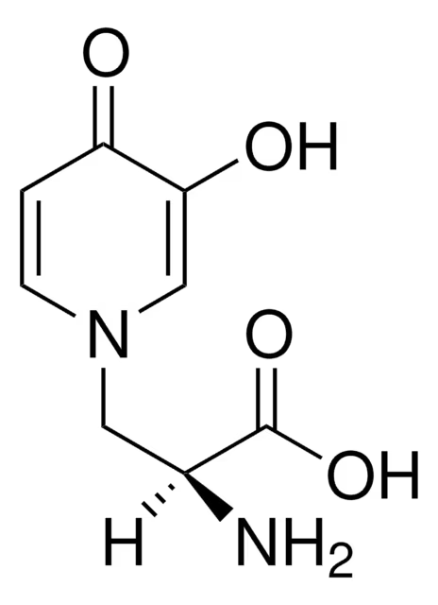
CAS Number500-44-7
SynonymsMimosine; (S)-2-amino-3-(3-hydroxy-4-oxo-4H-[1]pyridyl)-propionic acid; EINECS 207-905-1; leucenine; (S)-2-Amino-3-(3-hydroxy-4-oxo-4H-[1]pyridyl)-propionsaeure; (s)-1(4h)-pyridinepropanoicaci; MimosineLeucenol; MFCD00075909; L-Mimosine from Koa hoale seeds; L-LEUCININE; L(-)-MIMOSINE; LEUCENOL
Molecular FormulaC8H10N2O4
Molecular Weight198.18
Purity≥98%
Density1.544g/cm3
Boiling Point428.6ºC at 760mmHg
Melting Point224-228 °C
AppearanceLight yellowish brown to pink crystalline powder
EINECS207-905-1
Symbol
Signal WordWarning
| Chemical & Physical Properties | |
|---|---|
| CAS Number | 500-44-7 |
| Catalog No. | 2A-9093725 |
| Chinese Name | 含羞草素 |
| Synonyms | Mimosine; (S)-2-amino-3-(3-hydroxy-4-oxo-4H-[1]pyridyl)-propionic acid; EINECS 207-905-1; leucenine; (S)-2-Amino-3-(3-hydroxy-4-oxo-4H-[1]pyridyl)-propionsaeure; (s)-1(4h)-pyridinepropanoicaci; MimosineLeucenol; MFCD00075909; L-Mimosine from Koa hoale seeds; L-LEUCININE; L(-)-MIMOSINE; LEUCENOL |
| Molecular Formula | C8H10N2O4 |
| Molecular Weight | 198.18 |
| Purity | ≥98 |
| Density | 1.544g/cm3 |
| Boiling Point | 428.6ºC at 760mmHg |
| Melting Point | 224-228 °C |
| Appearance | Light yellowish brown to pink crystalline powder |
| Storage Condition | Store sealed and placed in a ventilated, dry envir |
| Application | Mimosine is a tyrosine analogue that acts as an antioxidant through its powerful iron-binding activity [1]. Mimosine is a known Fe(III) chelator [2]. Mimosine induces apoptosis through metal ion chela |
| EINECS | 207-905-1 |
| HTC | 2933399090 |
| PubChem ID | 24896541 |
| MDL Number | MFCD00075909 |
| SMILES | N[C@@H](CN1C=CC(=O)C(O)=C1)C(O)=O |
| InChI | 1S/C8H10N2O4/c9-5(8(13)14)3-10-2-1-6(11)7(12)4-10/h1-2,4-5,12H,3,9H2,(H,13,14)/t5-/m0/s1 |
| InChI Key | WZNJWVWKTVETCG-YFKPBYRVSA-N |
| NACRES Code | NA.77 |
| UNSPSC | 12352209 |
| Hazard Symbols | transportation |
| MSDS | msds/93725_1_500_44_7.pdf |
| Bioactivity | Mimosine, a tyrosine analog , can act as an antioxidant by its potent iron-binding activity[1]. Mimosine is a known chelator of Fe(III)[2]. Mimosine induces apoptosis through metal ion chelation, mitochondrial activation and ROS production in human leukemic cells[3]. Anti-cancer, antiinflammation. Related Catalog Signaling Pathways >> Apoptosis >> Apoptosis Research Areas >> Cancer Research Areas >> Inflammation/Immunology In Vitro Mimosine, a known chelator of Fe(III), may facilitate Fe(III) uptake in leucaena by serving as a phytosiderophore[2]. Mimosine, a bidentate iron-binding ligand, may also play a role in cellular translocation of iron within leucaena[2]. Mimosine is a toxic nonprotein amino acid that is a major constituent of the tropical legumesLeucaenaandMimosa[4]. Mimosine (400 μM), through iron chelation, reversibly blocks cell cycle progression in MDA-MB-453 human breast cancer cells[4]. Mimosine (400 μM) reduces DNA synthesis by greater than 90% of control within 4 hr of treatment, and suppresses total proline-directed protein kinase activity to less than 10% of control after 16 hr treatment[4]. In Vivo Mimosine (30, and 60 mg/kg) decreases sperm concentration[5]. Animal Model: ICR male mice (6-8 weeks)[5] Dosage: 15, 30, or 60 mg/kg Administration: Injected (i.p.) for 7 consecutive days Result: Could significantly reduce sperm concentration as compared to the control or low dose mimosine group (15 mg/kg) at doses of 30 and 60 mg/kg. References [1]. Keiko Murakami, et al. Generation of reactive oxygen species by hydroxypyridone compound/iron complexes. Redox Rep. 2020 Dec;25(1):59-63. [2]. Michael D H Honda, et al. Mimosine facilitates metallic cation uptake by plants through formation of mimosine-cation complexes.Plant Mol Biol. 2020 Mar;102(4-5):431-445. [3]. MaherHallakMSc, et al. Mimosine Induces Apoptosis through Metal Ion Chelation, Mitochondrial Activation and Reactive Oxygen Species Production in Human Leukemic Cells. Blood.2004, Nov 16, 104 (11): 4481. [4]. K S Kulp, et al. Mimosine blocks cell cycle progression by chelating iron in asynchronous human breast cancer cells. Toxicol Appl Pharmacol. 1996 Aug;139(2):356-64. [5]. Pipatpong Kanla, et al. Acute Effects of Mimosine Purified from Leucaena leucocephala on Male Reproductive System of Adult Mice. Int. J. Morphol., 36(2):507-512, 2018. Chemical & Physical Properties Density 1.544g/cm3 Boiling Point 428.6ºC at 760mmHg Melting Point 224-228 °C Molecular Formula C8H10N2O4 Molecular Weight 198.18 Flash Point 213ºC Exact Mass 198.06400 PSA 105.55000 Index of Refraction 1.645 InChIKey WZNJWVWKTVETCG-YFKPBYRVSA-N SMILES NC(Cn1ccc(=O)c(O)c1)C(=O)O Storage condition 2-8C |
| Use of | Mimosine, a tyrosine analog , can act as an antioxidant by its potent iron-binding activity[1]. Mimosine is a known chelator of Fe(III)[2]. Mimosine induces apoptosis through metal ion chelation, mitochondrial activation and ROS production in human leukemic cells[3]. Anti-cancer, antiinflammation. Properties Articles43 Name l-mimosine Synonym More Synonyms Mimosine Biological Activity Description Mimosine, a tyrosine analog , can act as an antioxidant by its potent iron-binding activity[1]. Mimosine is a known chelator of Fe(III)[2]. Mimosine induces apoptosis through metal ion chelation, mitochondrial activation and ROS production in human leukemic cells[3]. Anti-cancer, antiinflammation. Related Catalog Signaling Pathways >> Apoptosis >> Apoptosis Research Areas >> Cancer Research Areas >> Inflammation/Immunology In Vitro Mimosine, a known chelator of Fe(III), may facilitate Fe(III) uptake in leucaena by serving as a phytosiderophore[2]. Mimosine, a bidentate iron-binding ligand, may also play a role in cellular translocation of iron within leucaena[2]. Mimosine is a toxic nonprotein amino acid that is a major constituent of the tropical legumesLeucaenaandMimosa[4]. Mimosine (400 μM), through iron chelation, reversibly blocks cell cycle progression in MDA-MB-453 human breast cancer cells[4]. Mimosine (400 μM) reduces DNA synthesis by greater than 90% of control within 4 hr of treatment, and suppresses total proline-directed protein kinase activity to less than 10% of control after 16 hr treatment[4]. References [1]. Keiko Murakami, et al. Generation of reactive oxygen species by hydroxypyridone compound/iron complexes. Redox Rep. 2020 Dec;25(1):59-63. [2]. Michael D H Honda, et al. Mimosine facilitates metallic cation uptake by plants through formation of mimosine-cation complexes.Plant Mol Biol. 2020 Mar;102(4-5):431-445. [3]. MaherHallakMSc, et al. Mimosine Induces Apoptosis through Metal Ion Chelation, Mitochondrial Activation and Reactive Oxygen Species Production in Human Leukemic Cells. Blood.2004, Nov 16, 104 (11): 4481. [4]. K S Kulp, et al. Mimosine blocks cell cycle progression by chelating iron in asynchronous human breast cancer cells. Toxicol Appl Pharmacol. 1996 Aug;139(2):356-64. [5]. Pipatpong Kanla, et al. Acute Effects of Mimosine Purified from Leucaena leucocephala on Male Reproductive System of Adult Mice. Int. J. Morphol., 36(2):507-512, 2018. Chemical & Physical Properties Molecular Formula C8H10N2O4 Exact Mass 198.06400 PSA 105.55000 Index of Refraction 1.645 InChIKey WZNJWVWKTVETCG-YFKPBYRVSA-N |
| Tax Rebate | 13.0% |
| Supervision | None. MFN tariff: 6.5%. Ordinary tariff: 20.0% |
| Transport Info | Product name: Purity: 98.0% |
| MSDS Transport Info | Module 14. Shipping information 14.1 UN dangerous goods number European Land Transport Dangerous Regulations: -International Maritime Dangerous Regulations: -International Air Transport Dangerous Regulations: - 14.2 Names specified by the United Nations (UN) European Land Transport Dangerous Regulations: Non-dangerous goods IMDG Code: Non-dangerous goods International air transport dangerous goods regulations: non-dangerous goods 14.3 Transport hazard categories European Land Transport Dangerous Regulations: -International Maritime Dangerous Regulations: -International Air Transport Dangerous Regulations: - 14.4 Package group European Land Transport Dangerous Regulations: -International Maritime Dangerous Regulations: -International Air Transport Dangerous Regulations: - 14.5 Environmental hazards European Land Transport Dangerous Regulations: No International Maritime Transport Dangerous Regulations Maritime Pollutants: No International Air Transport Risk Regulations: No 14.6 Special reminder to users No data available |
| Related Products in Specialty Chemicals | ||
|---|---|---|
| COPPER SULFATE | 31207-09-7 | 2A-9093712 |
| Lignosulfonic acid | 8062-15-5 | 2A-9093716 |
| 1-(1,1-dimethylethoxy)-2-methylpropane | 33021-02-2 | 2A-9093720 |
| 3-(3-PENTYLOXIRANYL)-2E-PROPENOL | 134454-31-2 | 2A-9093721 |
| SODIUM NITROPRUSSIDE DIHYDRATE | 13755-38-9 | 2A-9093723 |
| Patassium Citrate | 2A-175373 | 2A-9093726 |
| DISTILLED MONOSTEARATES (DMG-90) | 2A-175374 | 2A-9093727 |
| Vita Wheat Gluten | 2A-175377 | 2A-9093730 |
| FERRICYANIDE | 13408-62-3 | 2A-9093731 |
| DOMOIC ACID | 14277-97-5 | 2A-9093732 |
| Browse all Specialty Chemicals products » | ||
Phone:
630-322-8886
630-322-8887
Email:
Office Locations:
Chicago, IL, USA
San Francisco, CA, USA


 EN
EN


 SDS
SDS