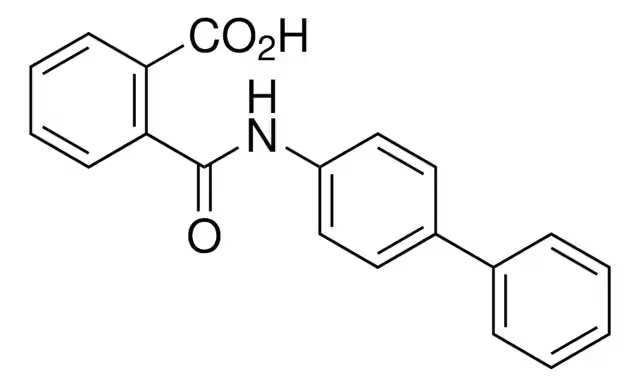
CAS Number4727-31-5
Synonyms2-[([1,1'-biphenyl]-4-ylamino)carbonyl]benzoic acid; Kartogenin; 2-([1,1'-Biphenyl]-4-ylcarbamoyl)benzoic acid; 2-(4-Biphenylylcarbamoyl)benzoic acid; 2-(Biphenyl-4-ylcarbamoyl)benzoic acid; KGN
Molecular FormulaC20H15NO3
Molecular Weight317.34
Purity≥98 (HPLC)%
Density1.3±0.1 g/cm3
Boiling Point464.4±38.0 °C at 760 mmHg
Appearancepowder
Symbol
Signal WordWarning
| Chemical & Physical Properties | |
|---|---|
| CAS Number | 4727-31-5 |
| Catalog No. | 2A-9093275 |
| Chinese Name | 2-([1,1-联苯]-4-基氨基甲酰)苯甲酸 |
| Synonyms | 2-[([1,1'-biphenyl]-4-ylamino)carbonyl]benzoic acid; Kartogenin; 2-([1,1'-Biphenyl]-4-ylcarbamoyl)benzoic acid; 2-(4-Biphenylylcarbamoyl)benzoic acid; 2-(Biphenyl-4-ylcarbamoyl)benzoic acid; KGN |
| Molecular Formula | C20H15NO3 |
| Molecular Weight | 317.34 |
| Purity | ≥98 (HPLC) |
| Density | 1.3±0.1 g/cm3 |
| Boiling Point | 464.4±38.0 °C at 760 mmHg |
| Appearance | powder |
| Water Solubility | DMSO: >15mg/mL |
| Storage Condition | room temp |
| Application | Kartogenin is an inducer of differentiation of human mesenchymal stem cells into chondrocytes. |
| HTC | 2924299090 |
| PubChem ID | 329825371 |
| MDL Number | MFCD00560510 |
| SMILES | O=C(NC1=CC=C(C2=CC=CC=C2)C=C1)C(C=CC=C3)=C3C(O)=O |
| InChI | 1S/C20H15NO3/c22-19(17-8-4-5-9-18(17)20(23)24)21-16-12-10-15(11-13-16)14-6-2-1-3-7-14/h1-13H,(H,21,22)(H,23,24) |
| InChI Key | SLUINPGXGFUMLL-UHFFFAOYSA-N |
| NACRES Code | NA.77 |
| UNSPSC | 12352200 |
| Hazard Symbols | 9.0 |
| MSDS | msds/93275_1_4727_31_5.pdf |
| Bioactivity | Kartogenin is an inducer of differentiation of human mesenchymal stem cells into chondrocytes. Related Catalog Signaling Pathways >> Stem Cell/Wnt >> TGF-beta/Smad Signaling Pathways >> TGF-beta/Smad >> TGF-beta/Smad Research Areas >> Others In Vitro Kartogenin enhances cell proliferation in both cell types in a concentration-dependent manner and induces chondrogenic differentiation of stem cells, as demonstrated by high expression levels of chondrogenic markers aggrecan, collagen II and Sox-9. Besides, kartogenin induces the formation of cartilage-like tissues in cell cultures, as observed through the staining of abundant proteoglycans, collagen II and osteocalcin[1]. Kartogenin stimulates type-I collagen synthesis of fibroblasts at the mRNA and protein levels in a time-dependent manner without obvious influence on fibroblasts' apoptosis and viability. Smad4/smad5 of the TGF-β signaling pathway is activated by kartogenin while MAPK signaling pathway remains unchanged[2]. Kartogenin treatment enhances chondrocyte pericellular matrix assembly and retention in the presence of IL-1β. Kartogenin partially blocks the IL-1β-induced increased expression of ADAMTS-5. Additionally, kartogenin-treated articular chondrocytes exhibits a decrease in CD44 proteolytic fragmentation[3]. In Vivo hen injected into intact rat patellar tendons, kartogenin induces cartilage-like tissue formation in the injected area. When injected into experimentally injured rat Achilles TBJs, wound healing in the TBJs is enhanced, as evidenced by the formation of extensive cartilage-like tissues[1]. Kartogenin stimulates collagen synthesis in the mouse dermis. Dermis in the kartogenin (100 nM)-treated group exhibits increased dermal thickness and intense blue staining, which represents more collagen composition in the dermis[2]. Cell Assay Rabbit BMSCs or PTSCs are treated with various concentrations (1 nM to 5 μM) of kartogenin. The medium is changed every 3 days and after 2 weeks, cell proliferation is measured by population doubling time[1]. Animal Admin Rats: Then rats are divided into two groups based on the injections received: six rats are given 10 µL saline injections in each wound (wound-only group) and six rats receive 10 µL of 100 µM kartogenin solution each in the wounded areas (wound+kartogenin group). The injections are given immediately after wounding and repeated on days 2, 4, 7 and 12[1]. References [1]. Zhang J, et al. Kartogenin induces cartilage-like tissue formation in tendon-bone junction. Bone Res. 2014;2. pii: 14008. [2]. Wang J, et al. A heterocyclic molecule kartogenin induces collagen synthesis of human dermal fibroblasts by activating the smad4/smad5 pathway. Biochem Biophys Res Commun. 2014 Jul 18;450(1):568-74. [3]. Ono Y, et al. Chondroprotective Effect of Kartogenin on CD44-Mediated Functions in Articular Cartilage and Chondrocytes. Cartilage. 2014 Jul;5(3):172-80. Chemical & Physical Properties Density 1.3±0.1 g/cm3 Boiling Point 464.4±38.0 °C at 760 mmHg Molecular Formula C20H15NO3 Molecular Weight 317.338 Flash Point 234.6±26.8 °C Exact Mass 317.105194 PSA 66.40000 LogP 3.81 Vapour Pressure 0.0±1.2 mmHg at 25°C Index of Refraction 1.674 InChIKey SLUINPGXGFUMLL-UHFFFAOYSA-N SMILES O=C(O)c1ccccc1C(=O)Nc1ccc(-c2ccccc2)cc1 Storage condition room temp Water Solubility DMSO: >15mg/mL |
| Use of | Kartogenin is an inducer of differentiation of human mesenchymal stem cells into chondrocytes. Properties Name 2-[(4-phenylphenyl)carbamoyl]benzoic acid Synonym More Synonyms Kartogenin Biological Activity Description Kartogenin is an inducer of differentiation of human mesenchymal stem cells into chondrocytes. Related Catalog Signaling Pathways >> Stem Cell/Wnt >> TGF-beta/Smad Signaling Pathways >> TGF-beta/Smad >> TGF-beta/Smad Research Areas >> Others In Vivo hen injected into intact rat patellar tendons, kartogenin induces cartilage-like tissue formation in the injected area. When injected into experimentally injured rat Achilles TBJs, wound healing in the TBJs is enhanced, as evidenced by the formation of extensive cartilage-like tissues[1]. Kartogenin stimulates collagen synthesis in the mouse dermis. Dermis in the kartogenin (100 nM)-treated group exhibits increased dermal thickness and intense blue staining, which represents more collagen composition in the dermis[2]. Cell Assay Rabbit BMSCs or PTSCs are treated with various concentrations (1 nM to 5 μM) of kartogenin. The medium is changed every 3 days and after 2 weeks, cell proliferation is measured by population doubling time[1]. Animal Admin Rats: Then rats are divided into two groups based on the injections received: six rats are given 10 µL saline injections in each wound (wound-only group) and six rats receive 10 µL of 100 µM kartogenin solution each in the wounded areas (wound+kartogenin group). The injections are given immediately after wounding and repeated on days 2, 4, 7 and 12[1]. References [1]. Zhang J, et al. Kartogenin induces cartilage-like tissue formation in tendon-bone junction. Bone Res. 2014;2. pii: 14008. [3]. Ono Y, et al. Chondroprotective Effect of Kartogenin on CD44-Mediated Functions in Articular Cartilage and Chondrocytes. Cartilage. 2014 Jul;5(3):172-80. Chemical & Physical Properties Molecular Formula C20H15NO3 Exact Mass 317.105194 PSA 66.40000 Index of Refraction 1.674 InChIKey SLUINPGXGFUMLL-UHFFFAOYSA-N Storage condition room temp |
| Tax Rebate | 13.0% |
| Supervision | None. MFN tariff: 6.5%. Ordinary tariff: 30.0% |
| Transport Info | Product name: Purity: 98.0% |
| MSDS Transport Info | Module 14. Shipping information 14.1 UN dangerous goods number European Land Transport Danger Regulations: 3077 International Maritime Transport Danger Regulations: 3077 International Air Transport Danger Regulations: 3077 14.2 Names specified by the United Nations (UN) European land transport hazard regulations: ENVIRONMENTALLY HAZARDOUS SUBSTANCE, SOLID, N.O.S. (2-[(Biphenyl-4- yl)carbamoyl]benzoic acid) IMDG Code: ENVIRONMENTALLY HAZARDOUS SUBSTANCE, SOLID, N.O.S. (2-[(Biphenyl-4- yl)carbamoyl]benzoic acid) International air transport hazard regulations: Environmentally hazardous substance, solid, n.o.s. (2-[(Biphenyl-4-yl)carbamoyl]benzoic acid) 14.3 Transport hazard categories European land transport Dangerous Regulations: 9 International sea transport Dangerous Regulations: 9 International air transport Dangerous Regulations: 9 14.4 Package group European Land Transport Danger Regulations: III International Maritime Transport Danger Regulations: III International Air Transport Danger Regulations: III 14.5 Environmental hazards European Land Transport Dangerous Regulations: Yes International Maritime Transport Dangerous Regulations Maritime Pollutants: Yes International Air Transport Dangerous Regulations: Yes 14.6 Special reminder to users further information Dangerous goods are individually packaged, with liquids exceeding 5 liters or solids exceeding 5 kilograms. The outer packaging of each independent package and the combined independent inner package must have EHS on it. Identification (according to European ADR Regulation 2.2.9.1.10, IMDG Regulation 2.10.3), See reverse side of invoice or packing slip. |
| Related Products in Specialty Chemicals | ||
|---|---|---|
| SBE 13 hydrochloride | 1052532-15-6 | 2A-9093267 |
| ANA12 | 219766-25-3 | 2A-9093268 |
| SPIROBIINDANE | 1568-80-5 | 2A-9093269 |
| GSK2578215A | 1285515-21-0 | 2A-9093273 |
| Bikinin | 188011-69-0 | 2A-9093274 |
| Methyl 6-broMo-4-chloronicotinate | 1256789-73-7 | 2A-9093279 |
| N-Ethylpentylone HCl | 17763-02-9 | 2A-9093280 |
| actinorhodin | 1397-77-9 | 2A-9093282 |
| Dihydroetorphine | 14357-76-7 | 2A-9093283 |
| phosphonic acid | 15468-10-7 | 2A-9093284 |
| Browse all Specialty Chemicals products » | ||
Phone:
630-322-8886
630-322-8887
Email:
Office Locations:
Chicago, IL, USA
San Francisco, CA, USA


 EN
EN


 SDS
SDS