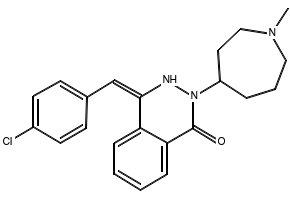
CAS Number58581-89-8
SynonymsUNII:ZQI909440X; 4-(4-Chlorobenzyl)-2-(1-methyl-4-azepanyl)-1(2H)-phthalazinone; Optilast; 4-(p-Chlorobenzyl)-2-(N-methylperhydroazepin-4-yl)-1(2H)-phthalazinone; Allergodil; 4-[(4-chlorophenyl)methyl]-2-(1-methylazepan-4-yl)phthalazin-1(2H)-one; Azelastine; 4-[(4-Chlorophenyl)methyl]-2-(hexahydro-1-methyl-1H-azepin-4-yl)-1(2H)-phthalazinone; 4-(4-Chlorobenzyl)-2-(1-methylazepan-4-yl)phthalazin-1(2H)-one; Rhinolast; MFCD00242781; 4-(p-Chlorobenzyl)-2-(hexahydro-1-methyl-1H-azepin-4-yl)-1(2H)-phthalazinone
Molecular FormulaC22H24O1N3Cl1
Molecular Weight381.9
Purity98%
Density1.3±0.1 g/cm3
Boiling Point533.9±60.0 °C at 760 mmHg
Appearancewhite crystal powder
Symbol
Signal WordWarning
| Chemical & Physical Properties | |
|---|---|
| CAS Number | 58581-89-8 |
| Catalog No. | 2A-9009279 |
| Chinese Name | 盐酸氮卓斯汀 |
| Synonyms | UNII:ZQI909440X; 4-(4-Chlorobenzyl)-2-(1-methyl-4-azepanyl)-1(2H)-phthalazinone; Optilast; 4-(p-Chlorobenzyl)-2-(N-methylperhydroazepin-4-yl)-1(2H)-phthalazinone; Allergodil; 4-[(4-chlorophenyl)methyl]-2-(1-methylazepan-4-yl)phthalazin-1(2H)-one; Azelastine; 4-[(4-Chlorophenyl)methyl]-2-(hexahydro-1-methyl-1H-azepin-4-yl)-1(2H)-phthalazinone; 4-(4-Chlorobenzyl)-2-(1-methylazepan-4-yl)phthalazin-1(2H)-one; Rhinolast; MFCD00242781; 4-(p-Chlorobenzyl)-2-(hexahydro-1-methyl-1H-azepin-4-yl)-1(2H)-phthalazinone |
| Molecular Formula | C22H24O1N3Cl1 |
| Molecular Weight | 381.9 |
| Purity | 98 |
| Density | 1.3±0.1 g/cm3 |
| Boiling Point | 533.9±60.0 °C at 760 mmHg |
| Appearance | white crystal powder |
| Storage Condition | Store in an airtight container in a dry, cool plac |
| Packaging | III |
| Application | Azelastine is a second-generation H1 receptor antagonist. |
| HTC | 2933990090 |
| MDL Number | MFCD00242781 |
| SMILES | CN1CCCC(n2nc(Cc3ccc(Cl)cc3)c3ccccc3c2=O)CC1 |
| InChI | InChI=1S/C22H24ClN3O.ClH/c1-25-13-4-5-18(12-14-25)26-22(27)20-7-3-2-6-19(20)21(24-26)15-16-8-10-17(23)11-9-16;/h2-3,6-11,18H,4-5,12-15H2,1H3;1H |
| InChI Key | MBUVEWMHONZEQD-UHFFFAOYSA-N |
| Hazard Symbols | 6.1(b) |
| MSDS | msds/9279_1_58581_89_8.pdf |
| Use of | Azelastine is a potent, second-generation, selective, histamine antagonist.Target: Histamine ReceptorAzelastine is a selective H(1)-receptor antagonist that inhibits histamine release and interferes with activation of several other mediators of allergic inflammation. Azelastine can inhibit CHMCs activation and release of IL-6, tryptase, and histamine. On an equimolar basis, azelastine was a more potent inhibitor than olopatadine [1]. Topical azelastine progressively improved itching and conjunctival redness in PAC patients compared to placebo and was at least as effective as levocabastine. Rapid relief is consistent with H(1)-receptor antagonist action, while continued improvement up to 6 weeks may be consistent with mechanisms involving other mediators of allergic inflammation [2]. Azelastine nasal spray was reported to control all rhinitis symptoms, including nasal congestion, regardless of rhinitis diagnosis during the 2-week study period. Patients with seasonal allergic rhinitis and patients with seasonal allergic rhinitis plus nonallergic triggers were identified as patient types most likely to respond to azelastine nasal spray [3]. Properties Name azelastine Synonym More Synonyms Azelastine Biological Activity Description Azelastine is a potent, second-generation, selective, histamine antagonist.Target: Histamine ReceptorAzelastine is a selective H(1)-receptor antagonist that inhibits histamine release and interferes with activation of several other mediators of allergic inflammation. Azelastine can inhibit CHMCs activation and release of IL-6, tryptase, and histamine. On an equimolar basis, azelastine was a more potent inhibitor than olopatadine [1]. Topical azelastine progressively improved itching and conjunctival redness in PAC patients compared to placebo and was at least as effective as levocabastine. Rapid relief is consistent with H(1)-receptor antagonist action, while continued improvement up to 6 weeks may be consistent with mechanisms involving other mediators of allergic inflammation [2]. Azelastine nasal spray was reported to control all rhinitis symptoms, including nasal congestion, regardless of rhinitis diagnosis during the 2-week study period. Patients with seasonal allergic rhinitis and patients with seasonal allergic rhinitis plus nonallergic triggers were identified as patient types most likely to respond to azelastine nasal spray [3]. Related Catalog Signaling Pathways >> GPCR/G Protein >> Histamine Receptor Signaling Pathways >> Immunology/Inflammation >> Histamine Receptor Research Areas >> Inflammation/Immunology References [1]. Kempuraj, D., et al., Azelastine is more potent than olopatadine n inhibiting interleukin-6 and tryptase release from human umbilical cord blood-derived cultured mast cells. Ann Allergy Asthma Immunol, 2002. 88(5): p. 501-6. [2]. Canonica, G.W., et al., Topical azelastine in perennial allergic conjunctivitis. Curr Med Res Opin, 2003. 19(4): p. 321-9. [3]. Lieberman, P., M.A. Kaliner, and W.J. Wheeler, Open-label evaluation of azelastine nasal spray in patients with seasonal allergic rhinitis and nonallergic vasomotor rhinitis. Curr Med Res Opin, 2005. 21(4): p. 611-8. Chemical & Physical Properties Exact Mass 381.160797 PSA 38.13000 Index of Refraction 1.642 InChIKey MBUVEWMHONZEQD-UHFFFAOYSA-N Storage condition 2-8℃ Toxicological Information CHEMICAL IDENTIFICATION RTECS NUMBER : CHEMICAL NAME : 1(2H)-Phthalazinone, 4-((4-chlorophenyl)methyl)-2-(hexahydro-1-methyl-1H-a zepin-4-yl)- CAS REGISTRY NUMBER : 58581-89-8 LAST UPDATED : DATA ITEMS CITED : MOLECULAR FORMULA : C22-H24-Cl-N3-O MOLECULAR WEIGHT : WISWESSER LINE NOTATION : T66 BVNNJ E1R DG& C- DT7NTJ A1 HEALTH HAZARD DATA ACUTE TOXICITY DATA TYPE OF TEST : LD50 - Lethal dose, 50 percent kill ROUTE OF EXPOSURE : SPECIES OBSERVED : Rodent - rat DOSE/DURATION : TOXIC EFFECTS : Peripheral Nerve and Sensation - flaccid paralysis without anesthesia (usually neuromuscular blockage) Behavioral - convulsions or effect on seizure threshold Lungs, Thorax, or Respiration - other changes REFERENCE : ARZNAD Arzneimittel-Forschung. Drug Research. (Editio Cantor Verlag, Postfach 1255, W-7960 Aulendorf, Fed. Rep. Ger.) V.1- 1951- Volume(issue)/page/year: 31,1184,1981 TYPE OF TEST : LD50 - Lethal dose, 50 percent kill ROUTE OF EXPOSURE : Intraperitoneal SPECIES OBSERVED : Rodent - rat DOSE/DURATION : 43200 ug/kg TOXIC EFFECTS : Peripheral Nerve and Sensation - flaccid paralysis without anesthesia (usually neuromuscular blockage) Behavioral - convulsions or effect on seizure threshold Lungs, Thorax, or Respiration - other changes REFERENCE : ARZNAD Arzneimittel-Forschung. Drug Research. (Editio Cantor Verlag, Postfach 1255, W-7960 Aulendorf, Fed. Rep. Ger.) V.1- 1951- Volume(issue)/page/year: 31,1184,1981 TYPE OF TEST : LD50 - Lethal dose, 50 percent kill ROUTE OF EXPOSURE : Subcutaneous SPECIES OBSERVED : Rodent - rat DOSE/DURATION : 59600 ug/kg TOXIC EFFECTS : Peripheral Nerve and Sensation - flaccid paralysis without anesthesia (usually neuromuscular blockage) Behavioral - convulsions or effect on seizure threshold Lungs, Thorax, or Respiration - other changes REFERENCE : ARZNAD Arzneimittel-Forschung. Drug Research. (Editio Cantor Verlag, Postfach 1255, W-7960 Aulendorf, Fed. Rep. Ger.) V.1- 1951- Volume(issue)/page/year: 31,1184,1981 TYPE OF TEST : LD50 - Lethal dose, 50 percent kill ROUTE OF EXPOSURE : Intravenous SPECIES OBSERVED : Rodent - rat DOSE/DURATION : 26900 ug/kg TOXIC EFFECTS : Peripheral Nerve and Sensation - flaccid paralysis without anesthesia (usually neuromuscular blockage) Behavioral - convulsions or effect on seizure threshold Lungs, Thorax, or Respiration - other changes REFERENCE : ARZNAD Arzneimittel-Forschung. Drug Research. (Editio Cantor Verlag, Postfach 1255, W-7960 Aulendorf, Fed. Rep. Ger.) V.1- 1951- Volume(issue)/page/year: 31,1184,1981 TYPE OF TEST : LD50 - Lethal dose, 50 percent kill ROUTE OF EXPOSURE : Intramuscular SPECIES OBSERVED : Rodent - rat DOSE/DURATION : TOXIC EFFECTS : Details of toxic effects not reported other than lethal dose value REFERENCE : IYKEDH Iyakuhin Kenkyu. Study of Medical Supplies. (Nippon Koteisho Kyokai, 12-15, 2-chome, Shibuya, Shibuya-ku, Tokyo 150, Japan) V.1- 1970- Volume(issue)/page/year: 17,1106,1986 TYPE OF TEST : LD50 - Lethal dose, 50 percent kill ROUTE OF EXPOSURE : SPECIES OBSERVED : Rodent - mouse DOSE/DURATION : TOXIC EFFECTS : Peripheral Nerve and Sensation - flaccid paralysis without anesthesia (usually neuromuscular blockage) Behavioral - convulsions or effect on seizure threshold Lungs, Thorax, or Respiration - other changes REFERENCE : ARZNAD Arzneimittel-Forschung. Drug Research. (Editio Cantor Verlag, Postfach 1255, W-7960 Aulendorf, Fed. Rep. Ger.) V.1- 1951- Volume(issue)/page/year: 31,1184,1981 TYPE OF TEST : LD50 - Lethal dose, 50 percent kill ROUTE OF EXPOSURE : Intraperitoneal SPECIES OBSERVED : Rodent - mouse DOSE/DURATION : 42800 ug/kg TOXIC EFFECTS : Peripheral Nerve and Sensation - flaccid paralysis without anesthesia (usually neuromuscular blockage) Behavioral - convulsions or effect on seizure threshold Lungs, Thorax, or Respiration - other changes REFERENCE : ARZNAD Arzneimittel-Forschung. Drug Research. (Editio Cantor Verlag, Postfach 1255, W-7960 Aulendorf, Fed. Rep. Ger.) V.1- 1951- Volume(issue)/page/year: 31,1184,1981 TYPE OF TEST : LD50 - Lethal dose, 50 percent kill ROUTE OF EXPOSURE : Subcutaneous SPECIES OBSERVED : Rodent - mouse DOSE/DURATION : 54200 ug/kg TOXIC EFFECTS : Peripheral Nerve and Sensation - flaccid paralysis without anesthesia (usually neuromuscular blockage) Behavioral - convulsions or effect on seizure threshold Lungs, Thorax, or Respiration - other changes REFERENCE : ARZNAD Arzneimittel-Forschung. Drug Research. (Editio Cantor Verlag, Postfach 1255, W-7960 Aulendorf, Fed. Rep. Ger.) V.1- 1951- Volume(issue)/page/year: 31,1184,1981 TYPE OF TEST : LD50 - Lethal dose, 50 percent kill ROUTE OF EXPOSURE : Intravenous SPECIES OBSERVED : Rodent - mouse DOSE/DURATION : 25400 ug/kg TOXIC EFFECTS : Details of toxic effects not reported other than lethal dose value REFERENCE : IYKEDH Iyakuhin Kenkyu. Study of Medical Supplies. (Nippon Koteisho Kyokai, 12-15, 2-chome, Shibuya, Shibuya-ku, Tokyo 150, Japan) V.1- 1970- Volume(issue)/page/year: 17,1106,1986 TYPE OF TEST : LD50 - Lethal dose, 50 percent kill ROUTE OF EXPOSURE : Intramuscular SPECIES OBSERVED : Rodent - mouse DOSE/DURATION : 59700 ug/kg TOXIC EFFECTS : Details of toxic effects not reported other than lethal dose value REFERENCE : IYKEDH Iyakuhin Kenkyu. Study of Medical Supplies. (Nippon Koteisho Kyokai, 12-15, 2-chome, Shibuya, Shibuya-ku, Tokyo 150, Japan) V.1- 1970- Volume(issue)/page/year: 17,1106,1986 TYPE OF TEST : LD50 - Lethal dose, 50 percent kill ROUTE OF EXPOSURE : SPECIES OBSERVED : Mammal - dog DOSE/DURATION : 51300 ug/kg TOXIC EFFECTS : Behavioral - convulsions or effect on seizure threshold Behavioral - changes in motor activity (specific assay) Gastrointestinal - nausea or vomiting REFERENCE : ARZNAD Arzneimittel-Forschung. Drug Research. (Editio Cantor Verlag, Postfach 1255, W-7960 Aulendorf, Fed. Rep. Ger.) V.1- 1951- Volume(issue)/page/year: 31,1184,1981 TYPE OF TEST : LD50 - Lethal dose, 50 percent kill ROUTE OF EXPOSURE : Intravenous SPECIES OBSERVED : Mammal - dog DOSE/DURATION : 13700 ug/kg TOXIC EFFECTS : Behavioral - convulsions or effect on seizure threshold Behavioral - changes in motor activity (specific assay) Gastrointestinal - nausea or vomiting REFERENCE : ARZNAD Arzneimittel-Forschung. Drug Research. (Editio Cantor Verlag, Postfach 1255, W-7960 Aulendorf, Fed. Rep. Ger.) V.1- 1951- Volume(issue)/page/year: 31,1184,1981 Safety Information Hazard Codes N-T,N,T RIDADR 1557 RTECS CY5950000 Packaging Group III Hazard Class 6.1(b) HS Code 2933990090 Synthetic Route 4-Chlorophenyla... CAS#:1878-66-6 Azelastine CAS#:58581-89-8 Literature: Archiv der Pharmazie, , vol. 321, # 4 p. 205 - 208 Phthalic anhydride CAS#:85-44-9 Azelastine CAS#:58581-89-8 Literature: Archiv der Pharmazie, , vol. 321, # 4 p. 205 - 208 (Z)-3-(4-chloro... CAS#:105279-16-1 Azelastine CAS#:58581-89-8 Literature: Archiv der Pharmazie, , vol. 321, # 4 p. 205 - 208 Precursor & DownStream Precursor 4 CAS#:1878-66-6 4-Chlorophenyla... CAS#:85-44-9 Phthalic anhydride CAS#:1859-33-2 1-methylazepan-4-one CAS#:53242-76-5 2-((4-Chlorophe... DownStream 0 |
| Tax Rebate | 13.0% |
| Supervision | None. MFN tariff: 6.5%. Ordinary tariff: 20.0% |
| Transport Info | Product name: Summary 2933990090. heterocyclic compounds with nitrogen hetero-atom(s) only. VAT:17.0%. Tax rebate rate:13.0%. . MFN tariff:6.5%. General tariff:20.0% |
| Related Products in Specialty Chemicals | ||
|---|---|---|
| Azaperon | 1649-18-9 | 2A-9009273 |
| Azapetine | 146-36-1 | 2A-9009274 |
| Azaserine | 115-02-6 | 2A-9009275 |
| Azasetron | 123040-69-7 | 2A-9009276 |
| Azaspirium chloride | 34959-30-3 | 2A-9009277 |
| Azepexole | 36067-73-9 | 2A-9009280 |
| Azidithion | 78-57-9 | 2A-9009281 |
| Azidocillin | 17243-38-8 | 2A-9009282 |
| Azimilide | 149908-53-2 | 2A-9009283 |
| Azimsulfuron | 120162-55-2 | 2A-9009284 |
| Browse all Specialty Chemicals products » | ||
Phone:
630-322-8886
630-322-8887
Email:
Office Locations:
Chicago, IL, USA
San Francisco, CA, USA


 EN
EN


 SDS
SDS