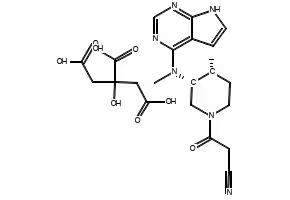
| Chemical & Physical Properties | |
|---|---|
| CAS Number | 540737-29-9 |
| Catalog No. | 2A-9091511 |
| Chinese Name | 枸橼酸托法替尼 |
| Synonyms | Tofacitinib citrate; Xeljanz; Tasocitinib citrate; Tofacitinibcitrate |
| Molecular Formula | C22H28O8N6 |
| Molecular Weight | 504.5 |
| Purity | 98 |
| Appearance | white to beige |
| Water Solubility | DMSO: soluble5mg/mL (clear solution; warmed) |
| Storage Condition | room temp |
| Application | Tofacitinib citrate is a JAK1/2/3 inhibitor with IC50s of 1, 20 and 112 nM respectively. |
| PubChem ID | 15168576 |
| MDL Number | MFCD23703608 |
| SMILES | CC1CCN(C(=O)CC#N)CC1N(C)c1ncnc2[nH]ccc12.O=C(O)CC(O)(CC(=O)O)C(=O)O |
| InChI | InChI=1S/C16H20N6O.C6H8O7/c1-11-5-8-22(14(23)3-6-17)9-13(11)21(2)16-12-4-7-18-15(12)19-10-20-16;7-3(8)1-6(13,5(11)12)2-4(9)10/h4,7,10-11,13H,3,5,8-9H2,1-2H3,(H,18,19,20);13H,1-2H2,(H,7,8)(H,9,10)(H,11,12)/t11-,13+;/m1./s1 |
| InChI Key | SYIKUFDOYJFGBQ-YLAFAASESA-N |
| Hazard Symbols | transportation |
| MSDS | msds/91511_1_540737_29_9.pdf |
| Bioactivity | Tofacitinib citrate is a JAK1/2/3 inhibitor with IC50s of 1, 20, and 112 nM, respectively. Related Catalog Signaling Pathways >> Epigenetics >> JAK Signaling Pathways >> JAK/STAT Signaling >> JAK Signaling Pathways >> Stem Cell/Wnt >> JAK Research Areas >> Inflammation/Immunology Target JAK3:1 nM (IC50) JAK2:20 nM (IC50) JAK1:112 nM (IC50) Rock-II:3400 nM (IC50) Lck:3870 nM (IC50) In Vitro Tofacitinib (CP-690550) citrate binds potentially at JAK3 and JAK2 as 2.2 nM and 5 nM (Kd). The report includes additional binding for Tofacitinib at Camk1 (Kd of 5,000 nM), DCamkL3 (Kd of 4.5 nM), Mst2 (Kd of 4,300 nM), Pkn1 (Kd of 200 nM), Rps6ka2 (Kin.Dom.2-C-terminal) (Kd of 1,400 nM), Rps6ka6 (Kin.Dom.2-C-terminal) (Kd of 1,200 nM), Snark (Kd of 420 nM), Tnk1 (Kd of 640 nM) and Tyk2 (Kd of 620 nM)[1]. K562, KCL22, and THP-1 cells are exposed to different doses of Imatinib (IMA) or JAK inhibitors for 72 h to quantify the effects of tyrosine kinase inhibitor (TKI) activity. Cell growth inhibition is then evaluated using the MTT assay. The proliferation of K562 and KCL22 cells, but not THP-1 cells, is inhibited by IMA in a concentration-dependent manner. The IC50 value of IMA is 0.28 µM for K562 and 0.17 µM for KCL22. Although treatment with Tofacitinib (TOF) or Ruxolitinib (RUX) alone does not suppress cell proliferation, both Tofacitinib and Ruxolitinib make the K562 and KCL22 more sensitive to IMA[4]. In Vivo Animals that are treated with Tofacitinib show a significantly lower production of anti-drug antibodies (ADAs) compare with PEG-treated control mice (for five weeks after initial immunization, p<0.01, n=8). Moreover ADAs become detectable earliest on day 28. A difference of 1000- to 200-fold in titers to SS1P is apparent from days 21 through 35, respectively. Compare to SS1P, mice injected with keyhole limpet hemocyanin (KLH) generate a more rapid antibody response. Yet, the administration of Tofacitinib reduces anti-KLH titers compare to controls (p<0.05 on day 21, p<0.01 on day 28, respectively, n=5). Reductions in titers ranged from 5000- to 250-fold from days 21 through 28, respectively[2]. Based on previous dose-response studies, a daily dose of Tofacitinib of 6.2 mg/kg is selected to provide 80% inhibition of hind paw volume and plasma exposure capable of suppressing the JAK1 and JAK3 signaling pathways for >4 hours[3]. Kinase Assay Kinase activity is recorded via a competition binding assay of selected kinases that are fused to a proprietary tag. Measurements of the amount of kinase binds to an immobilized, active-site directed ligand in the presence and absence of the test compound (e.g., Tofacitinib) provide a % of DMSO control for binding of ligand. Activities between 0 and 10 are selected for Kd determinations. Dendrogram representations are generated by an in-house visualization tool designated PhyloChem[1]. Cell Assay Cell survival assay is performed using MTT. Briefly, K562, KCL22, and THP-1 cells (1×10⁵ cells/well) are plated onto 96-well microplates and treated with or without IMA (0.06-1.0 μM) and/or Tofacitinib (10-1,000 nM) or RUX (10-1,000 nM) for 72 h at 37°C in a humidified 5% (v/v) CO2 atmosphere. The medium (200 µL) is then incubated with 10 µL of 5 mg/ml MTT solution for 4 h at 37°C. After being centrifuged at 352 g for 5 min, the culture medium is removed, and 100 µL of DMSO are added to each well to dissolve the formazan. Absorbance is measured at 570 nm using a microplate reader. The results are expressed as percentages[4]. Animal Admin Mice[2] Female BALB/c mice (6-8 weeks old) are used. Mice receive Tofacitinib in PEG300 (100 mg/mL) or vehicle alone (PEG300) by osmotic pump infusion (0.25 μL/hour, 28 days). Four days prior to immunization, mice are anesthetized and their dorsal surface is shaved. A one cm incision is made on the back to create a subcutaneous pocket and insert the pump. The incision site is closed with wound clips. Mice are injected weekly (i.p.) with SS1P recombinant immunotoxin (RIT; 5 μg/mouse) beginning on day 0; control mice received injections of saline alone. Every week before SS1P or vehicle immunization, 50 μL of blood is drawn to obtain serum samples. Sera are stored at -80°C until analyzed. Rats[3] Adjuvant-induced arthritis (AIA) is induced in female Lewis rats. Rats are randomized according to hind paw volume and assigned to Tofacitinib or vehicle treatment regimens. Groups of 7-8 rats per treatment group, and normal naive rats (n=4 per group), are euthanized either 4 hours, 4 days, or 7 days after beginning treatment (days 16, 20, and 23 after immunization, respectively). Once-daily oral administration of vehicle or Tofacitinib (6.2 mg/kg) is initiated on day 16 following immunization and continued through day 23. Paw volumes are reassessed 4 and 7 days after the beginning of treatment (days 20 and 23 after immunization, respectively). For micro-computed tomography (micro-CT) imaging, as well as tartrate-resistant acid phosphatase (TRAP) staining in paw tissue, AIA is induced in a separate cohort of Lewis rats. References [1]. Jiang JK, et al. Examining the chirality, conformation and selective kinase inhibition of 3-((3R,4R)-4-methyl-3-(methyl(7H-pyrrolo[2,3-d]pyrimidin-4-yl)amino)piperidin-1-yl)-3-oxopropanenitrile (CP-690,550). J Med Chem. 2008 Dec 25;51(24):8012-8. [2]. Onda M, et al. Tofacitinib suppresses antibody responses to protein therapeutics in murine hosts. J Immunol. 2014 Jul 1;193(1):48-55. [3]. LaBranche TP, et al. JAK inhibition with tofacitinib suppresses arthritic joint structural damage through decreased RANKL production. Arthritis Rheum. 2012 Nov;64(11):3531-42. [4]. Yagi K, et al. Pharmacological inhibition of JAK3 enhances the antitumor activity of imatinib in human chronic myeloid leukemia. Eur J Pharmacol. 2018 Apr 15;825:28-33. Chemical & Physical Properties Molecular Formula C22H28N6O8 Molecular Weight 504.493 Exact Mass 504.196869 PSA 221.04000 LogP 0.23418 Appearance of Characters white to beige InChIKey SYIKUFDOYJFGBQ-YLAFAASESA-N SMILES CC1CCN(C(=O)CC#N)CC1N(C)c1ncnc2[nH]ccc12.O=C(O)CC(O)(CC(=O)O)C(=O)O Storage condition room temp Water Solubility DMSO: soluble5mg/mL (clear solution; warmed) |
| Use of | Properties Name tofacitinib citrate Synonym More Synonyms Tofacitinib (CP-690550) Citrate Biological Activity Related Catalog Signaling Pathways >> Epigenetics >> JAK Signaling Pathways >> JAK/STAT Signaling >> JAK Signaling Pathways >> Stem Cell/Wnt >> JAK Research Areas >> Inflammation/Immunology JAK3:1 nM (IC50) JAK2:20 nM (IC50) JAK1:112 nM (IC50) Rock-II:3400 nM (IC50) Lck:3870 nM (IC50) Kinase Assay Kinase activity is recorded via a competition binding assay of selected kinases that are fused to a proprietary tag. Measurements of the amount of kinase binds to an immobilized, active-site directed ligand in the presence and absence of the test compound (e.g., Tofacitinib) provide a % of DMSO control for binding of ligand. Activities between 0 and 10 are selected for Kd determinations. Dendrogram representations are generated by an in-house visualization tool designated PhyloChem[1]. References [1]. Jiang JK, et al. Examining the chirality, conformation and selective kinase inhibition of 3-((3R,4R)-4-methyl-3-(methyl(7H-pyrrolo[2,3-d]pyrimidin-4-yl)amino)piperidin-1-yl)-3-oxopropanenitrile (CP-690,550). J Med Chem. 2008 Dec 25;51(24):8012-8. [2]. Onda M, et al. Tofacitinib suppresses antibody responses to protein therapeutics in murine hosts. J Immunol. 2014 Jul 1;193(1):48-55. [3]. LaBranche TP, et al. JAK inhibition with tofacitinib suppresses arthritic joint structural damage through decreased RANKL production. Arthritis Rheum. 2012 Nov;64(11):3531-42. [4]. Yagi K, et al. Pharmacological inhibition of JAK3 enhances the antitumor activity of imatinib in human chronic myeloid leukemia. Eur J Pharmacol. 2018 Apr 15;825:28-33. Chemical & Physical Properties Molecular Formula C22H28N6O8 Exact Mass 504.196869 PSA 221.04000 LogP 0.23418 Appearance of Characters white to beige InChIKey SYIKUFDOYJFGBQ-YLAFAASESA-N Storage condition room temp |
| Transport Info | Product name: Purity: 99.0% |
| MSDS Transport Info | Module 14. Shipping information 14.1 UN dangerous goods number European Land Transport Dangerous Regulations: -International Maritime Dangerous Regulations: -International Air Transport Dangerous Regulations: - 14.2 Names specified by the United Nations (UN) European Land Transport Dangerous Regulations: Non-dangerous goods IMDG Code: Non-dangerous goods International air transport dangerous goods regulations: non-dangerous goods 14.3 Transport hazard categories European Land Transport Dangerous Regulations: -International Maritime Dangerous Regulations: -International Air Transport Dangerous Regulations: - 14.4 Package group European Land Transport Dangerous Regulations: -International Maritime Dangerous Regulations: -International Air Transport Dangerous Regulations: - 14.5 Environmental hazards European Land Transport Dangerous Regulations: No International Maritime Transport Dangerous Regulations Maritime Pollutants: No International Air Transport Risk Regulations: No 14.6 Special reminder to users No data available The above information is believed to be correct, but is not all-inclusive and should be used as a guide only. The information in this document is based on our current knowledge and is Correct safety instructions apply to this product. This information does not represent a warranty as to the properties of this product. See reverse side of invoice or packing slip. |
| Related Products in API & Advanced Intermediates | ||
|---|---|---|
| 4-Hydroxytestosteronedecanoate | 613235-00-0 | 2A-9089584 |
| Entecavir | 142217-69-4 | 2A-9090343 |
| 4-Hydroxytestosteronecypionate | 2562-44-9 | 2A-9090685 |
| PemetrexedDisodiumheptahydrate | 357166-29-1 | 2A-9090874 |
| TENOFOVIR DIPHOSPHATE | 166403-66-3 | 2A-9091497 |
| Clindamycin B 2-Phosphate | 54887-31-9 | 2A-9091517 |
| VALPROIC ACID-D6 | 87745-18-4 | 2A-9091533 |
| N-desmethyl sildenafil-d8 | 2A-173224 | 2A-9091534 |
| GABAPENTIN-D4 | 1185039-20-6 | 2A-9091535 |
| (R)-(-)-IBUPROFEN | 51146-57-7 | 2A-9091544 |
| Browse all API & Advanced Intermediates products » | ||
Phone:
630-322-8886
630-322-8887
Email:
Office Locations:
Chicago, IL, USA
San Francisco, CA, USA


 EN
EN


 SDS
SDS