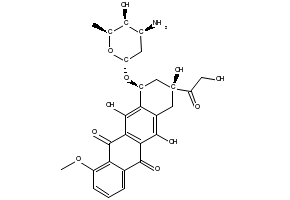
CAS Number23214-92-8
SynonymsADM hydrochloride; Adriamycin hydrochloride; Adriamycin; [3H]-Doxorubicin; adriamycine; EINECS 245-495-6; Doxil; Adriamycin HCl; DOXORUBICIN; Rubex; Adriamycin RDF; Adriamycin, hydrochloride; Adriamycin PFS; Adriblastin
Molecular FormulaC27H29NO11
Molecular Weight543.53
Purity98%
Density1.61 g/cm3
Melting Point205ºC
AppearanceOrange to red powder
| Chemical & Physical Properties | |
|---|---|
| CAS Number | 23214-92-8 |
| Catalog No. | 2A-9009066 |
| Chinese Name | 阿霉素 |
| Synonyms | ADM hydrochloride; Adriamycin hydrochloride; Adriamycin; [3H]-Doxorubicin; adriamycine; EINECS 245-495-6; Doxil; Adriamycin HCl; DOXORUBICIN; Rubex; Adriamycin RDF; Adriamycin, hydrochloride; Adriamycin PFS; Adriblastin |
| Molecular Formula | C27H29NO11 |
| Molecular Weight | 543.53 |
| Purity | 98 |
| Density | 1.61 g/cm3 |
| Melting Point | 205ºC |
| Appearance | Orange to red powder |
| Water Solubility | Soluble |
| Storage Condition | The warehouse is ventilated and dried at low tempe |
| Application | Doxorubicin is a cytotoxic anthracycline antibiotic used to treat a variety of cancers. The possible mechanism by which Doxorubicin acts in cancer cells is by intercalating into DNA and disrupting top |
| MDL Number | C27H29NO11 |
| SMILES | COc1cccc2c1C(=O)c1c(O)c3c(c(O)c1C2=O)CC(O)(C(=O)CO)CC3OC1CC(N)C(O)C(C)O1 |
| InChI | InChI=1S/C27H29NO11/c1-10-22(31)13(28)6-17(38-10)39-15-8-27(36,16(30)9-29)7-12-19(15)26(35)21-20(24(12)33)23(32)11-4-3-5-14(37-2)18(11)25(21)34/h3-5,10,13,15,17,22,29,31,33,35-36H,6-9,28H2,1-2H3/t10-,13-,15-,17-,22+,27-/m0/s1 |
| InChI Key | AOJJSUZBOXZQNB-TZSSRYMLSA-N |
| MSDS | msds/9066_1_23214_92_8.pdf |
| Bioactivity | Doxorubicin is a cytotoxic anthracycline antibiotic for the treatment of multiple cancers. The possible mechanisms by which doxorubicin acts in the cancer cell are intercalation into DNA and disruption of topoisomerase-II-mediated DNA repair. Related Catalog Signaling Pathways >> Antibody-drug Conjugate >> ADC Cytotoxin Signaling Pathways >> Autophagy >> Autophagy Signaling Pathways >> Autophagy >> Mitophagy Research Areas >> Cancer Natural Products >> Others Target Topoisomerase II In Vitro Combination of Doxorubicin and Simvastatin in the highest tested concentrations (2 μM and 10 μM, respec-tively) kills 97% of the Hela cells[2]. In Vivo Mice bearing PC3 xenografts are injected with 2, 4 or 8 mg/kg Doxorubicin and tumor volume is measured over time. A dose of 2 mg/kg does not affect tumor growth while higher dosages delay tumor growth initially (p<0.05 at days 18 and 22), 4 mg/kg or 8 mg/kg Doxorubicin significantly reduces levels of c-FLIP in PC3 xenografts[3]. A single intraperitoneal injection 10 mg/kg (Doxorubicin 1) is administered in rats, 10 daily intraperitoneal injections of 1 mg/kg (Doxorubicin 2), or in 5 weekly intraperitoneal injections of 2 mg/kg (Doxorubicin 3). An 80% mortality rate is observed at day 28 in Doxorubicin 1, whereas Doxorubicin 2 and Doxorubicin 3 reached 80% mortality at days 107 and 98, respectively. Fractional shortening decreased by 30% at week 2 in Doxorubicin DOX1, 55% at week 13 in Doxorubicin 2, and 42% at week 13 in Doxorubicin 3[4]. Cell Assay 160 μL of Hela cells suspension (3×10⁴ cell/mL) is dispensed into three 96-well U-bottom microplates and incubated for 24 h at 37°C in a fully humidified atmosphere of 5% CO2. In plate 1, serial dilutions of Doxorubicin (20 μL; final concentration, 0.1-2 μM) and Simvastatin (20 μL; final concentration, 0.25-2 μM) are added to a final volume of 200 μL and incubated for another 72 h. In plates 2 and 3 serial dilutions of each drug (Simvastatin or Doxorubicin, 40 μL) are added. After an incubation period of 24 h, the medium is aspirated and the cells are washed in PBS. Then, serial dilutions of other drug (40 μL) are added and supplemented with culture medium to a final volume of 200 μL, and incubated for 48 h. Doxorubicin and Simvastatin are used individually as positive controls (40 μL in each well), and the cells treated only with solvent are considered as negative controls. To evaluate cell survival, 20 μL of MTT solution (5 mg/mL in PBS) is added to each well and incubated for 3 h. Then the media is replaced with 150 μL of DMSO, and complete solubilization of formazan crystals is achieved by repeated pipetting of the solution. Absorbance is then determined at 540 nm by an ELISA plate reader. Each drug concentration is assayed in 4 or 8 wells and repeated 3 times. The cytotoxic/cytostatic effect of Doxorubicin is expressed as the relative viability (% control) and calculated. Percentage of cell survival in the negative control is assumed as 100. Relative viability=(experimental absorbance-background absorbance)/ (absorbance of untreated controls-background absorbance)×100 %[2]. Animal Admin Mice[3] Athymic male nude mice (3-4 weeks old) are used. PC3 cells (4×10⁶) are injected subcutaneously into the flanks of mice. Animals bearing tumors are randomly assigned to treatment groups (five or six mice per group) and treatment initated when xenografts reached volumes of about 100 mm3. Tumors are measured using digital calipers and volume calculated using the formula: Volume=Width2×Length×0.52, where width represents the shorter dimension of the tumor. Treatments are administered as indicated using vehicle (PBS containing 0.1% BSA), Doxorubicin (2-8 mg/kg), Apo2L/TRAIL (500 μg/animal), or a combination of 4 mg/kg Doxorubicin followed by 500 μg Apo2L/TRAIL. Doxorubicin is administered systemically whereas Apo2L/TRAIL is given either intra-tumorally or systemically. All treatments are given once. Mice are monitored daily for signs of adverse effects (listlessness and scruffy apparance). Treatments seemed to be well tolerated. The mean±SEM is calculated for each data point. Differences between treatment groups are analyzed by the student t-test. Differences are considered significant when P<0.05. Rats[4] Thirty male Sprague-Dawley rats weighing 250 to 300 g are randomly assigned to 1 of 3 experimental groups: Doxorubicin schedule 1 (Doxorubicin 1, n=10), Doxorubicin schedule 2 (Doxorubicin 2, n=10), or Doxorubicin schedule 3 (Doxorubicin 3, n=10). For all Doxorubicin treatment schedules, the cumulative dose of Doxorubicin is 10 mg/kg. Schedule 1 involves a single bolus intraperitoneal injection of Doxorubicin at 10 mg/kg. Schedule 2 involves 10 intraperitoneal injections of Doxorubicin at 1 mg/kg for 10 consecutive days. Schedule 3 involves 5 intraperitoneal injections of Doxorubicin at 2 mg/kg, once each week, for 5 wk. Immediately before the first Doxorubicin treatment and at weekly intervals after beginning Doxorubicin treatment, blood pressure and cardiac function are assessed in all surviving animals as long as there are at least 3 rats per group. References [1]. Nitiss JL, et al. Targeting DNA topoisomerase II in cancer chemotherapy.Nat Rev Cancer. 2009 May;9(5):338-50. [2]. Sadeghi-Aliabadi H, et al. Cytotoxic evaluation of doxorubicin in combination with simvastatin against human cancer cells. Res Pharm Sci. 2010 Jul;5(2):127-33. [3]. El-Zawahry A, et al. Doxorubicin increases the effectiveness of Apo2L/TRAIL for tumor growth inhibition of prostate cancerxenografts. BMC Cancer. 2005 Jan 7;5:2. [4]. Hayward R, et al. Doxorubicin cardiotoxicity in the rat: an in vivo characterization. J Am Assoc Lab Anim Sci. 2007 Jul;46(4):20-32. [5]. Zhang D, et al. Co-delivery nanoparticles with characteristics of intracellular precision release drugs for overcoming multidrug resistance. Int J Nanomedicine. 2017 Mar 16;12:2081-2108. [6]. Majumder S, et al. Shifts in podocyte histone H3K27me3 regulate mouse and human glomerular disease. J Clin Invest. 2018 Jan 2;128(1):483-499. Chemical & Physical Properties Density 1.61 g/cm3 Melting Point 205ºC Molecular Formula C27H29NO11 Molecular Weight 543.52 Flash Point 443.8ºC PSA 206.07000 LogP 1.50360 Vapour Pressure 9.64E-28mmHg at 25°C Index of Refraction 1.709 InChIKey AOJJSUZBOXZQNB-TZSSRYMLSA-N SMILES COc1cccc2c1C(=O)c1c(O)c3c(c(O)c1C2=O)CC(O)(C(=O)CO)CC3OC1CC(N)C(O)C(C)O1 Water Solubility Soluble |
| Use of | Doxorubicin is a cytotoxic anthracycline antibiotic for the treatment of multiple cancers. The possible mechanisms by which doxorubicin acts in the cancer cell are intercalation into DNA and disruption of topoisomerase-II-mediated DNA repair. Properties Name doxorubicin Synonym More Synonyms Doxorubicin hydrochloride Biological Activity Description Doxorubicin is a cytotoxic anthracycline antibiotic for the treatment of multiple cancers. The possible mechanisms by which doxorubicin acts in the cancer cell are intercalation into DNA and disruption of topoisomerase-II-mediated DNA repair. Related Catalog Signaling Pathways >> Antibody-drug Conjugate >> ADC Cytotoxin Signaling Pathways >> Autophagy >> Autophagy Signaling Pathways >> Autophagy >> Mitophagy Research Areas >> Cancer Natural Products >> Others Topoisomerase II In Vitro Combination of Doxorubicin and Simvastatin in the highest tested concentrations (2 μM and 10 μM, respec-tively) kills 97% of the Hela cells[2]. References [1]. Nitiss JL, et al. Targeting DNA topoisomerase II in cancer chemotherapy.Nat Rev Cancer. 2009 May;9(5):338-50. [2]. Sadeghi-Aliabadi H, et al. Cytotoxic evaluation of doxorubicin in combination with simvastatin against human cancer cells. Res Pharm Sci. 2010 Jul;5(2):127-33. [4]. Hayward R, et al. Doxorubicin cardiotoxicity in the rat: an in vivo characterization. J Am Assoc Lab Anim Sci. 2007 Jul;46(4):20-32. [5]. Zhang D, et al. Co-delivery nanoparticles with characteristics of intracellular precision release drugs for overcoming multidrug resistance. Int J Nanomedicine. 2017 Mar 16;12:2081-2108. Chemical & Physical Properties Molecular Formula C27H29NO11 PSA 206.07000 LogP 1.50360 Index of Refraction 1.709 InChIKey AOJJSUZBOXZQNB-TZSSRYMLSA-N Water Solubility Soluble |
| Transport Info | Product Name: Doxorubicin |
| Related Products in Specialty Chemicals | ||
|---|---|---|
| Actarit | 18699-02-0 | 2A-9009057 |
| Adibendan | 100510-33-6 | 2A-9009062 |
| Adinazolam | 37115-32-5 | 2A-9009063 |
| Adipiodone | 606-17-7 | 2A-9009064 |
| Adrafinil | 63547-13-7 | 2A-9009065 |
| Adriamycinol | 54193-28-1 | 2A-9009067 |
| Adriamycinone | 24385-10-2 | 2A-9009068 |
| Aequinetin | 2A-300153 | 2A-9009070 |
| Aflatoxin B1 | 1162-65-8 | 2A-9009072 |
| Aflatoxin G1 | 1165-39-5 | 2A-9009073 |
| Browse all Specialty Chemicals products » | ||
Phone:
630-322-8886
630-322-8887
Email:
Office Locations:
Chicago, IL, USA
San Francisco, CA, USA


 EN
EN


 SDS
SDS