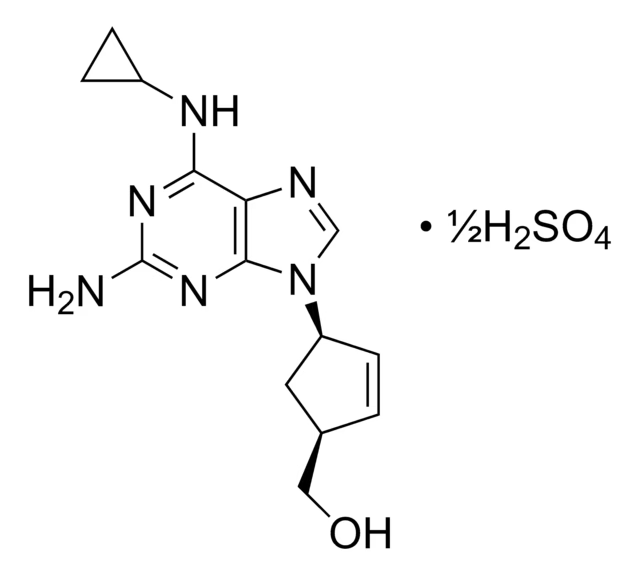
CAS Number136470-78-5
SynonymsMFCD00903850; (1S,4R)-4-[2-Amino-6-(cyclopropylamino)-9H-purin-9-yl]-2-cyclopentene-1-methanol; (1S,cis)-4-[2-amino-6-(cyclopropylamino)-9H-purin-9-yl]-2-cyclopentene-1-methanol; Abacavir; {(1S,4R)-4-[2-Amino-6-(cyclopropylamino)-9H-purin-9-yl]-2-cyclopenten-1-yl}methanol; {(1S,4R)-4-[2-Amino-6-(cyclopropylamino)-9H-purin-9-yl]cyclopent-2-en-1-yl}methanol; {(4R)-4-[2-Amino-6-(cyclopropylamino)-9H-purin-9-yl]cyclopent-2-en-1-yl}methanol
Molecular FormulaC14H18N6O
Molecular Weight335.37
Purity≥98 (HPLC)%
Density1.7±0.1 g/cm3
Boiling Point636.0±65.0 °C at 760 mmHg
Melting Point161 °C(dec.)
Appearancepowder
Symbol
Signal WordWarning
| Chemical & Physical Properties | |
|---|---|
| CAS Number | 136470-78-5 |
| Catalog No. | 2A-9009021 |
| Chinese Name | 阿巴卡韦 |
| Synonyms | MFCD00903850; (1S,4R)-4-[2-Amino-6-(cyclopropylamino)-9H-purin-9-yl]-2-cyclopentene-1-methanol; (1S,cis)-4-[2-amino-6-(cyclopropylamino)-9H-purin-9-yl]-2-cyclopentene-1-methanol; Abacavir; {(1S,4R)-4-[2-Amino-6-(cyclopropylamino)-9H-purin-9-yl]-2-cyclopenten-1-yl}methanol; {(1S,4R)-4-[2-Amino-6-(cyclopropylamino)-9H-purin-9-yl]cyclopent-2-en-1-yl}methanol; {(4R)-4-[2-Amino-6-(cyclopropylamino)-9H-purin-9-yl]cyclopent-2-en-1-yl}methanol |
| Molecular Formula | C14H18N6O |
| Molecular Weight | 335.37 |
| Purity | ≥98 (HPLC) |
| Density | 1.7±0.1 g/cm3 |
| Boiling Point | 636.0±65.0 °C at 760 mmHg |
| Melting Point | 161 °C(dec.) |
| Appearance | powder |
| Water Solubility | Water solubility: insoluble |
| Storage Condition | 0-6°C |
| Packaging | III |
| Application | Abacavir is a powerful nucleoside analog and reverse transcriptase inhibitor. |
| PubChem ID | 329825149 |
| MDL Number | MFCD04112763 |
| SMILES | OS(O)(=O)=O.Nc1nc(NC2CC2)c3ncn([C@@H]4C[C@H](CO)C=C4)c3n1.Nc5nc(NC6CC6)c7ncn([C@@H]8C[C@H](CO)C=C8)c7n5 |
| InChI | 1S/2C14H18N6O.H2O4S/c2*15-14-18-12(17-9-2-3-9)11-13(19-14)20(7-16-11)10-4-1-8(5-10)6-21;1-5(2,3)4/h2*1,4,7-10,21H,2-3,5-6H2,(H3,15,17,18,19);(H2,1,2,3,4)/t2*8-,10+;/m11./s1 |
| InChI Key | WMHSRBZIJNQHKT-FFKFEZPRSA-N |
| NACRES Code | NA.77 |
| UNSPSC | 12352200 |
| Hazard Symbols | 6.1(b) |
| MSDS | msds/9021_1_136470_78_5.pdf |
| Bioactivity | Abacavir is a powerful nucleoside analog reverse transcriptase inhibitor (NRTI) used to treat HIV and AIDS. IC50 value:Target: NRTI; reverse transcriptase inhibitorAbacavir is a nucleoside reverse transcriptase inhibitor marketed since 1999 for the treatment of infection with the human immunodeficiency virus type 1 (HIV). Despite its clinical efficacy, abacavir administration has been associated with serious and sometimes fatal toxic events. Abacavir has been reported to undergo bioactivation in vitro, yielding reactive species that bind covalently to human serum albumin, but the haptenation mechanism and its significance to the toxic events induced by this anti-HIV drug have yet to be elucidated. The mechanism underlying abacavir hypersensitivity syndrome is related to the change in the HLA-B*5701 protein product. Abacavir binds with high specificity to the HLA-B*5701 protein, changing the shape and chemistry of the antigen-binding cleft. This results in a change in immunological tolerance and the subsequent activation of abacavir-specific cytotoxic T cells, which produce a systemic reaction known as abacavir hypersensitivity syndrome. Related Catalog Signaling Pathways >> Anti-infection >> HIV Signaling Pathways >> Anti-infection >> Reverse Transcriptase Research Areas >> Infection References [1]. Charneira C, et al. Reactive aldehyde metabolites from the anti-HIV drug abacavir: amino acid adducts as possible factors in abacavir toxicity. Chem Res Toxicol. 2011 Dec 19;24(12):2129-41. [2]. Hervey PS, et al. Abacavir: a review of its clinical potential in patients with HIV infection. Drugs. 2000 Aug;60(2):447-79. Chemical & Physical Properties Density 1.7±0.1 g/cm3 Boiling Point 636.0±65.0 °C at 760 mmHg Melting Point 161 °C(dec.) Molecular Formula C14H18N6O Molecular Weight 286.332 Flash Point 338.4±34.3 °C Exact Mass 286.154205 PSA 101.88000 LogP 0.72 Vapour Pressure 0.0±2.0 mmHg at 25°C Index of Refraction 1.864 InChIKey MCGSCOLBFJQGHM-SCZZXKLOSA-N SMILES Nc1nc(NC2CC2)c2ncn(C3C=CC(CO)C3)c2n1 Storage condition 0-6°C |
| Use of | Abacavir is a powerful nucleoside analog reverse transcriptase inhibitor (NRTI) used to treat HIV and AIDS. IC50 value:Target: NRTI; reverse transcriptase inhibitorAbacavir is a nucleoside reverse transcriptase inhibitor marketed since 1999 for the treatment of infection with the human immunodeficiency virus type 1 (HIV). Despite its clinical efficacy, abacavir administration has been associated with serious and sometimes fatal toxic events. Abacavir has been reported to undergo bioactivation in vitro, yielding reactive species that bind covalently to human serum albumin, but the haptenation mechanism and its significance to the toxic events induced by this anti-HIV drug have yet to be elucidated. The mechanism underlying abacavir hypersensitivity syndrome is related to the change in the HLA-B*5701 protein product. Abacavir binds with high specificity to the HLA-B*5701 protein, changing the shape and chemistry of the antigen-binding cleft. This results in a change in immunological tolerance and the subsequent activation of abacavir-specific cytotoxic T cells, which produce a systemic reaction known as abacavir hypersensitivity syndrome. Properties Name abacavir Synonym More Synonyms Abacavir Biological Activity Description Abacavir is a powerful nucleoside analog reverse transcriptase inhibitor (NRTI) used to treat HIV and AIDS. IC50 value:Target: NRTI; reverse transcriptase inhibitorAbacavir is a nucleoside reverse transcriptase inhibitor marketed since 1999 for the treatment of infection with the human immunodeficiency virus type 1 (HIV). Despite its clinical efficacy, abacavir administration has been associated with serious and sometimes fatal toxic events. Abacavir has been reported to undergo bioactivation in vitro, yielding reactive species that bind covalently to human serum albumin, but the haptenation mechanism and its significance to the toxic events induced by this anti-HIV drug have yet to be elucidated. The mechanism underlying abacavir hypersensitivity syndrome is related to the change in the HLA-B*5701 protein product. Abacavir binds with high specificity to the HLA-B*5701 protein, changing the shape and chemistry of the antigen-binding cleft. This results in a change in immunological tolerance and the subsequent activation of abacavir-specific cytotoxic T cells, which produce a systemic reaction known as abacavir hypersensitivity syndrome. Related Catalog Signaling Pathways >> Anti-infection >> HIV Signaling Pathways >> Anti-infection >> Reverse Transcriptase Research Areas >> Infection References [1]. Charneira C, et al. Reactive aldehyde metabolites from the anti-HIV drug abacavir: amino acid adducts as possible factors in abacavir toxicity. Chem Res Toxicol. 2011 Dec 19;24(12):2129-41. [2]. Hervey PS, et al. Abacavir: a review of its clinical potential in patients with HIV infection. Drugs. 2000 Aug;60(2):447-79. Chemical & Physical Properties Molecular Formula C14H18N6O Exact Mass 286.154205 PSA 101.88000 Index of Refraction 1.864 InChIKey MCGSCOLBFJQGHM-SCZZXKLOSA-N |
| Transport Info | Product name: Purity: 98.0% |
| MSDS Transport Info | Module 14. Shipping information United Nations classification: inconsistent with United Nations classification standards UN number: not specified |
| Related Products in API & Advanced Intermediates | ||
|---|---|---|
| (S)-(-)-Metoprolol | 81024-42-2 | 2A-9008946 |
| (S)-(-)-Verapamil hydrochloride | 36622-28-3 | 2A-9008947 |
| 3,6-Diacetylmorphine | 561-27-3 | 2A-9008980 |
| 6-Acetylmorphine | 2784-73-8 | 2A-9009003 |
| 7-(2-Hydroxyethyl)theophylline | 519-37-9 | 2A-9009011 |
| Acarbose | 56180-94-0 | 2A-9009029 |
| Acetaminophen glucuronide | 120595-80-4 | 2A-9009038 |
| Adefovir | 106941-25-7 | 2A-9009060 |
| Adefovir dipivoxil | 142340-99-6 | 2A-9009061 |
| Adriblastina; Doxorubicin hydrochloride | 25316-40-9 | 2A-9009069 |
| Browse all API & Advanced Intermediates products » | ||
Phone:
630-322-8886
630-322-8887
Email:
Office Locations:
Chicago, IL, USA
San Francisco, CA, USA


 EN
EN


 SDS
SDS